Oct. 15, 2026
FRP Hand Lay-Up Process: Manufacturing Method, Advantages and Applications
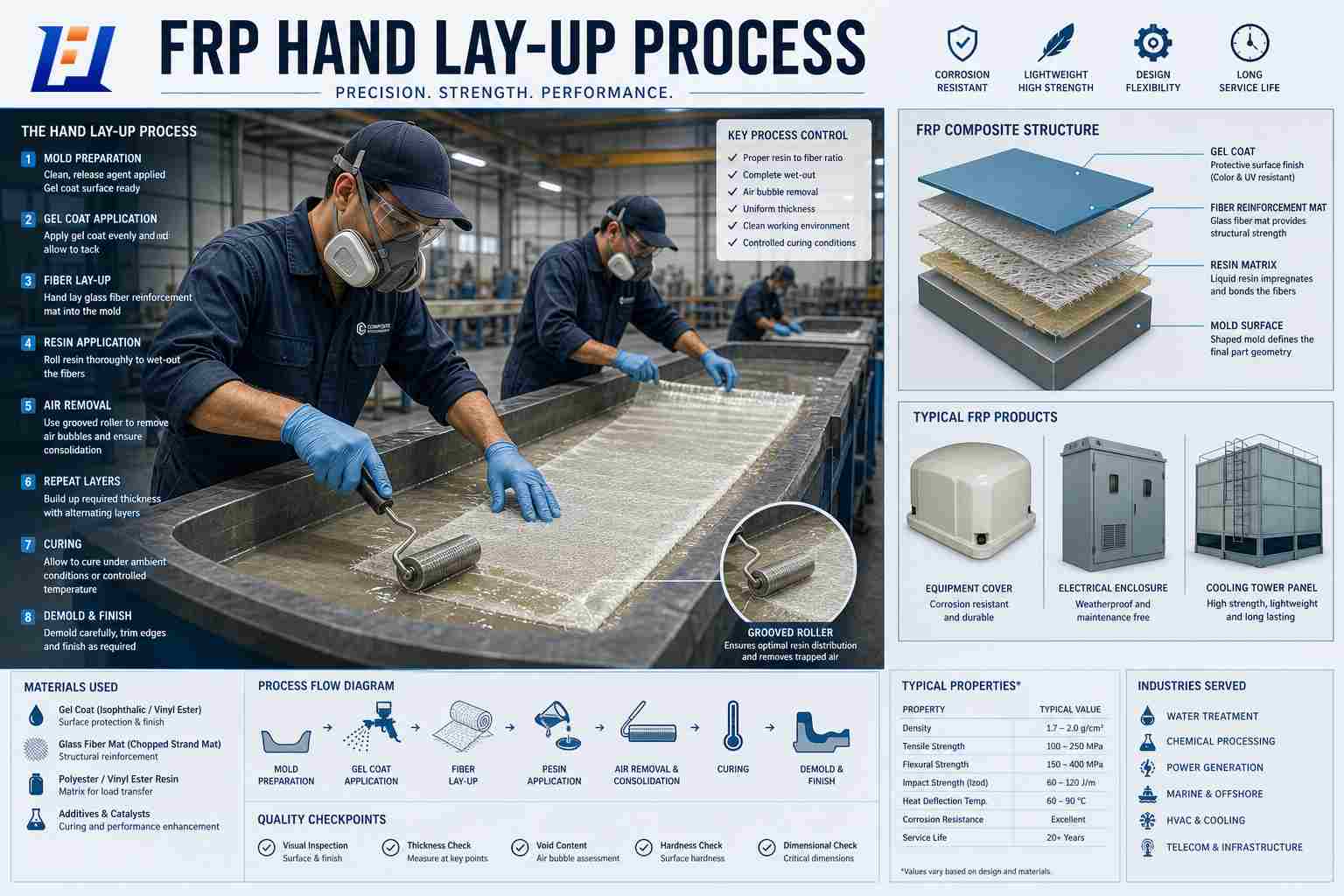
Hand lay-up is one of the most established manufacturing methods used to produce fiber-reinforced plastic (FRP) products. Also known as fiberglass hand lay-up molding, this process involves manually placing reinforcing fibers into a mold and applying resin to form a composite structure.
FRP combines reinforcing materials, typically glass fiber, with a resin matrix, such as unsaturated polyester, vinyl ester, or epoxy resin. The glass fibers provide mechanical strength, while the resin binds the fibers together, transfers loads, and helps protect the reinforcement from environmental exposure.
Unlike automated manufacturing methods, hand lay-up relies primarily on skilled operators to position the reinforcement, wet it with resin, remove trapped air, and control the laminate thickness. Because of its flexibility and relatively low tooling requirements, hand lay-up is widely used for large, complex, customized, and low-to-medium-volume FRP products.
Although specific production procedures vary depending on the product design and resin system, the general manufacturing process consists of several key steps.
The mold is cleaned and inspected to ensure that its surface is free from dust, grease, and other contaminants. A suitable release agent is then applied to help separate the finished product from the mold. For products requiring a smooth, colored, or weather-resistant exterior, a compatible gel coat may be applied before the structural laminate is built up.
The quality of mold preparation directly affects the surface finish, dimensional consistency, and ease of demolding.
Glass fiber reinforcement is placed into the mold according to the product design. Depending on the required mechanical properties and geometry, the reinforcement may include chopped strand mat, woven roving, stitched fabrics, or combinations of different reinforcement types.
The fiber arrangement, number of layers, and orientation influence the final product's strength and stiffness. For this reason, the reinforcement schedule should be selected according to the intended application, rather than by simply increasing the number of layers.
Resin is applied to the reinforcement using brushes, rollers, or other suitable tools. The operator works the resin into the glass fibers to achieve thorough wet-out.
Proper wet-out is essential because dry fibers and incomplete resin penetration can create weak areas in the laminate. At the same time, excessive resin can increase product weight without providing a proportional improvement in strength. The resin formulation, mixing ratio, working life, and ambient conditions must be controlled according to the resin manufacturer's technical instructions.
After the resin is applied, rollers are used to remove trapped air and consolidate the laminate. This step helps reduce voids and improves contact between the fibers and resin.
Careful consolidation is particularly important for structural products, where internal defects may affect load-bearing performance and long-term reliability.
The laminated product is allowed to cure under controlled or specified environmental conditions. During curing, the resin undergoes a chemical reaction and develops its intended mechanical properties. Curing time depends on the resin system, product thickness, ambient temperature, and curing conditions. Some products may require additional post-curing to achieve specified performance.
The product should not be demolded or put into service until it has reached the required state of cure.
Once curing is complete, the product is removed from the mold. Excess material may be trimmed, and edges, openings, and connection areas are finished as required. Depending on the application, additional operations may include drilling, cutting, bonding, coating, or assembly.
Finally, the product should be inspected for dimensional accuracy, surface defects, and other acceptance criteria specified in the product requirements.
Hand lay-up remains an important manufacturing option because it offers several practical advantages.
Hand lay-up is suitable for products with large dimensions, curved surfaces, irregular geometries, and customized structures. Manufacturers can adjust the mold, reinforcement arrangement, laminate thickness, and resin system to meet different project requirements.
Compared with some automated or high-volume molding processes, hand lay-up can often be implemented with simpler tooling and lower initial equipment investment. This can make it a practical option for prototypes, specialized components, replacement parts, and orders with limited production quantities.
The process is not inherently limited to small components. With appropriate mold design, handling arrangements, and production facilities, hand lay-up can be used to manufacture relatively large FRP structures. This is one reason it is used for large covers, protective cover, and customized industrial components.
Manufacturers can select different glass fiber reinforcement materials and resin systems based on the product's operating environment and performance requirements. Consequently, products made using the hand lay-up process exhibit higher strength than those produced via pultrusion or compression molding.
Despite its flexibility, hand lay-up also has limitations that should be considered during product selection.
Labor-intensive production. Much of the process depends on manual operations. Production speed and labor requirements can therefore vary with product size, geometry, and laminate complexity.
Greater dependence on operator skill. Inconsistent resin application, fiber placement, or air removal can lead to variations in thickness, resin content, and laminate quality.
Potential variation between batches. Compared with highly automated processes, hand lay-up may require more careful process controls to maintain consistent product dimensions and mechanical properties.
For these reasons, hand lay-up is not automatically the best solution for every FRP product. The appropriate process should be determined by the product's design, quantity, performance requirements, and total manufacturing cost.
Hand lay-up is particularly useful for customized products that require flexible mold design or relatively complex shapes. Typical applications include:
Not every FRP product is manufactured by hand lay-up. For example, pultrusion is generally better suited to continuous constant-cross-section profiles, while compression molding may be more appropriate for certain repeatable, high-volume molded components. The correct process depends on the product rather than the material alone.
Different FRP manufacturing methods serve different purposes.
Table 1 — Comparison of FRP Manufacturing Methods
|
Feature |
Hand Lay-Up |
Pultrusion |
Compression Molding |
|
Basic principle |
Manual placement of reinforcement and resin |
Continuous fiber reinforcement pulled through a heated die |
Material is formed in a mold under heat and pressure |
|
Design flexibility |
High for customized shapes |
Best for constant cross-sections |
Suitable for mold-defined repeatable shapes |
|
Typical production scale |
Prototypes and low-to-medium volume orders |
Continuous, repetitive production |
Often suitable for repeatable high volume production |
|
Tooling considerations |
Often relatively low initial tooling cost |
Requires a dedicated die |
Requires dedicated matched tooling or a suitable mold system |
|
Typical applications |
Custom covers, housings, panels and selected tanks |
FRP profiles, rods, beams and structural sections |
Selected molded parts and repeatable components |
Quality control should begin before production and continue through final inspection.
Raw material inspection: Verify the specifications and suitability of the glass fiber, resin, gel coat, and other materials.
Process control: Follow the approved resin mixing instructions, reinforcement schedule, wet-out procedure, consolidation method, and curing requirements.
Visual inspection: Check for visible cracks, blisters, exposed fibers, dry areas, excessive porosity, and other defects relevant to the product specification.
Dimensional inspection: Verify overall dimensions, wall or laminate thickness where applicable, opening locations, and other critical tolerances.
Mechanical and performance testing: Where required, conduct tests appropriate to the intended application, such as flexural testing, tensile testing, hardness testing, water-tightness testing, or other specified performance evaluations.
For structural or safety-critical products, inspection and testing should be based on the applicable standards, approved drawings, and agreed acceptance criteria. Visual inspection alone cannot establish all mechanical properties or confirm long-term service performance.
When selecting a manufacturing process, buyers should consider more than the initial unit price. Key factors include:
For customized products and complex shapes, hand lay-up may provide a practical balance between design flexibility and manufacturing cost. For standardized products requiring consistent dimensions and repetitive output, a more automated process may be more appropriate.
Hebei Fortis Technology Co., Ltd. is a specialized manufacturer of pultruded FRP structural profiles and composite environmental products based in Hebei Province, China. With over 20 years of experience in composite material manufacturing and 33 modern FRP production lines, the company is dedicated to the research and production of advanced composite materials. The production process includes hand lay-up, pultrusion profiles, winding and compression molding, etc. It offers standard and customized specifications, multiple colors and resin systems for selection. It serves global customers in fields such as petrochemicals, water treatment, power, construction, ships and agriculture.
For more information, please contact our technical team.
Hebei Fortis Technology Co., Ltd.
TEL: +86 18932662725 / 19033312730
Email: allen@hbfortis.com
Contact us immediately to discuss your product project requirements
Navigation
Navigation
Contact Us
Tel.: +86 189 3266 2725
E-mail: sale@hbfortis.com
Add.: No.8-1, Zhenxing Street, Matun Town, Zaoqiang County, Hengshui City, Hebei Province
Get in Touch
Get in Touch