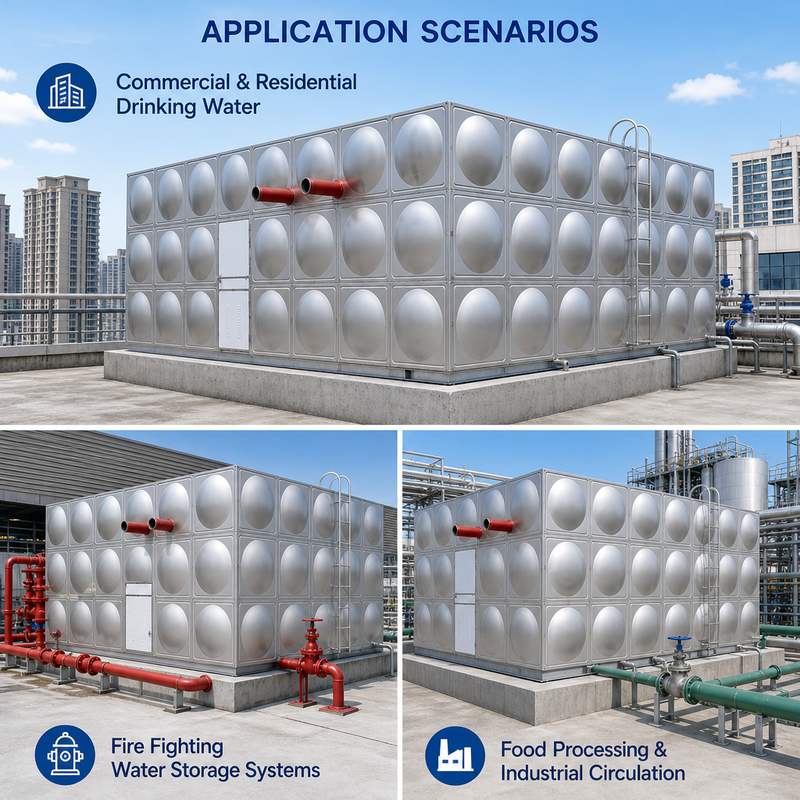
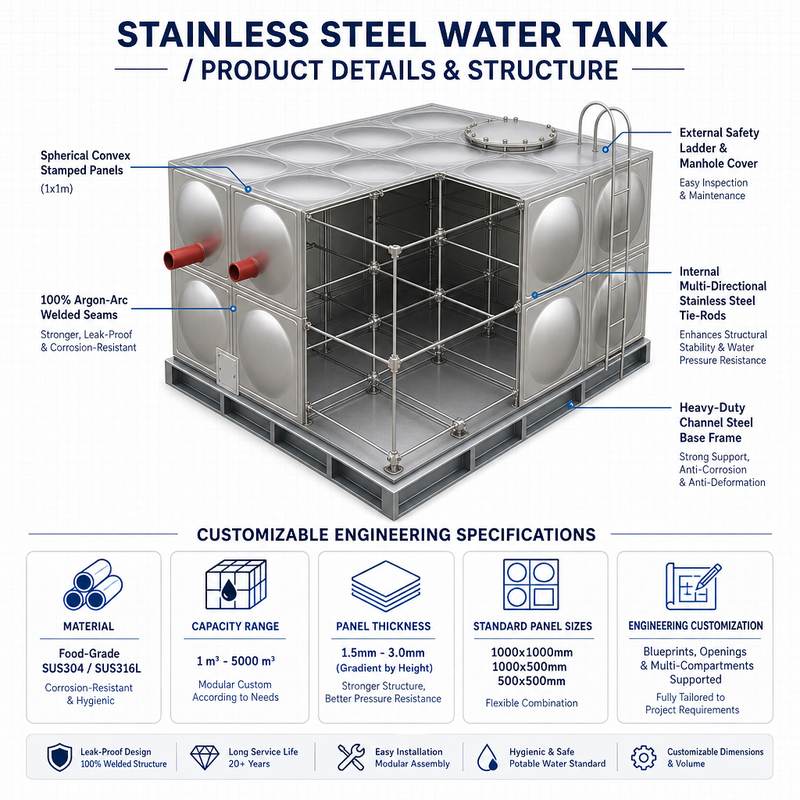
Unlike trading companies reselling generic units, we are a China-based fabrication plant specializing in site-assembled stainless steel water tanks engineered for demanding commercial and municipal environments. Whether you are specifying a fire reserve tank that must sustain rapid flow rates under emergency conditions, a food-grade potable water system for a beverage or pharmaceutical facility, or a process cooling tank for an HVAC plant, we fabricate panels in both SS304 and low-carbon SS316L grades — the latter chosen specifically for its resistance to intergranular corrosion at weld seams, which is critical when tanks are assembled on-site and must remain leak-free for decades. Every panel is produced with argon arc welding, dimensional accuracy checks, and hydrostatic leak testing before shipment, and we support OEM panel sizing to match your structural drawings. To help you clear local compliance and procurement audits, we provide third-party inspection reports (SGS/BV), material test certificates (MTC), and full heat-number traceability — cutting out the middleman margin without compromising on documentation or after-sales support.

Hebei Fortis Technology Co., Ltd Product Brochure
Product Advantages
Stainless steel water tanks resist rust, chemical attack, and chloride-induced pitting far better than galvanized or concrete alternatives, which means no flaking coatings, no rust-colored water, and no premature replacement. For buyers specifying SS304 or low-carbon SS316L, the material's chromium-rich passive layer self-repairs when scratched, so the tank keeps its integrity even in coastal, humid, or industrially polluted environments. The practical result is a storage asset with a service life that routinely exceeds two decades, lowering total cost of ownership rather than just the initial purchase price.
Because stainless steel is non-porous and does not leach chemicals, it is the preferred material for potable water, beverage production, and pharmaceutical processes. There is no biofilm-friendly roughness, no plasticizer migration, and no algae growth on internal surfaces, so stored water stays within drinking-water standards over long retention periods. For clients facing local health-authority inspections, this hygiene profile translates directly into fewer compliance headaches and a tank that can be cleaned and sanitized without degrading the surface.
Our tanks are shipped as modular stainless steel panels rather than as a single welded vessel, which means they can be carried through standard doorways, lifted by small cranes, and assembled inside existing buildings or on rooftops where a monolithic tank could never be delivered. This panel-based approach also allows custom sizing to fit irregular footprints and structural load limits, giving project engineers flexibility that prefabricated plastic or concrete tanks simply cannot offer.
Application Scenarios
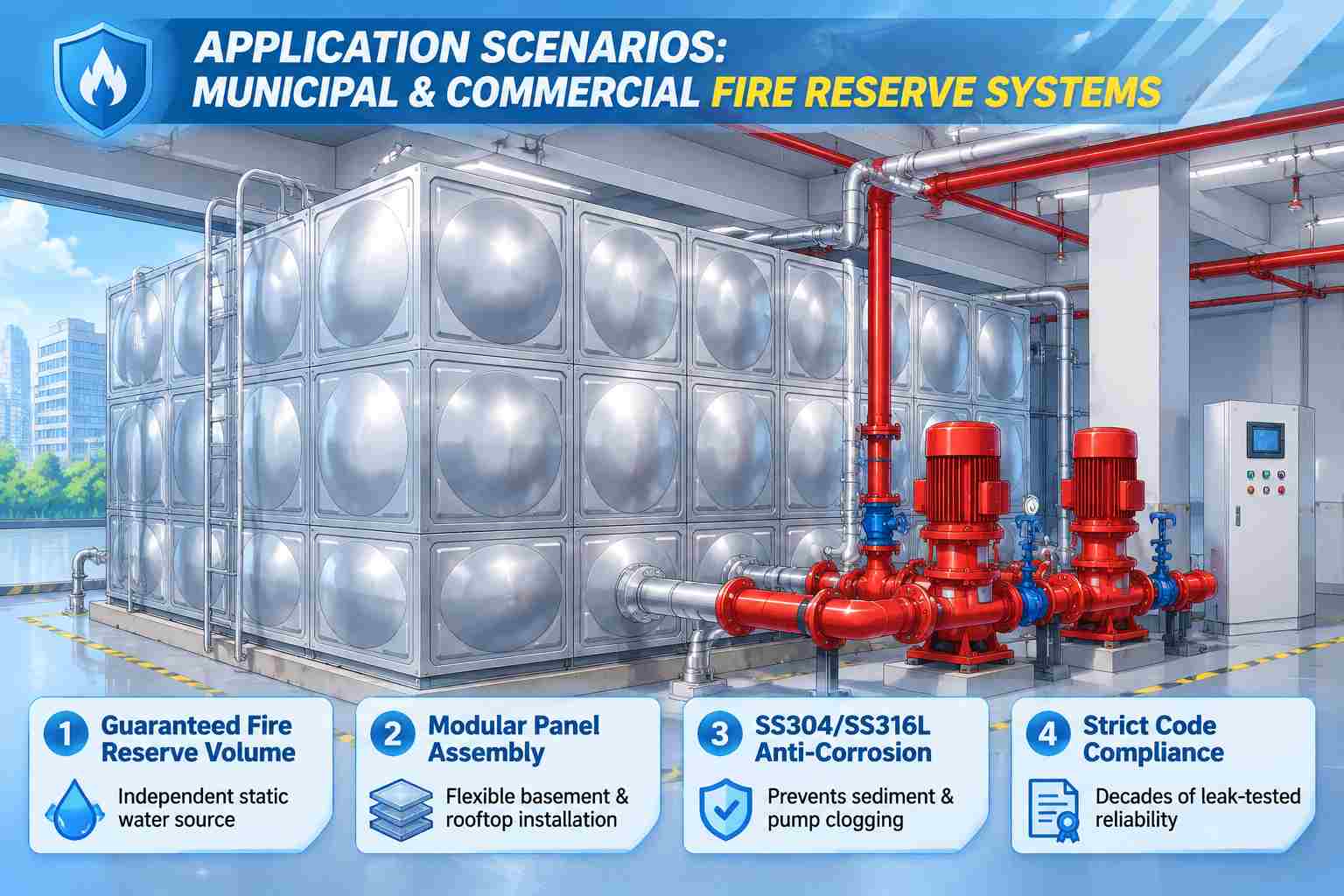
In fire reserve applications, the tank is typically deployed as a dedicated static water source connected to sprinkler networks, fire pumps, and hydrant lines, often installed in a basement plant room, rooftop, or an outdoor compound with a reinforced concrete base. The panel-assembled design allows the vessel to be built inside existing buildings or lifted to rooftops where a monolithic tank could not pass, while SS304 or SS316L construction keeps the stored water clean during long idle periods between tests. The core problem this solves is reliable water availability during a fire event: fire codes require a guaranteed reserve volume that cannot be depleted by domestic demand, and a corroding or coated tank risks sediment, pump clogging, and failed inspections. The practical value is code compliance with confidence — a welded, leak-tested tank that holds its volume for decades, reduces inspection findings, and protects the building's occupants and insurance standing.
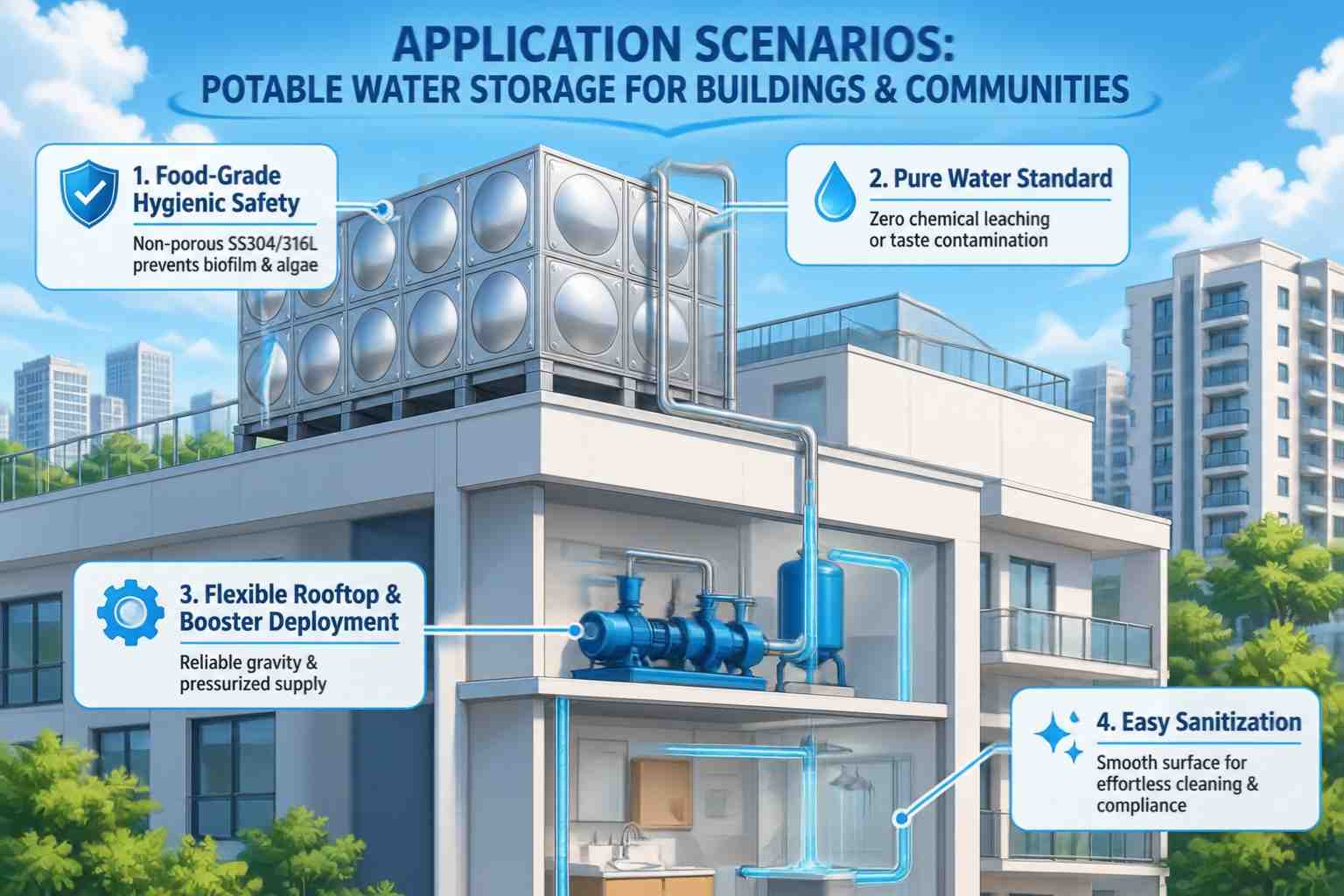
For potable water, the tank is deployed as the primary storage vessel between the municipal supply or borehole and the building's distribution network — on rooftops for gravity feed, in plant rooms with booster pumps, or as community-level storage in residential developments and remote settlements. Non-porous stainless steel surfaces prevent biofilm formation, algae growth, and chemical leaching, so water quality stays within drinking-water standards even during long retention periods. This solves the contamination and taste problems common to concrete, galvanized, and plastic tanks, where rough surfaces harbor bacteria and coatings degrade over time. The value delivered is direct: safe water at the tap, fewer health-authority findings, and a tank that can be drained, cleaned, and sanitized without damaging its interior surface.
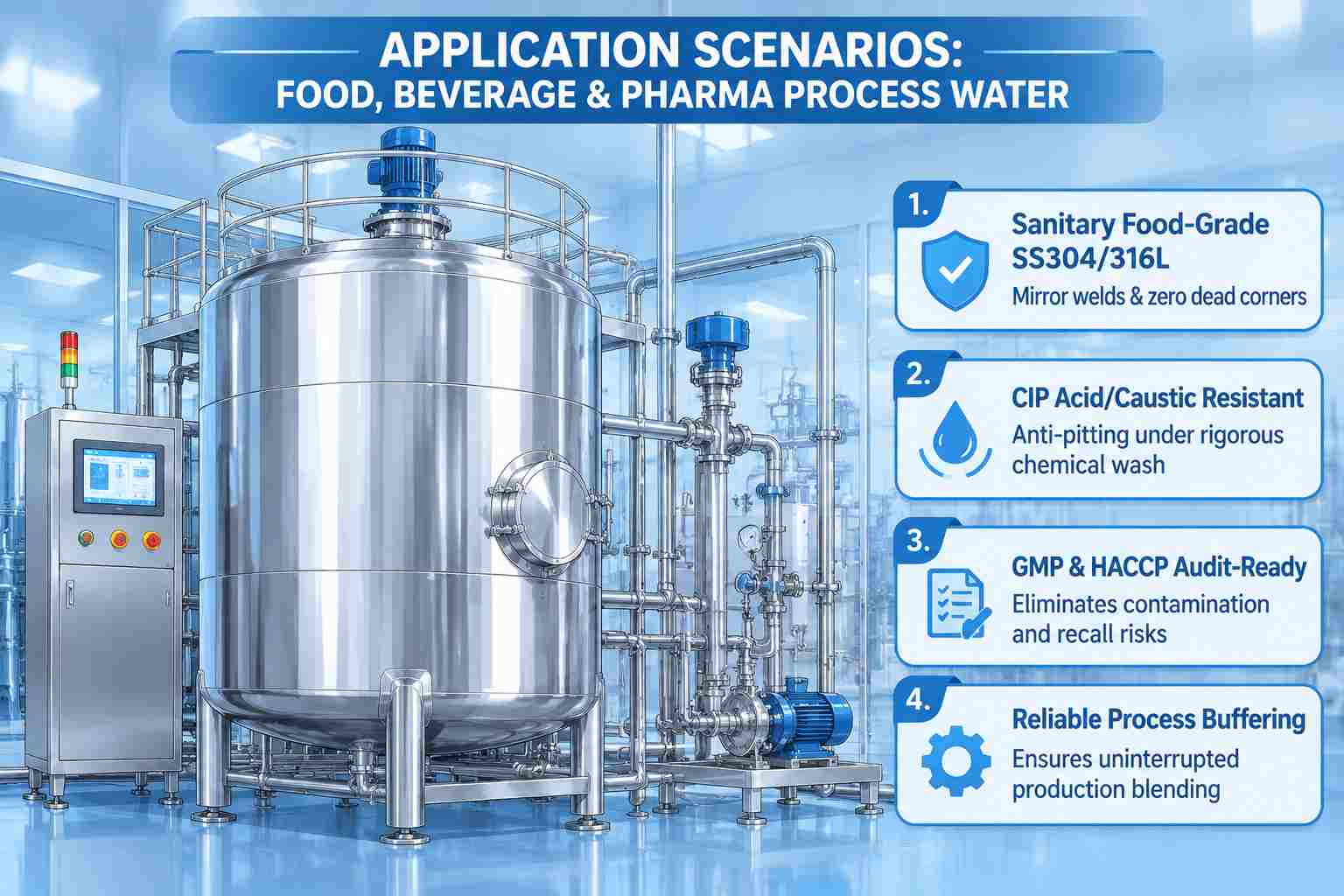
In food and beverage plants, breweries, dairies, and pharmaceutical facilities, the tank is deployed as process water storage or as a buffer vessel feeding CIP (clean-in-place) systems, blending lines, and production equipment. Food-grade SS304 or SS316L with smooth internal welds and no dead corners ensures the water contacting product or equipment meets hygiene standards, and the material withstands repeated caustic and acid cleaning cycles without pitting. The problem addressed is compliance and product safety: regulators and brand auditors scrutinize every water-contact surface, and a tank that cannot be validated or cleaned effectively becomes a recall risk. The real value is audit-ready hygiene — a vessel that passes food-safety inspections, supports HACCP documentation, and protects the brand from contamination incidents.
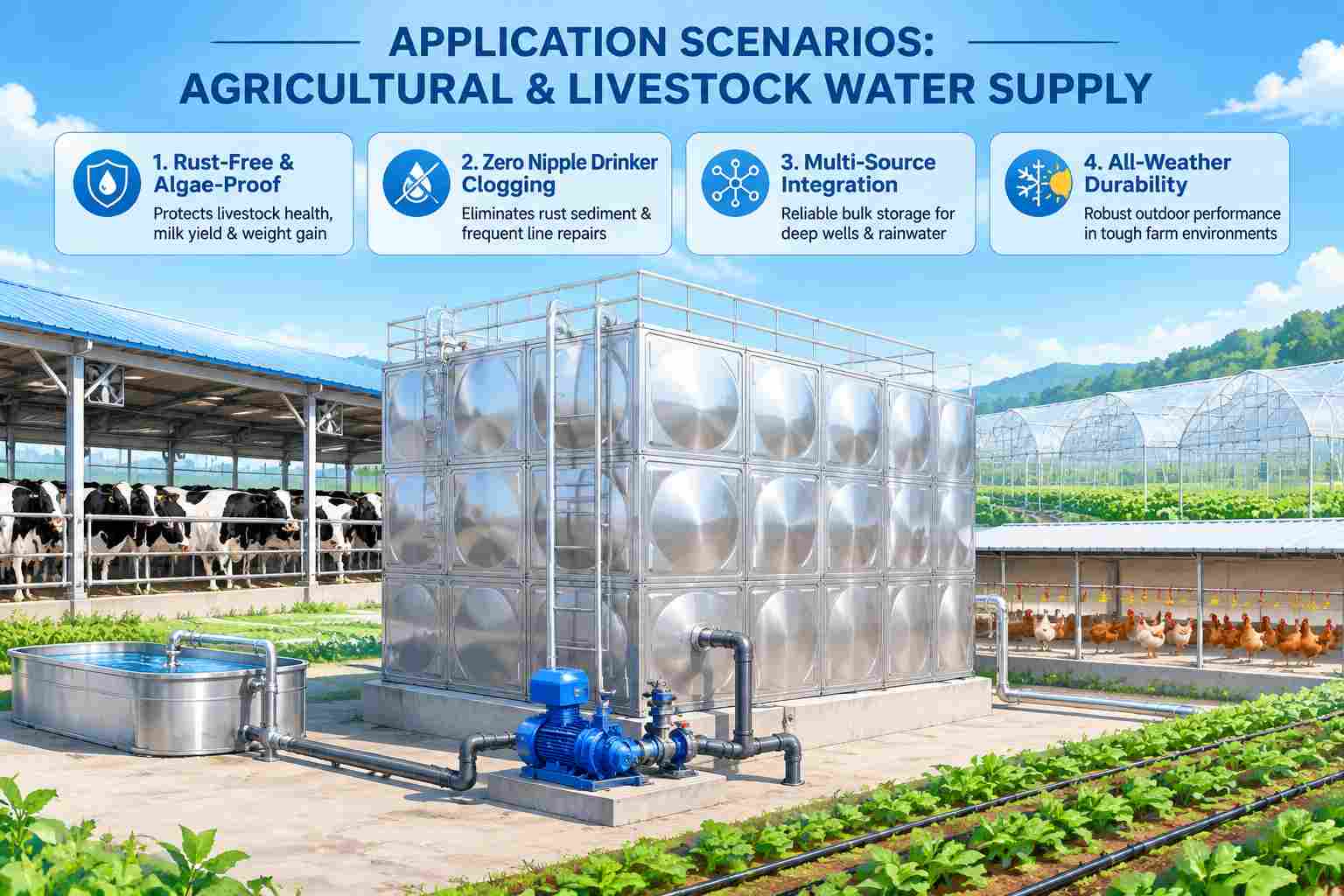
On farms, ranches, and livestock operations, the tank is deployed as a bulk water store fed by wells, boreholes, or rainwater harvesting, then distributed to drinking lines, irrigation points, and wash-down stations. The corrosion-resistant, non-porous interior keeps water free of rust and bacterial growth, which matters for animal health and for produce-wash applications where water quality affects food safety. This addresses the failure mode of galvanized and concrete tanks in rural settings — rust, sediment, and algae that foul drinking nipples and force frequent cleaning. The practical value is livestock health and operational simplicity: a dependable, low-maintenance water source that supports weight gain and milk yield, reduces line-blockage repairs, and holds up under outdoor and variable-power conditions.
Parameter Specifications
|
Product |
SS water tank |
|
Panel shape |
Ball shape |
|
Size(mm) |
1000×1000 ; 1000×500 ; 500×500 |
|
Thickness(mm) |
4-16 |
|
Volume(m³) |
customization |
|
Accessories |
|
Related Products

SS Water Tank for Fire Protection & Potable Storage | Factory Direct Exporter
Looking for a reliable SS water tank supplier? We are a China-based factory exporter specializing in food-grade & fire-fighting storage tanks. Get direct pricing & global shipping.

FRP Panel Water Tank for Fire Storage & Farm Irrigation to Chinese Factory Direct Exporter
Exporting GRP sectional tanks for fire water storage and farm irrigation. Food-grade panel options, wind-load rated, shipped as modular kits worldwide.

FRP Panel Water Tank for Fire & Potable Use | Factory Direct Export
Factory-direct FRP panel tanks for potable water & fire reserve. SMC molded, leak-proof, fast export shipping. Get a quote for your project specs today.

FRP Water Tank for Chemical Plants, Hotels & Fire Reserve | China Factory Exporter
Custom FRP water tanks for potable, industrial, and fire water storage. Direct China factory exporter — no middleman, fast quotes, global shipping.
Contact us immediately to discuss your product project requirements
Navigation
Navigation
Contact Us
Tel.: +86 189 3266 2725
E-mail: sale@hbfortis.com
Add.: No.8-1, Zhenxing Street, Matun Town, Zaoqiang County, Hengshui City, Hebei Province
Get in Touch
Get in Touch