Aug. 07, 2026
Fiberglass Reinforced Plastic (FRP) septic tanks are well-established wastewater pretreatment units widely used in residential, commercial, and industrial sectors. Thanks to their corrosion resistance, structural stability, ease of installation, and environmental performance, FRP septic tanks offer clear advantages over traditional concrete and steel alternatives and have become a preferred solution for modern decentralized wastewater treatment systems.
Compared with conventional septic tanks, FRP septic tanks demonstrate superior performance in durability, efficiency, and maintenance:
1. Lightweight and High Strength
FRP septic tanks weigh approximately 30% of equivalent concrete tanks, making transportation and installation significantly easier, especially in remote or restricted locations. The FRP composite material provides excellent resistance to corrosion and chemical attack, with a design service life exceeding 30 years.
2. Seamless Structure and Environmental Protection
Manufactured using one-piece molding technology, FRP septic tanks eliminate leakage risks and help prevent soil and groundwater contamination. They comply with ROHS and other environmental standards.
3. Low Maintenance and High Treatment Efficiency
The smooth inner surface minimizes sludge buildup, reducing cleaning frequency to just one or two times per year. Optimized internal design allows organic pollutant removal rates of over 85%.
4. Wide Range of Customizable Capacities
FRP septic tanks are available in capacities ranging from 500L to 50,000L and can be customized to meet specific project requirements.
FRP septic tanks treat wastewater through a stable biological process consisting of the following stages:
1.Sedimentation: Solid particles settle at the bottom to form sludge, while oils and lighter substances float to the surface;
2.Anaerobic Digestion: Anaerobic bacteria decompose organic matter in the sludge, producing biogas and liquid effluent while reducing sludge volume and odor;
3.Filtration and Discharge: Treated effluent passes through a filtration layer or is discharged into a municipal sewage system for further treatment.
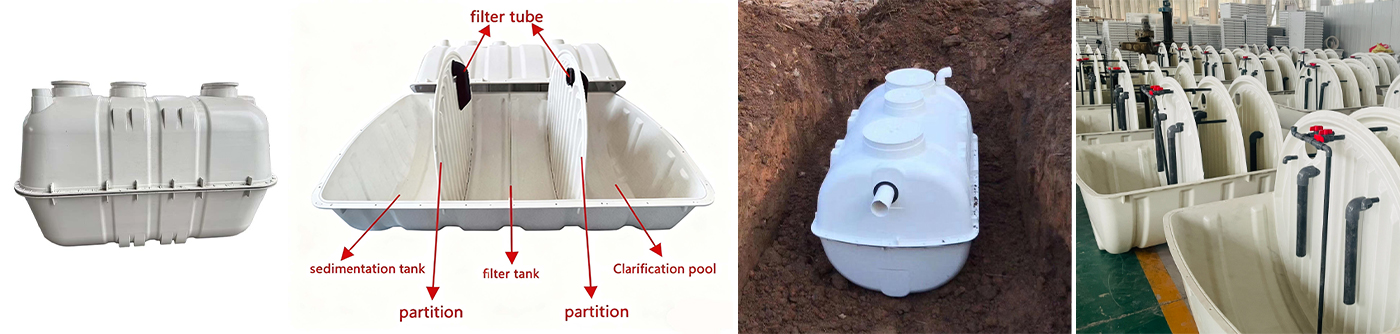
FRP septic tanks are suitable for a wide range of scenarios, including:
● Residential buildings without access to municipal sewage networks.
● Commercial facilities such as hotels, restaurants, schools, and office buildings.
● Industrial and construction sites generating limited non-toxic wastewater.
● Rural and remote areas with underdeveloped sewage infrastructure.
When selecting an FRP septic tank, the following factors should be considered:
● Appropriate capacity based on the number of users and daily water consumption.
● Compliance with international certifications such as ISO and CE.
● Installation conditions, including site space and soil characteristics.
● Availability of technical support and after-sales services.
With advantages including lightweight construction, corrosion resistance, stable operation, and low maintenance requirements, FRP septic tanks have become an essential component of modern wastewater treatment systems. Their versatility and environmental performance make them a reliable long-term solution for residential, commercial, and industrial applications.
Related News
Contact us immediately to discuss your product project requirements
Navigation
Navigation
Contact Us
Tel.: +86 189 3266 2725
E-mail: sale@hbfortis.com
Add.: No.8-1, Zhenxing Street, Matun Town, Zaoqiang County, Hengshui City, Hebei Province
Get in Touch
Get in Touch