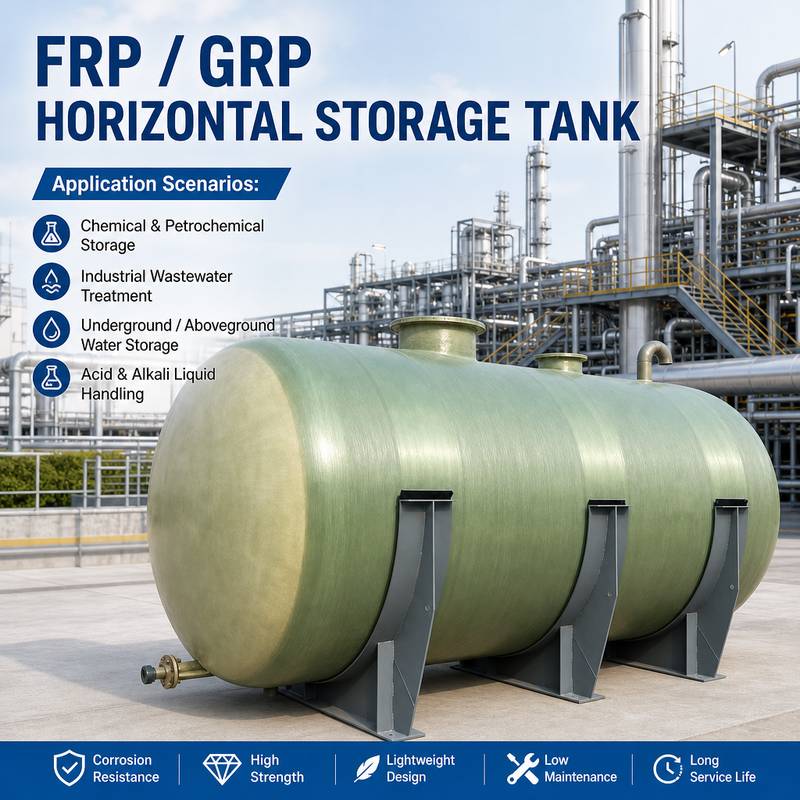
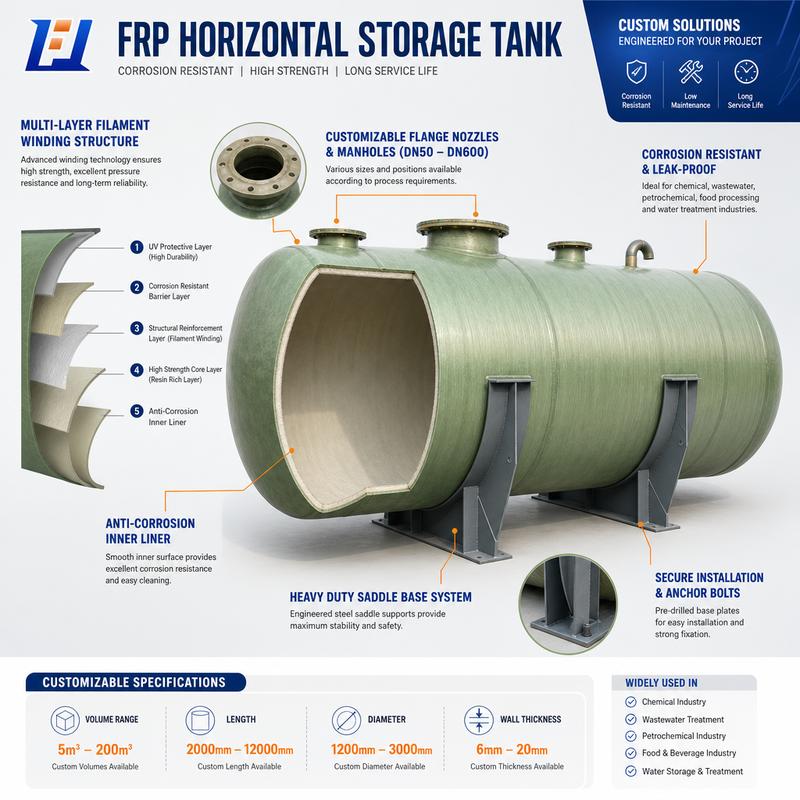
Horizontal FRP storage tanks are specified under a different set of engineering constraints than vertical ones, and we build to those constraints rather than adapting a vertical shell. The critical variables are saddle spacing, longitudinal bending at mid-span, and the concentrated bearing stress where the shell meets each saddle—get any of these wrong and the tank develops stress cracking or sags under its own loaded weight. We calculate saddle positions against your stored volume, liquid specific gravity, and the actual support pad layout at the installation site, then reinforce the shell laminate where bending demand peaks and orient side-entry nozzles to match the piping you already have in place. Our horizontal range serves acid bulk storage on chemical plant pads, diesel and fuel reserves at depots and generator sites, brine and produced-water handling in oilfield and desalination operations, and potable water reserves for municipal and camp supply—each duty drawing a resin system matched to the medium, concentration, and operating temperature rather than a catalog-grade compromise. Because winding, curing, hydrostatic testing, saddle fabrication, and export crating all happen under one roof, buyers get factory-direct pricing without intermediary margin, plus the documentation package that customs and project inspectors request: resin batch certificates, laminate schedule records, hydrostatic test reports with deflection readings, and material traceability sheets. We accommodate mixed-specification orders within a single container, support pre-shipment inspection by SGS, BV, or TÜV at our workshop, and coordinate flat-rack, break-bulk, or standard container loading depending on tank diameter and the receiving site's unloading capability, providing lifting lug locations and rigging diagrams so the tank can be handled without improvisation on arrival. If your project involves a horizontal tank on saddles, send us the medium, volume, specific gravity, and site support arrangement—we will respond with a saddle spacing calculation, a resin specification, and a factory-direct quotation rather than a generic datasheet.

Hebei Fortis Technology Co., Ltd Product Brochure
Product Advantages
A horizontal FRP tank lives or dies by its saddle arrangement. We calculate saddle positions against your stored volume, liquid specific gravity, and the support pad layout at the installation site, then reinforce the shell laminate where longitudinal bending demand peaks at mid-span. Saddle horn reinforcement prevents the concentrated bearing stress that causes stress cracking in poorly supported tanks. The result is a shell that holds its profile under full load rather than bowing between supports, and the saddle spacing calculation ships with the tank so your civil contractor can set foundations to the correct dimensions.
Nozzles on a horizontal tank are not placed by habit—they follow the piping you actually have on site. We orient side-entry connections, manways, vent and drain points to match your layout, so field piping does not require spool-piece improvisation or flange reorientation during installation. Bottom drain arrangements are configured for full drainage of the shell, and top venting is positioned to avoid liquid carryover during filling. Buyers who provide a P&ID or site sketch receive a nozzle orientation drawing for approval before winding begins, which eliminates the costly rework that follows a mismatched flange pattern on arrival.
Our horizontal tanks serve four distinct duty families, each drawing a different resin system. Acid bulk storage uses vinyl ester or bisphenol-A fumarate depending on concentration and temperature; fuel and diesel reserves use resin systems validated for hydrocarbon contact; brine and produced-water handling uses systems resistant to chloride attack and salinity cycling; potable water reserves use food-grade isophthalic resin with certification documentation. Because the resin is selected against your medium rather than a generic "corrosion-resistant" grade, the tank resists permeation at the wall over its service life, and the resin datasheet and batch certificate ship with the unit so the specification can be verified on arrival.
Application Scenarios
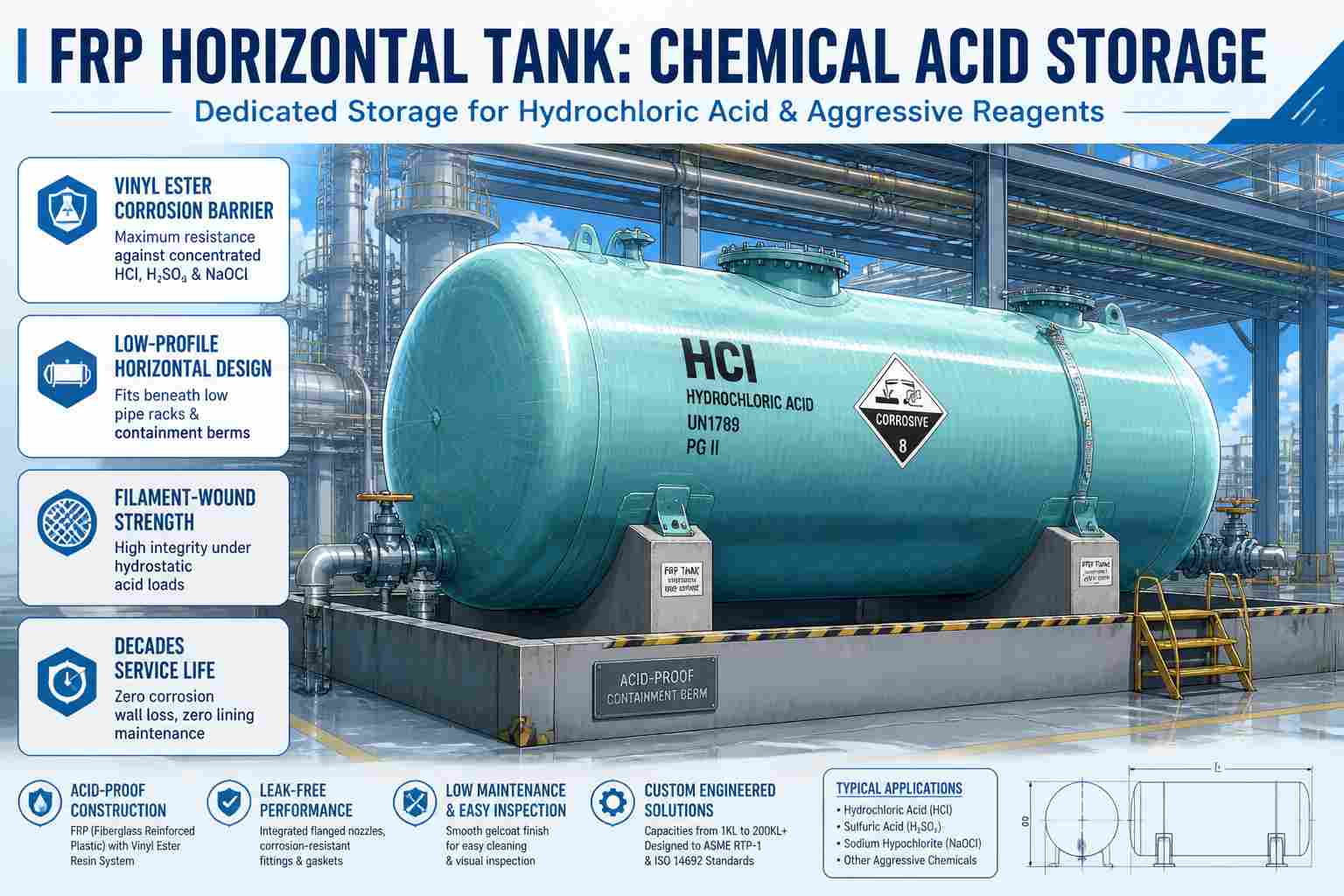
Horizontal FRP tanks are deployed in chemical plants as dedicated storage vessels for hydrochloric acid, sulfuric acid, sodium hypochlorite, and other aggressive reagents where metallic tanks would fail rapidly. The horizontal configuration is selected when the tank must fit beneath existing pipe racks, inside a containment berm with limited height, or within a modular process skid. Vinyl ester resin systems provide the necessary chemical resistance for concentrated acids, while the filament-wound structural layer withstands the hydrostatic loads of a long horizontal shell. This solves the persistent problem of hydrogen generation and rapid wall loss that occurs when HCl contacts carbon steel, eliminating the need for expensive alloy alternatives or frequent tank replacement. The practical value is a storage asset with a service life measured in decades rather than years, with no internal lining to inspect or replace, and no risk of catastrophic leakage from undetected corrosion pits.
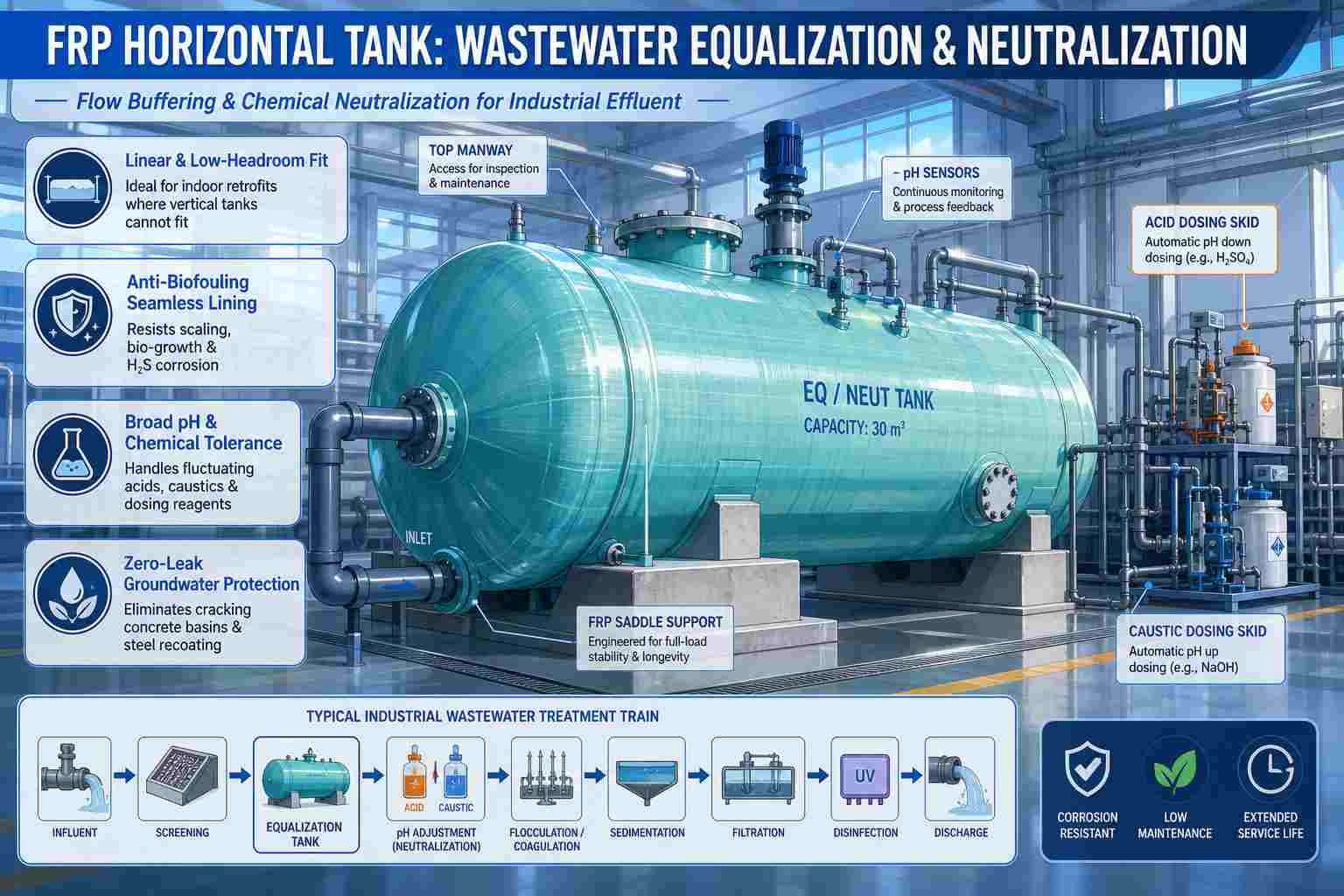
In industrial wastewater treatment facilities, horizontal FRP tanks serve as equalization basins and neutralization vessels, buffering variable flows and pH swings before downstream treatment. The horizontal orientation is particularly valuable in retrofit projects where a vertical tank cannot be lifted into an existing building or where the treatment train must be arranged along a linear footprint. The smooth, seamless interior resists biofouling and scaling from sewage-borne hydrogen sulfide and biological growth, while the corrosion barrier handles the mixed acids and caustics used in pH adjustment. This addresses the twin problems of concrete basins that crack and leak over time and steel tanks that require continuous coating maintenance in a humid, chemically aggressive environment. The delivered value is a leak-proof, maintenance-free vessel that protects groundwater, reduces plant downtime, and eliminates the recurring cost of internal recoating that steel equalization tanks demand.
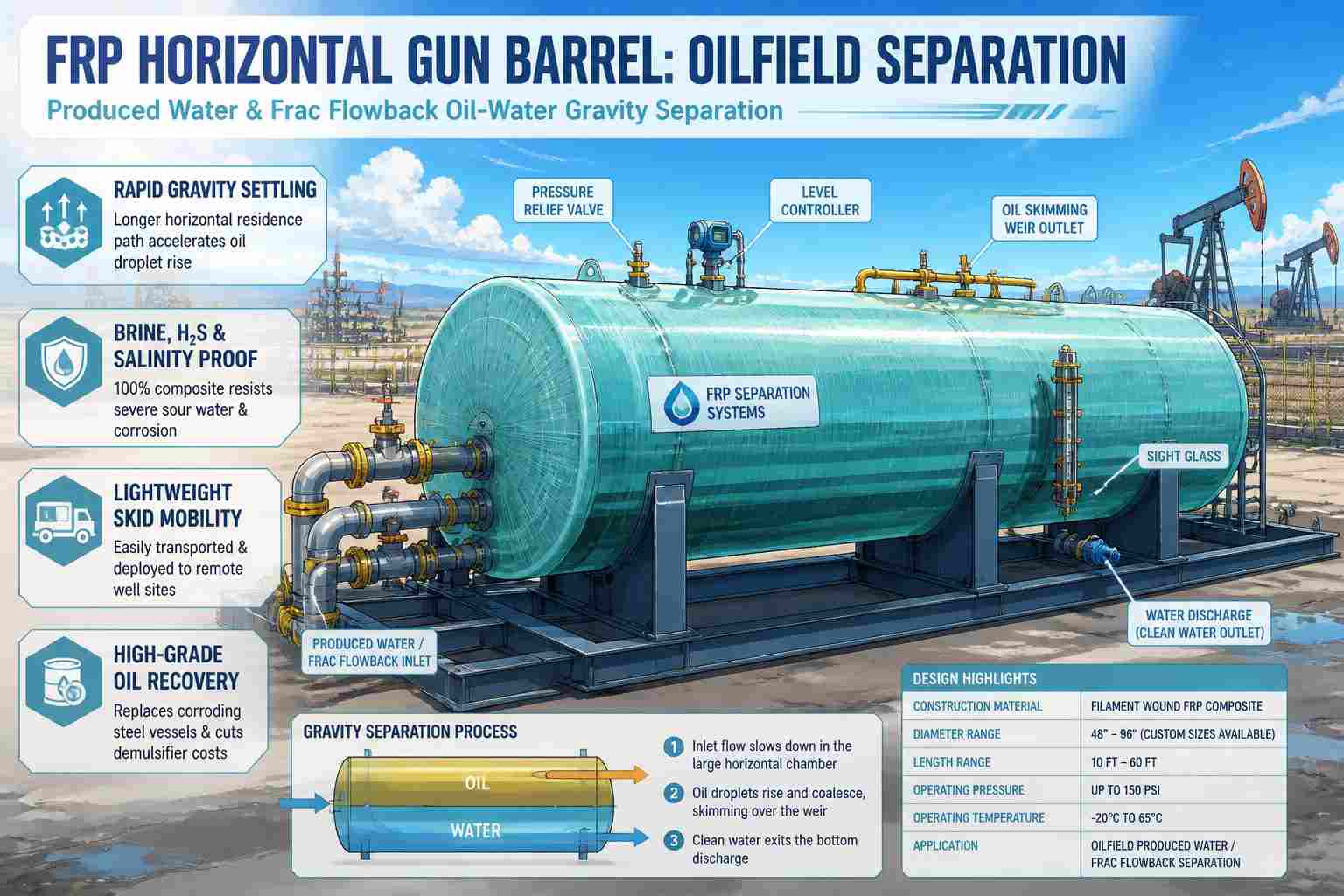
In oil and gas production facilities, horizontal FRP vessels function as gun barrels and free-water knockouts, separating oil from produced water through gravity settling before disposal or recycling. The horizontal geometry is essential here: a single horizontal gun barrel can replace multiple vertical offload tanks, and the longer horizontal residence path provides a shallower rise distance for oil droplets, dramatically accelerating separation without heat or chemical addition. The FRP construction resists the produced water’s high salinity, hydrogen sulfide content, and residual hydrocarbons, while the lightweight shell allows shop fabrication and rapid deployment to remote well sites where crane capacity is limited. This solves the operational bottleneck of slow vertical separation and the corrosion nightmare of carbon steel gun barrels that pit and fail in brine service. The practical value is pipeline-grade oil recovery from what would otherwise be disposal-bound water, reduced chemical demulsifier consumption, and a vessel that can be relocated as field operations shift.
Parameter Specifications
|
Product |
Horizontal Storage Tank |
|||
|
F=D/4 |
||||
|
Model |
Volume(m³) |
Diameter(mm) |
Height(mm) |
Number of Supports N1 |
|
FT-HST1 |
1 |
1000 |
1450 |
2 |
|
FT-HST2a |
2 |
1000 |
2730 |
3 |
|
FT-HST2b |
2 |
1200 |
1990 |
2 |
|
FT-HST2c |
2 |
1400 |
1560 |
2 |
|
FT-HST3a |
3 |
1000 |
4010 |
4 |
|
FT-HST3b |
3 |
1200 |
2870 |
2 |
|
FT-HST3c |
3 |
1400 |
2200 |
2 |
|
FT-HST4a |
4 |
1200 |
3760 |
3 |
|
FT-HST4b |
4 |
1400 |
2850 |
3 |
|
FT-HST5 |
5 |
1400 |
3500 |
3 |
|
FT-HST6 |
6 |
1600 |
3300 |
2 |
|
FT-HST7 |
7 |
1600 |
3800 |
3 |
|
FT-HST8a |
8 |
1600 |
4300 |
3 |
|
FT-HST9 |
9 |
1600 |
4780 |
3 |
|
FT-HST10a |
10 |
1600 |
5300 |
3 |
|
FT-HST10b |
10 |
2000 |
4250 |
3 |
|
FT-HST11a |
11 |
1600 |
5800 |
4 |
|
FT-HST11b |
11 |
2000 |
4640 |
3 |
|
FT-HST12a |
12 |
1600 |
6280 |
4 |
|
FT-HST12b |
12 |
2000 |
5040 |
3 |
|
FT-HST12c |
12 |
2200 |
3540 |
2 |
|
FT-HST15a |
15 |
2000 |
6220 |
3 |
|
FT-HST15b |
15 |
2200 |
4330 |
2 |
|
FT-HST15c |
15 |
2400 |
3750 |
2 |
|
FT-HST18a |
18 |
2000 |
7400 |
4 |
|
FT-HST18b |
18 |
2200 |
5120 |
2 |
|
FT-HST18c |
18 |
2400 |
4410 |
2 |
|
FT-HST20a |
20 |
2000 |
8190 |
4 |
|
FT-HST20b |
20 |
2200 |
5650 |
3 |
|
FT-HST20c |
20 |
2400 |
4850 |
2 |
|
FT-HST20d |
20 |
2600 |
4220 |
2 |
|
FT-HST25a |
25 |
2000 |
8310 |
4 |
|
FT-HST25b |
25 |
2200 |
6960 |
3 |
|
FT-HST25c |
25 |
2400 |
5960 |
2 |
|
FT-HST25d |
25 |
2600 |
5160 |
2 |
|
FT-HST25e |
25 |
2800 |
3740 |
2 |
|
FT-HST30a |
30 |
2200 |
8280 |
4 |
|
FT-HST30b |
30 |
2400 |
7060 |
3 |
|
FT-HST30c |
30 |
2600 |
6100 |
3 |
|
FT-HST30d |
30 |
2800 |
4560 |
2 |
|
FT-HST30e |
30 |
3000 |
4100 |
2 |
|
FT-HST35a |
35 |
2400 |
8170 |
3 |
|
FT-HST35b |
35 |
2600 |
7050 |
3 |
|
FT-HST35c |
35 |
2800 |
5370 |
2 |
|
FT-HST35d |
35 |
3000 |
4820 |
2 |
|
FT-HST40a |
40 |
2400 |
9270 |
3 |
|
FT-HST40b |
40 |
2600 |
7990 |
3 |
|
FT-HST40c |
40 |
2800 |
6180 |
2 |
|
FT-HST40d |
40 |
3000 |
5520 |
2 |
|
FT-HST50a |
50 |
2600 |
9870 |
4 |
|
FT-HST50b |
50 |
2800 |
6990 |
2 |
|
FT-HST50c |
50 |
3000 |
6240 |
3 |
|
FT-HST60a |
60 |
2800 |
8620 |
3 |
|
FT-HST60b |
60 |
3000 |
7660 |
3 |
|
FT-HST70a |
70 |
2800 |
10240 |
3 |
|
FT-HST70b |
70 |
3000 |
9050 |
3 |
|
FT-HST80a |
80 |
3000 |
10470 |
4 |
|
FT-HST80b |
80 |
3000 |
11880 |
4 |
Related Products

FRP Vertical Storage Tank Supplier | Chemical & Wastewater Storage | Factory Direct Export
As a China-based FRP vertical storage tank manufacturer, we supply corrosion-resistant tanks for chemical processing, wastewater treatment & food-grade storage. Factory-direct pricing, export documentation support.

FRP Horizontal Tank Supplier for Chemical Storage & Wastewater | Factory Direct
As a China-based FRP horizontal tank manufacturer, we supply filament-wound tanks for acid storage, effluent equalization & firewater. Request a direct factory quote.

FRP Horizontal Tank Factory Direct | Chemical & Wastewater Storage Exporter
China factory-direct FRP horizontal tanks for acid storage & effluent treatment. Filament-wound, corrosion-proof, custom saddle supports. Get exporter pricing now.

FRP Desulfurization Tower for Power Plant & Chemical Flue Gas to China Factory Exporter
Direct from China factory. High-efficiency FRP desulfurization towers for power plant, steel & chemical flue gas purification. Corrosion-resistant, custom design, CE/ISO. Get a quote.
Contact us immediately to discuss your product project requirements
Navigation
Navigation
Contact Us
Tel.: +86 189 3266 2725
E-mail: sale@hbfortis.com
Add.: No.8-1, Zhenxing Street, Matun Town, Zaoqiang County, Hengshui City, Hebei Province
Get in Touch
Get in Touch