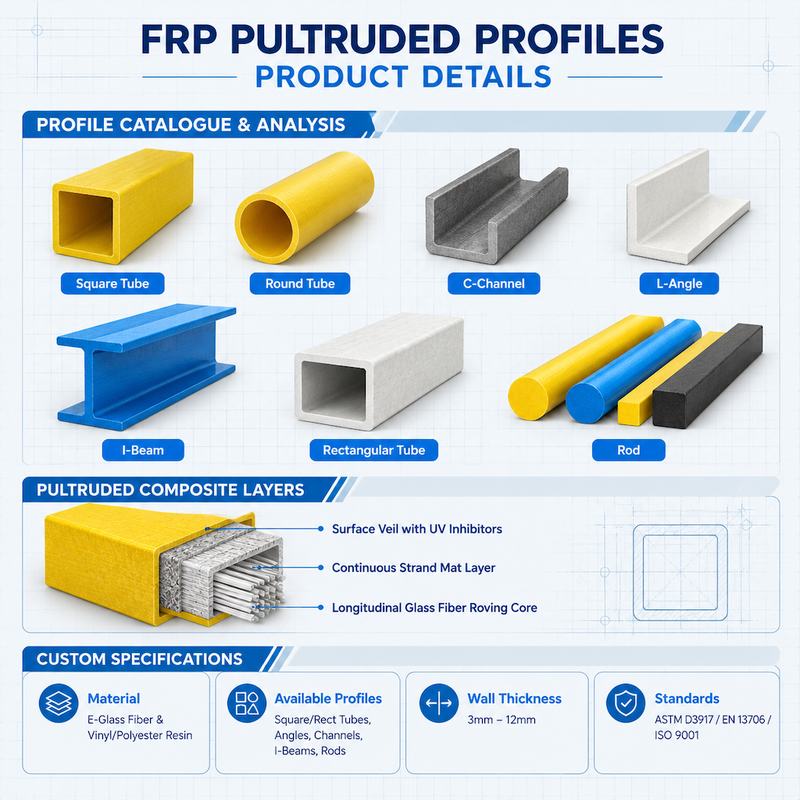
We produce FRP pultruded profiles in China for building framework applications where steel or aluminum would demand ongoing maintenance against moisture, thermal bridging and galvanic corrosion at connection points. Our pultrusion line handles both custom die profiles and standard structural shapes, with resin formulation, glass content and dimensional tolerance held consistent across production batches—so the section approved at design submittal stage is the section that arrives in the container, not a bench sample that cannot be reproduced at volume. For building framework systems, including cladding support grids, curtain wall sub-frames, rooftop equipment screening frames and modular enclosure structures, we manage die development, production scheduling, export packing and shipping documentation in-house, giving project procurement teams a direct line to the people running the line rather than a relay through trading intermediaries. Because pultruded profiles carry low thermal conductivity relative to metal alternatives, they reduce condensation risk and thermal bridging at frame-to-envelope connections, which matters in insulated building assemblies where cold bridges undermine energy performance. We support mixed-section orders combining structural shapes and custom profiles in a single shipment, provide batch traceability records and resin certificates on request, and plan production capacity around confirmed project timelines so that repeat orders for phased building programmes maintain the same specification baseline. For buyers sourcing FRP profiles from China for building framework, façade support or modular construction projects, our role is direct: consistent profiles, documented material properties, and delivery schedules that hold across every phase of the build.

Hebei Fortis Technology Co., Ltd Product Brochure
Product Advantages
Pultruded FRP profiles weigh approximately 75% less than steel and about 30% less than aluminum for equivalent sections. This density advantage is not merely a material specification—it changes how a building framework project is executed. Crane capacity requirements drop, manual handling becomes feasible for longer sections, and freight costs per container fall because more linear meters of profile fit within weight limits. For export buyers shipping to sites where heavy lifting equipment is unavailable or expensive to mobilize, the weight reduction translates directly into installation speed and reduced equipment rental expenditure. Strongwell reports that FRP structures can cost up to 15% less than carbon steel and 30% less than galvanized steel on an installed basis, largely because simpler installation procedures replace welding and specialized labor.
FRP pultruded profiles do not rust, rot, or corrode in the manner of steel or wood. They resist a broad range of chemical exposures and harsh environments without the protective coatings that steel requires. For building framework applications—particularly those in coastal areas, industrial settings, or structures with prolonged moisture exposure—this eliminates the recurring cost of sandblasting, scraping, and repainting that defines the maintenance schedule for steel framing. Fibergrate notes that FRP products will not corrode and maintain structural integrity over time, reducing or eliminating heavy maintenance requirements. The practical consequence for a building owner or facility manager is that the framework remains serviceable without scheduled intervention, and the profiles do not degrade from the inside out as steel does when coating integrity is compromised at connections or cut edges.
Application Scenarios
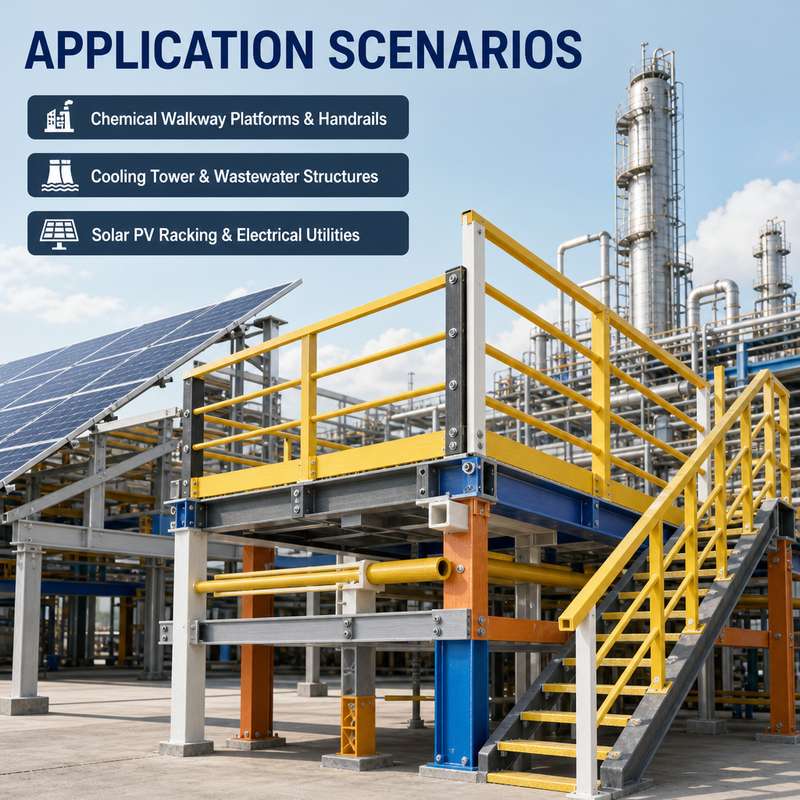
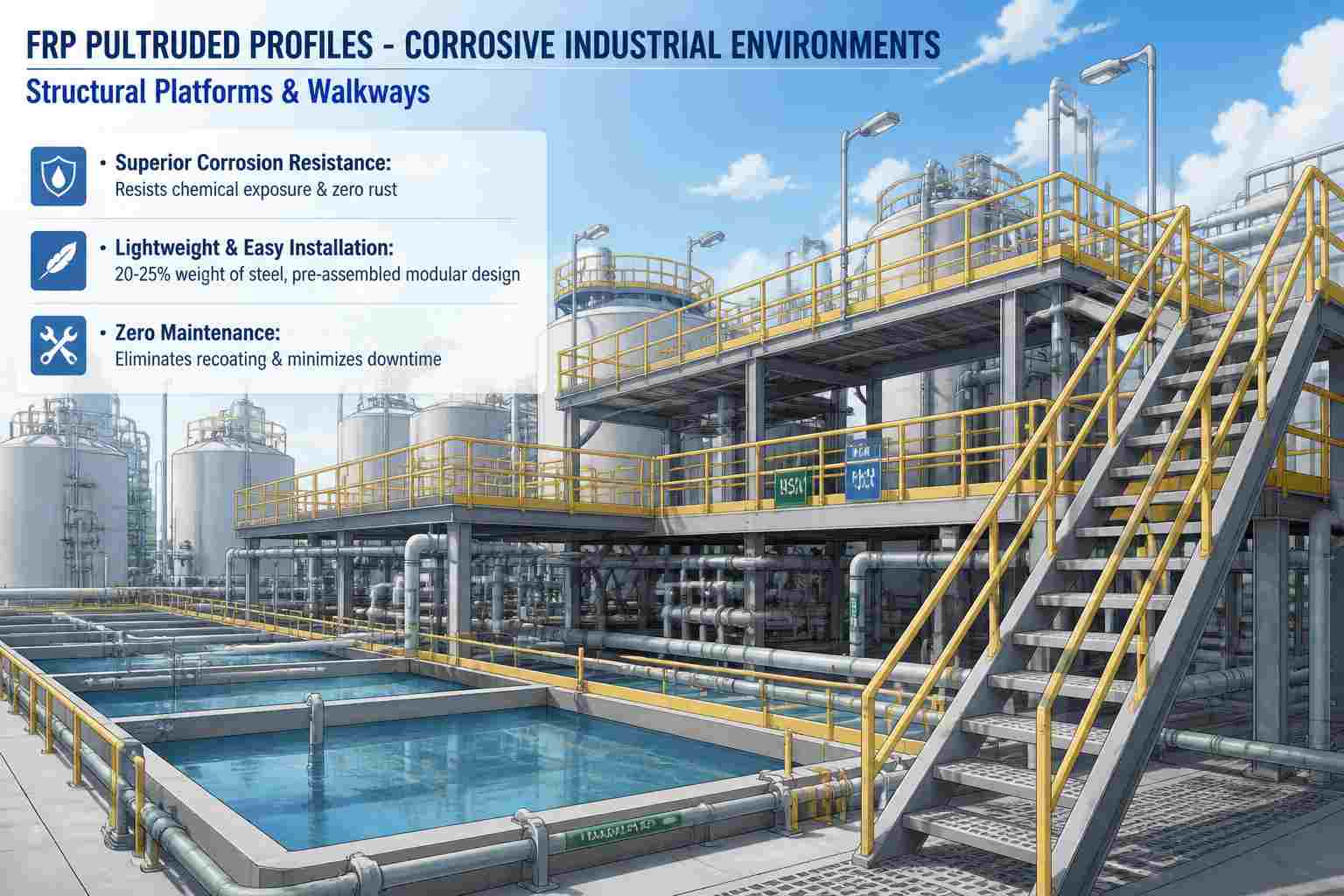
In pulp and paper mills, chemical plants, water treatment and wastewater treatment facilities, FRP pultruded profiles are used as structural platforms, walkway supports and railing systems. These environments have extremely high corrosion rates for steel, and traditional solutions require frequent coating maintenance or the use of expensive stainless steel alloys. FRP profiles do not decay or suffer from widespread corrosive elements, making them the natural choice for structural components in indoor and outdoor corrosive environments. During actual deployment, pultruded profiles can be pre-assembled into complete structures and then transported to the site. Due to their weight being only 20-25% of that of steel, the equipment required for hoisting and positioning is smaller, and the installation time is significantly shortened. The practical benefits include: eliminating the need for regular replacement due to corrosion, reducing downtime for maintenance, and maintaining structural integrity in chemical exposure areas without relying on protective coatings.
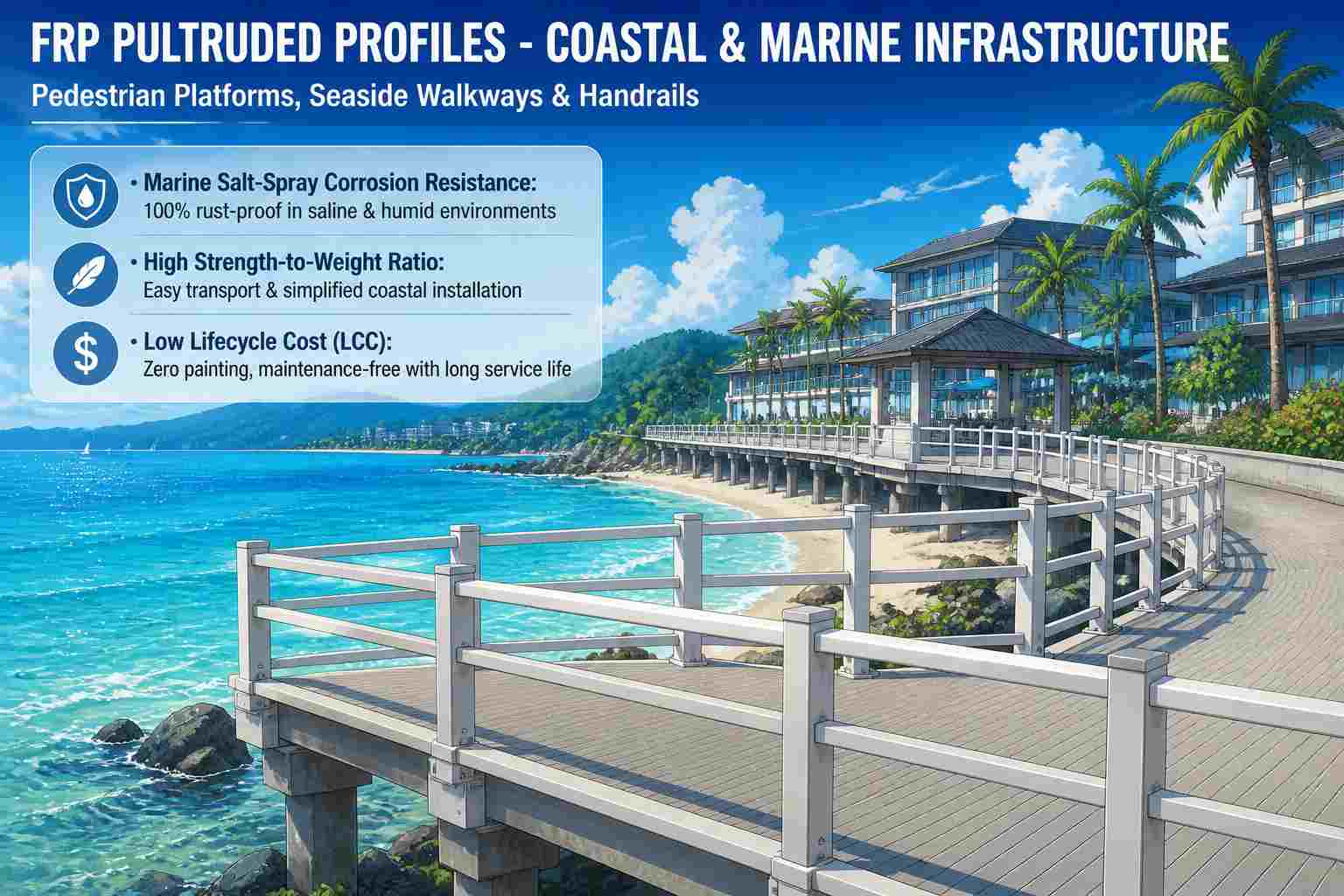
FRP pultruded profiles are deployed in seaside resorts and coastal public areas for constructing pedestrian platforms, decorative walkways, and handrail systems. At the Al Uqair Beach Resort project in Saudi Arabia, a 700-meter FRP structure was installed along the shoreline, anchored to precast concrete foundations embedded in the seabed. The profiles’ inherent corrosion resistance eliminates the rusting problem that plagues steel structures in salt-laden air, while their high strength-to-weight ratio simplifies transport and installation compared to concrete. The primary problem solved is the recurring maintenance burden and shortened service life of conventional materials in marine environments. The actual value delivered is a long-term, low-maintenance infrastructure asset that requires no painting or rust treatment, reducing lifecycle costs despite a higher initial cost than standard steel—yet remaining cheaper than 316-grade stainless steel.
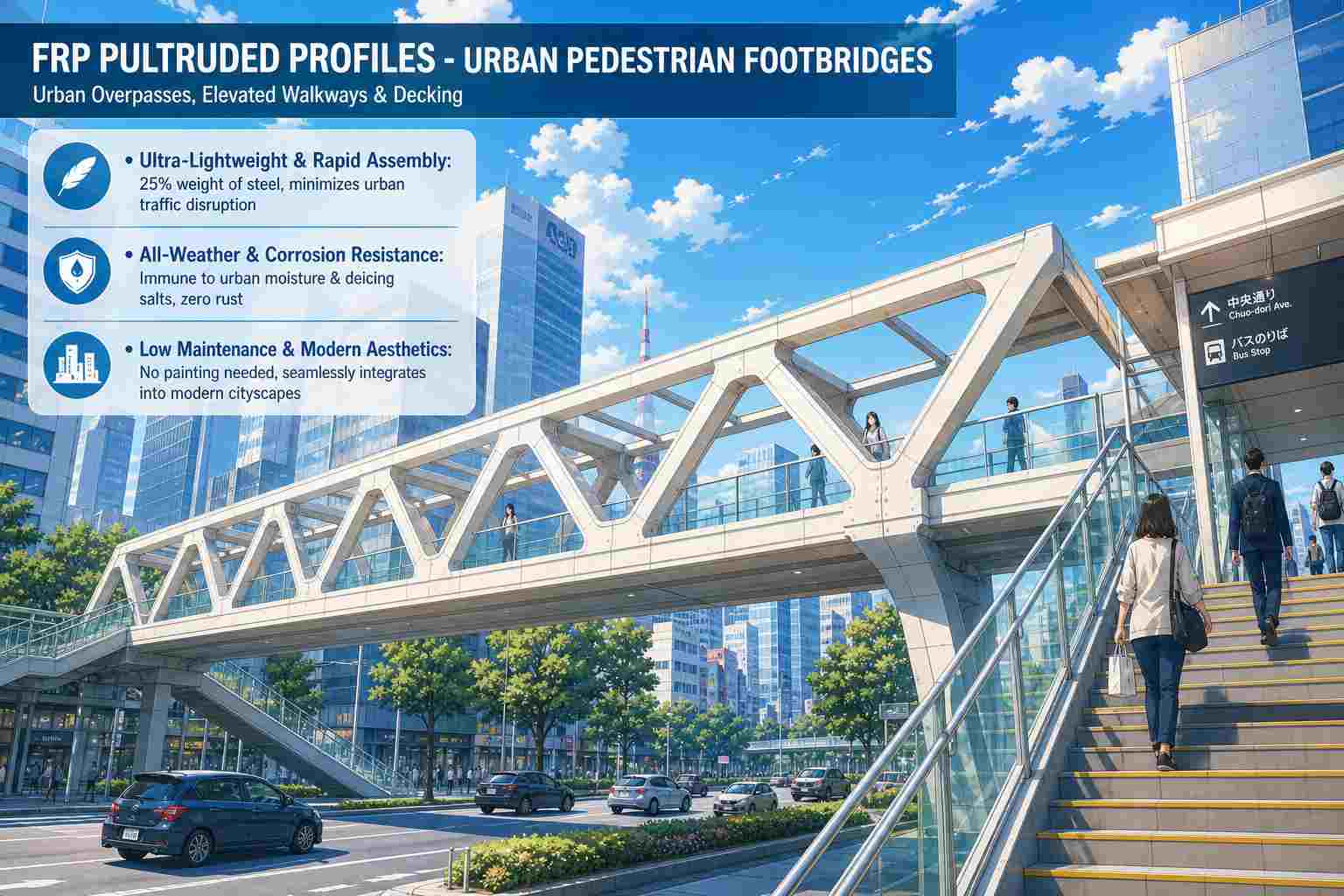
FRP pultruded profiles are increasingly utilized for pedestrian bridge girders, trusses, and deck systems, particularly in remote or environmentally sensitive locations. The material’s lightweight nature—approximately 25% the weight of steel—allows for pre-assembly and simplified logistics, as entire bridge sections can be shipped and lifted into place without heavy lifting equipment. This solves the challenge of constructing durable crossings in areas with limited access or where traditional materials would degrade rapidly due to moisture or salt exposure. The actual value is a rapidly deployable, long-lasting infrastructure solution that does not rot like timber or corrode like iron, requiring virtually no maintenance once installed while offering a service life comparable to that of the surrounding civil infrastructure.
Parameter Specifications
|
Product |
FRP Building Framework |
|||
|
Style |
Square |
Rectangular |
Round |
Triangle |
|
|
|
|
|
|
|
Prompt icon |
Design and customization according to requirements |
|||
|
marked words |
Design and customization according to requirements |
|||
Related Products

FRP Profiles Handrail for Wastewater Treatment Plants China Exporter
China exporter of FRP profiles handrail for marine walkways, mining sites, and cooling towers. Factory-direct supply, custom sizes, fast export delivery. Inquire now.

FRP Profiles Handrail Manufacturer for Offshore Platforms Chinese Exporter
Factory-direct FRP profiles handrail exporter. Corrosion-proof fiberglass railing for chemical, marine & offshore use. Custom pultrusion, bulk supply, fast shipping.

FRP Handrail Supplier for Chemical Plants | Direct Sales from Chinese Factory
Factory-direct FRP handrail exporter. Fiberglass handrails for chemical plants, offshore platforms & wastewater treatment. Custom sizes, bulk supply, fast quotes.

FRP Pultruded Profiles Exporter | Fiberglass Structural Shapes for Walkways Platforms
Reliable Chinese supplier of FRP pultruded profiles offers lightweight, non-slip fiberglass channels and angles. Ideal for industrial flooring, ladder systems, and utility enclosures. Factory prices with global shipping. Inquire now.
Contact us immediately to discuss your product project requirements
Navigation
Navigation
Contact Us
Tel.: +86 189 3266 2725
E-mail: sale@hbfortis.com
Add.: No.8-1, Zhenxing Street, Matun Town, Zaoqiang County, Hengshui City, Hebei Province
Get in Touch
Get in Touch