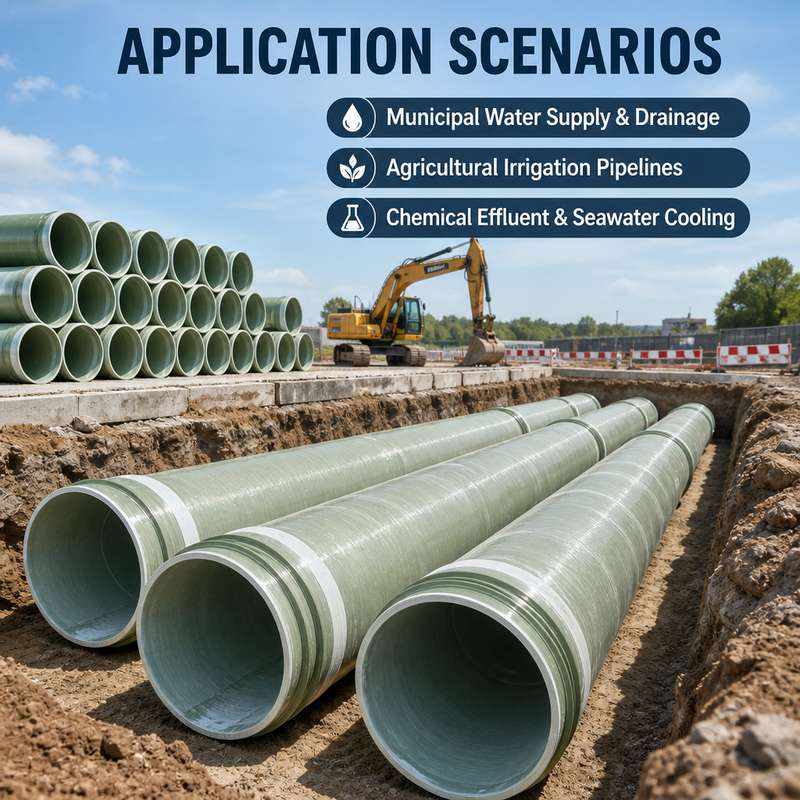
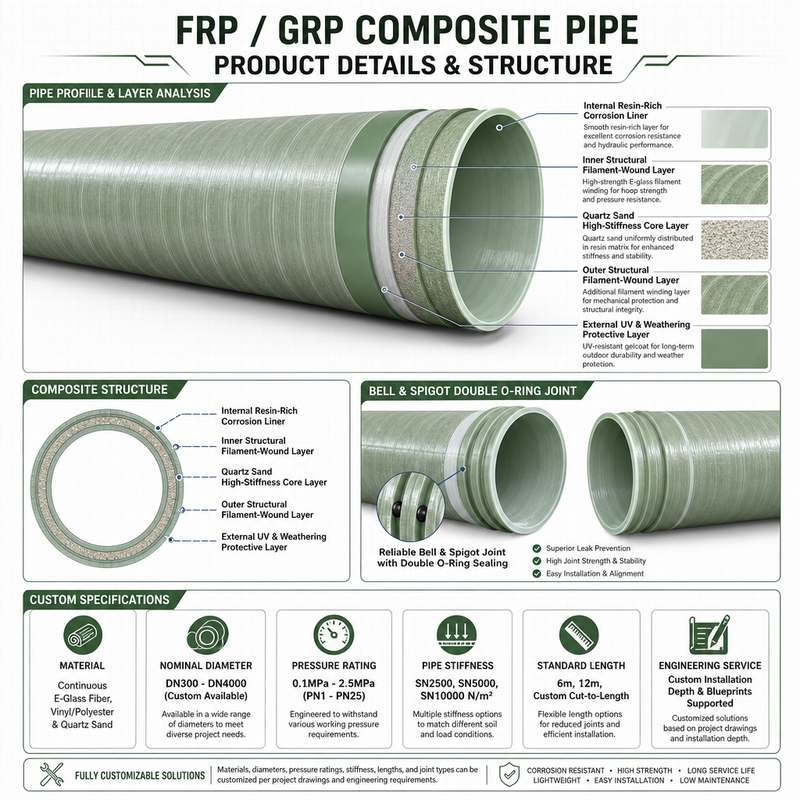
As a China-based FRP pipe manufacturer running direct factory export, we produce filament-wound fiberglass reinforced plastic piping for duty points where conventional materials degrade faster than the maintenance budget can absorb—hydrochloric acid dosing lines in chemical plants, seawater cooling loops on coastal LNG terminals, and gravity sewer mains scheduled for trenchless relining under operating city streets. Our production floor combines continuous filament winding, computer-controlled resin ratios, and in-house hydrostatic proof testing, which means wall thickness, hoop strength, and pressure ratings are verified before shipment rather than asserted on a traded certificate. Buyers comparing Chinese FRP pipe suppliers often discover that quoted prices diverge not because of resin grade but because one quote originates from a winding line and another from a broker's inbox; dealing with the manufacturer shortens that chain, keeps customization requests—bell-and-spigot ends, specific pressure classes, liner resin selection—inside a single accountable party, and allows export packing, third-party inspection coordination, and batch traceability records to be arranged without handoffs. For EPC contractors, municipal distributors, and industrial maintenance teams sourcing from Asia, the practical advantage is a supplier who can answer a technical query about cure profile or joint design the same day it is asked, because the people answering it stand next to the equipment that made the pipe.

Hebei Fortis Technology Co., Ltd Product Brochure
Product Advantages
FRP pipe resists attack from acids, alkalis, salts, and oxidizing agents without relying on a protective barrier that can chip, blister, or require re-coating every few years. Where carbon steel demands internal linings and cathodic protection, and stainless steel risks chloride stress cracking, fiberglass reinforced plastic holds its integrity in continuous immersion and splash zones alike. Chemical processors handling hydrochloric acid, sulfuric acid, or hypochlorite dosing lines typically find that FRP delivers a service life measured in decades rather than maintenance cycles, removing the recurring cost of inspection, patch repair, and premature replacement from the asset budget.
At roughly one-quarter the density of steel, FRP pipe arrives on site light enough for a small crew and standard lifting equipment to handle, which shortens installation windows and reduces crane hire, rigging, and labor hours. The same low weight translates into fewer supports and lighter structural loads on pipe racks, bridges, and building penetrations. For projects where access is constrained—retrofit work inside operating plants, elevated runs, or remote sites with limited logistics—the handling advantage of FRP often proves as decisive as its corrosion performance, because schedule risk and installation cost frequently outweigh material price differences.
The internal surface of a filament-wound FRP pipe is exceptionally smooth, with a Hazen-Williams C factor typically in the 150 range and a roughness coefficient well below that of concrete or aged steel. This means lower friction loss, smaller pumping energy demand, and the ability to specify a smaller diameter for the same flow rate in many designs. Unlike metallic pipe that roughens as corrosion products accumulate, FRP maintains its flow characteristics over the service life, so hydraulic design assumptions remain valid years after commissioning rather than drifting toward higher pumping costs and reduced capacity.
Application Scenarios
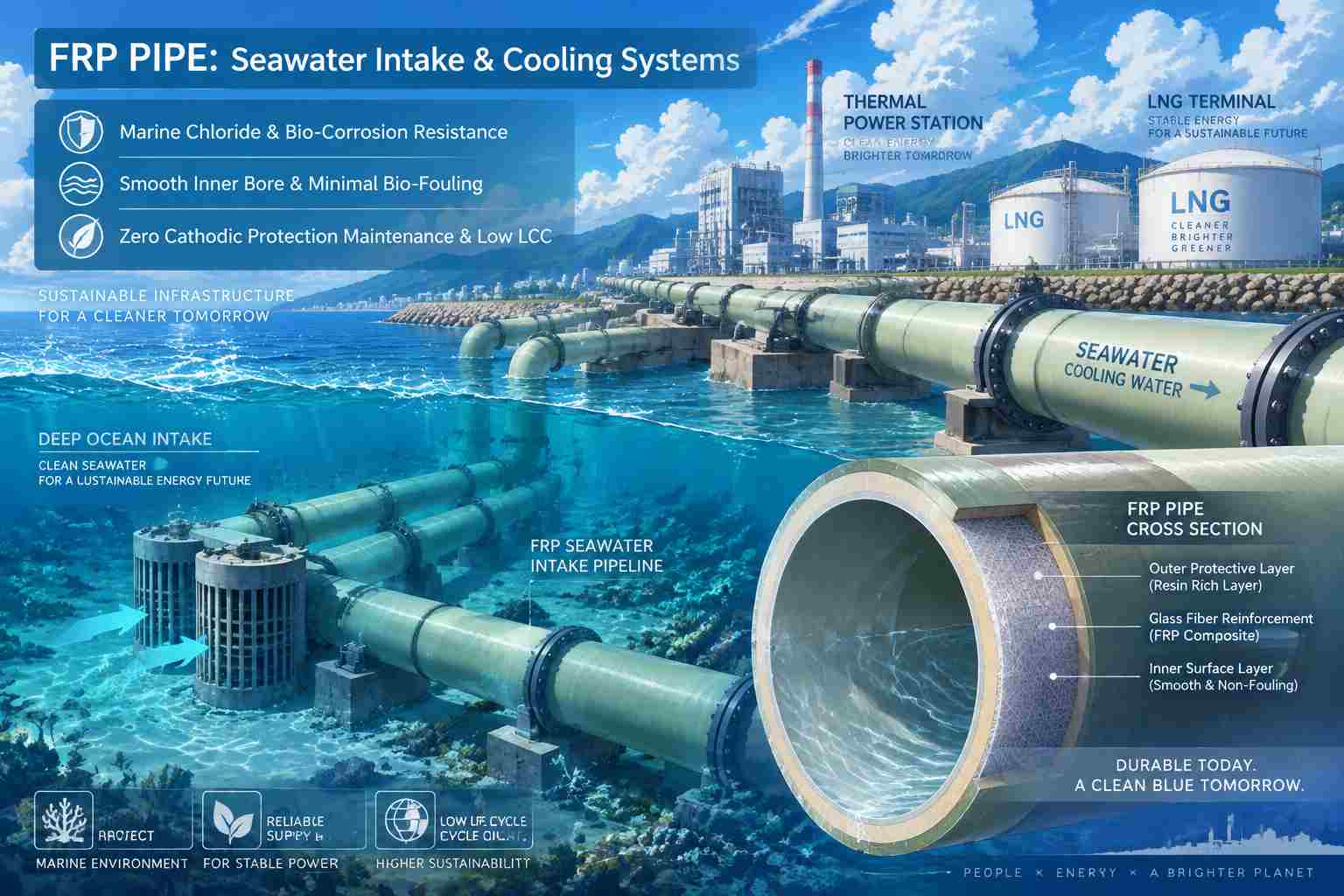
Coastal power stations, LNG terminals, and desalination plants deploy FRP pipe for seawater intake headers, cooling water supply and return lines, and outfall diffusers. These lines are often large diameter and buried or submerged, requiring joints that resist external hydrostatic loads and marine soil conditions. FRP's resistance to chloride attack and marine bio-corrosion addresses the core problem that carbon steel in seawater demands continuous cathodic protection and coating maintenance, while copper-nickel alloys carry high material cost and fouling concerns. The smooth bore also limits marine organism attachment and preserves flow capacity over time. The value delivered is a seawater system that avoids the rapid wall-loss and pitting failures of steel, reduces cathodic protection power and anode replacement costs, and maintains cooling efficiency across the plant's operating life.
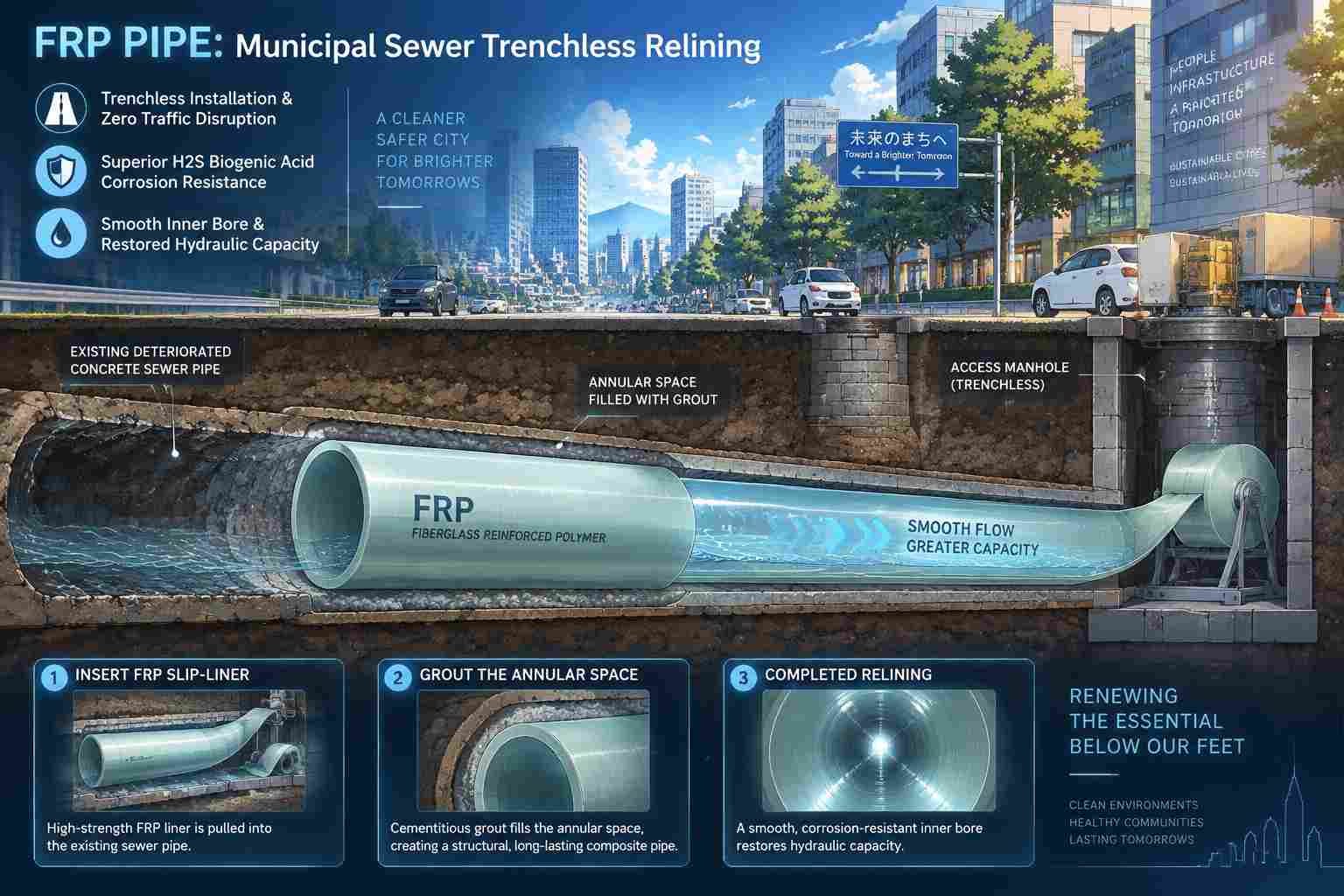
FRP pipe is used in trenchless rehabilitation of aging concrete and cast-iron sewers, where a smaller-diameter FRP liner is pulled or jacked into the existing main and the annular space grouted. The liner restores structural integrity and provides a smooth, corrosion-resistant bore that resists hydrogen sulfide attack—the primary cause of crown corrosion in concrete sewers. The deployment solves the problem of excavating operating city streets, disrupting traffic, and incurring high social and reinstatement costs, while addressing infiltration and exfiltration that overload treatment plants. The practical value is restored hydraulic capacity despite the reduced diameter (thanks to the low friction coefficient), a design life matching new construction, minimized surface disruption, and a rehabilitation cost substantially below full replacement.
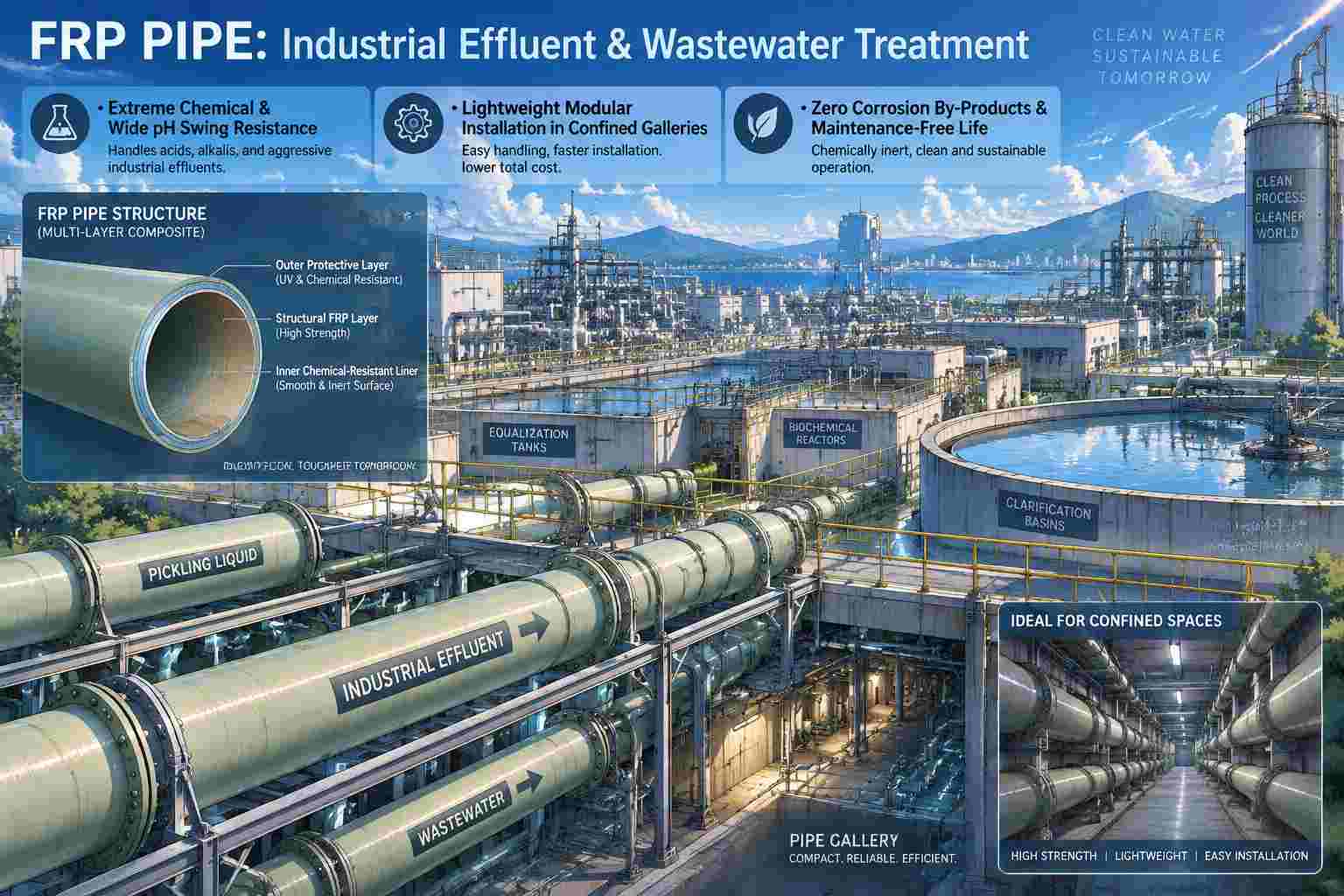
In industrial wastewater treatment, FRP pipe carries aggressive effluent streams—pickling liquors, plating rinse water, paper mill black liquor, and high-sulfide wastewater—between process units, equalization tanks, and treatment stages. These lines are frequently buried or installed in congested pipe galleries, where lightweight FRP sections reduce support requirements and allow installation in confined spaces. The material's resistance to pH swings and oxidizing disinfectants addresses the failure of concrete (sulfate and acid attack) and coated steel (coating breakdown at flanges and welds). The value is reliable conveyance of variable and aggressive waste streams without frequent replacement, lower maintenance intervention in confined and hazardous spaces, and protection of downstream treatment equipment from corrosion product contamination.
Parameter Specifications
|
Product |
FRP pipe |
||||
|
|
|||||
|
Model |
Inner.dia(mm) |
Length(mm) |
Channel Thickness(mm) |
||
|
P=0.6Mpa |
P=1.0Mpa |
P=1.6Mpa |
|||
|
FT-Pp10 |
10 |
1800 |
4.6 |
4.6 |
4.6 |
|
FT-Pp15 |
15 |
||||
|
FT-Pp20 |
20 |
||||
|
FT-Pp25 |
25 |
||||
|
FT-Pp32 |
32 |
||||
|
FT-Pp40 |
40 |
||||
|
FT-Pp50 |
50 |
6000 |
|||
|
FT-Pp65 |
65 |
||||
|
FT-Pp80 |
80 |
||||
|
FT-Pp100 |
100 |
5.9 |
|||
|
FT-Pp125 |
125 |
||||
|
FT-Pp150 |
150 |
5.9 |
|||
|
FT-Pp200 |
200 |
5.9 |
7.2 |
||
|
FT-Pp250 |
250 |
12000 |
8.5 |
||
|
FT-Pp300 |
300 |
7.2 |
9.8 |
||
|
FT-Pp350 |
350 |
8.5 |
11.1 |
||
|
FT-Pp400 |
400 |
12.4 |
|||
|
FT-Pp450 |
450 |
7.2 |
9.8 |
13.7 |
|
|
FT-Pp500 |
500 |
||||
|
FT-Pp600 |
600 |
8.5 |
12.4 |
15.0 |
|
|
FT-Pp700 |
700 |
9.8 |
13.7 |
20.2 |
|
|
FT-Pp800 |
800 |
15.0 |
22.8 |
||
|
FT-Pp900 |
900 |
11.1 |
16.3 |
25.4 |
|
|
FT-Pp1000 |
1000 |
12.4 |
17.3 |
28.0 |
|
|
FT-Pp1200 |
1200 |
13.7 |
|
|
|
|
FT-Pp1400 |
1400 |
16.3 |
|
|
|
|
FT-Pp1500 |
1500 |
|
|
||
|
FT-Pp1600 |
1600 |
17.6 |
|
|
|
|
FT-Pp1800 |
1800 |
18.9 |
|
|
|
|
FT-Pp2100 |
2100 |
22.8 |
|
|
|
|
FT-Pp2400 |
2400 |
25.4 |
|
|
|
|
FT-Pp2600 |
2600 |
26.7 |
|
|
|
|
FT-Pp3000 |
3000 |
30.6 |
|
|
|
|
FT-Pp3300 |
3300 |
33.2 |
|
|
|
|
FT-Pp3600 |
3600 |
35.8 |
|
|
|
|
FT-Pp4000 |
4000 |
39.7 |
|
|
|
Related Products

FRP Flange for Offshore & Chemical Piping | China Exporter Direct
Full-face and raised-face FRP flanges in ANSI 150–300# ratings, drilled to match metal mating flanges. Vinyl ester or epoxy build for brine, acid and seawater lines. Request export pricing.

FRP Pipe Elbow for Chemical & Desalination Plants | Factory Direct Exporter
ASME RTP-1 compliant FRP pipe elbows (45°/90°) from a China factory exporter. Corrosion-resistant filament-wound fittings for chemical, marine & wastewater projects. Get a direct quote.

China GFRP Pipe Exporter for Geothermal | Factory-Direct Custom Diameters
Professional FRP pipe supplier from China offers high-temp epoxy systems for flue gas desalination & geothermal brines. DN1000-DN4000 jacking pipes available. Full test reports with every export container. Request project-based quote.

FRP Pipe Manufacturer China | Direct Factory Supply for Desalination & Chemical Plants
Source high-strength corrosion-resistant FRP pipes directly from China's experienced exporter. ISO-certified production, OEM diameters 25mm-4000mm, rapid shipping for water treatment & mining projects. Get factory price now.
Contact us immediately to discuss your product project requirements
Navigation
Navigation
Contact Us
Tel.: +86 189 3266 2725
E-mail: sale@hbfortis.com
Add.: No.8-1, Zhenxing Street, Matun Town, Zaoqiang County, Hengshui City, Hebei Province
Get in Touch
Get in Touch