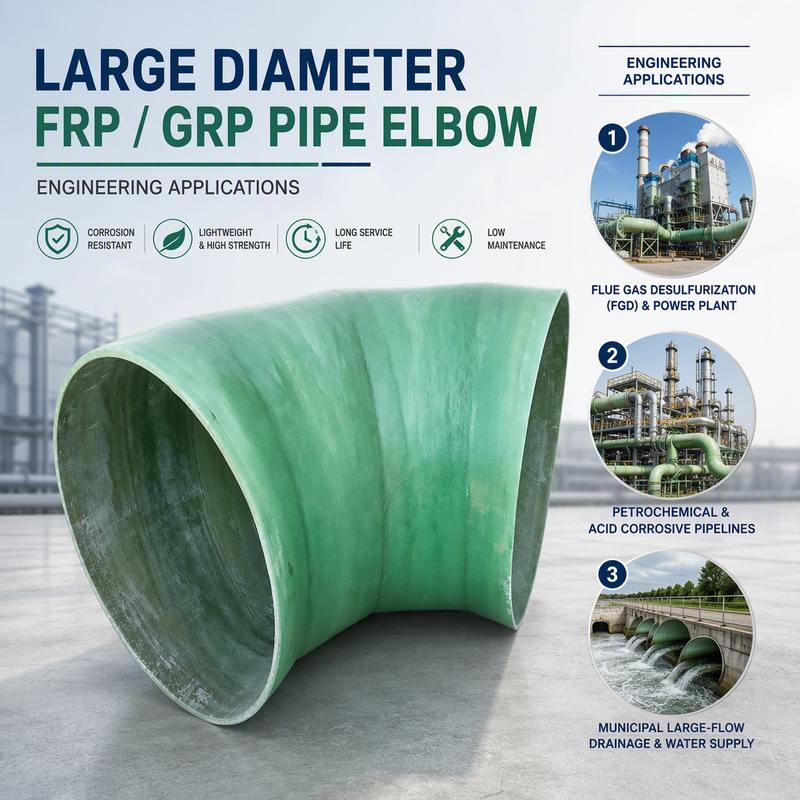
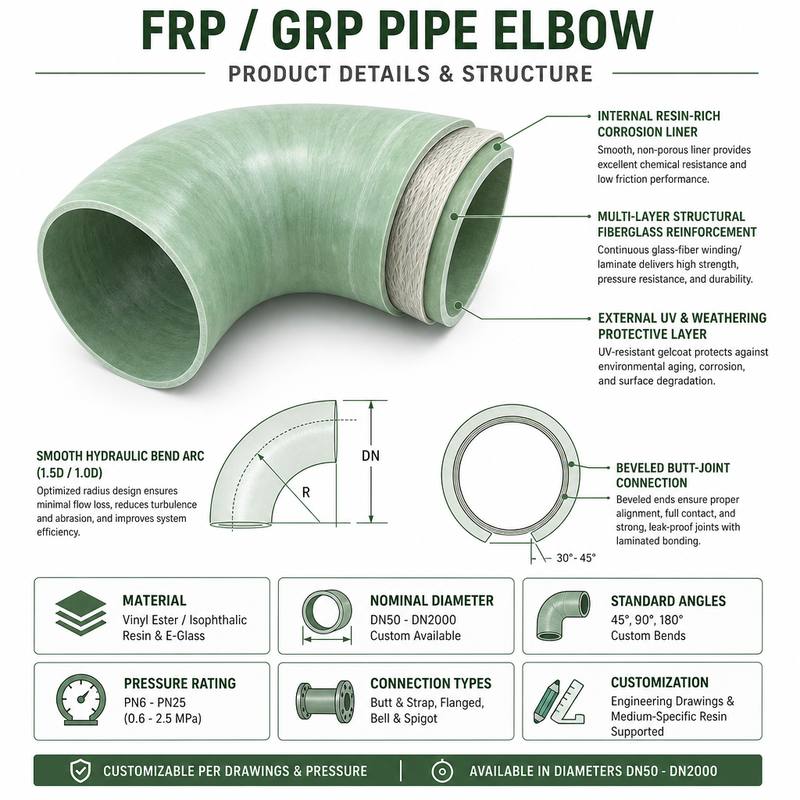
Sourcing FRP pipe elbows through a trading company often means paying twice for the same filament-wound fitting—once for the factory, once for the middleman. We are the factory. From our China production base, we wind, cure, machine, and pressure-test 45° and 90° FRP elbows in-house, then ship them directly to chemical processors, desalination plants, marine contractors, and wastewater treatment operators across Europe, the Middle East, and Southeast Asia. Every elbow is built to ASME RTP-1 and ASTM D3840, with resin systems—vinylester, epoxy, or bisphenol-A—matched to the specific acid, chloride, or solvent exposure of your line. Custom radii, non-standard angles, and stub-end configurations are routine, not exceptions; our CNC machining cell holds dimensional tolerances that keep spool fabrication on schedule. Before crating, each batch undergoes hydrostatic testing, Barcol hardness verification, and dimensional inspection, with mill test certificates and resin batch traceability included as standard. Because we handle export documentation, seaworthy packaging, and container loading ourselves, lead times stay predictable and landed costs stay transparent—no hidden margins, no surprise rework at the jobsite.

Hebei Fortis Technology Co., Ltd Product Brochure
Product Advantages
FRP pipe elbows resist attack from acids, chlorides, solvents, and oxidizing agents that rapidly degrade carbon steel or require expensive alloy substitutes. The thermoset resin matrix—whether vinylester, epoxy, or bisphenol-A—is selected to match the specific chemical exposure of the line, so the elbow maintains structural integrity in continuous service where stainless steel would pit or stress-crack. This extends replacement intervals from a few years to decades, cutting maintenance shutdowns and spares inventory for chemical plants, desalination trains, and wastewater systems.
At roughly one-quarter the density of steel, FRP elbows reduce the dead load on pipe supports and eliminate the need for heavy lifting equipment during spool assembly. Crews can handle and align 90° and 45° fittings manually, shortening installation time and reducing crane rental and rigging labor. The weight advantage also lowers freight costs on export shipments, since more fittings fit within container weight limits—a direct saving for overseas contractors managing landed cost.
The filament-wound interior surface of an FRP elbow delivers a Hazen-Williams C-factor typically above 150, compared with 100–120 for aged steel. This low friction loss means smaller pumps or lower energy consumption for the same flow rate, and the smooth bore resists scale buildup and sediment adhesion. Over a plant's operating life, the retained hydraulic performance translates into measurable pumping-energy savings and fewer cleaning interventions.
Application Scenarios
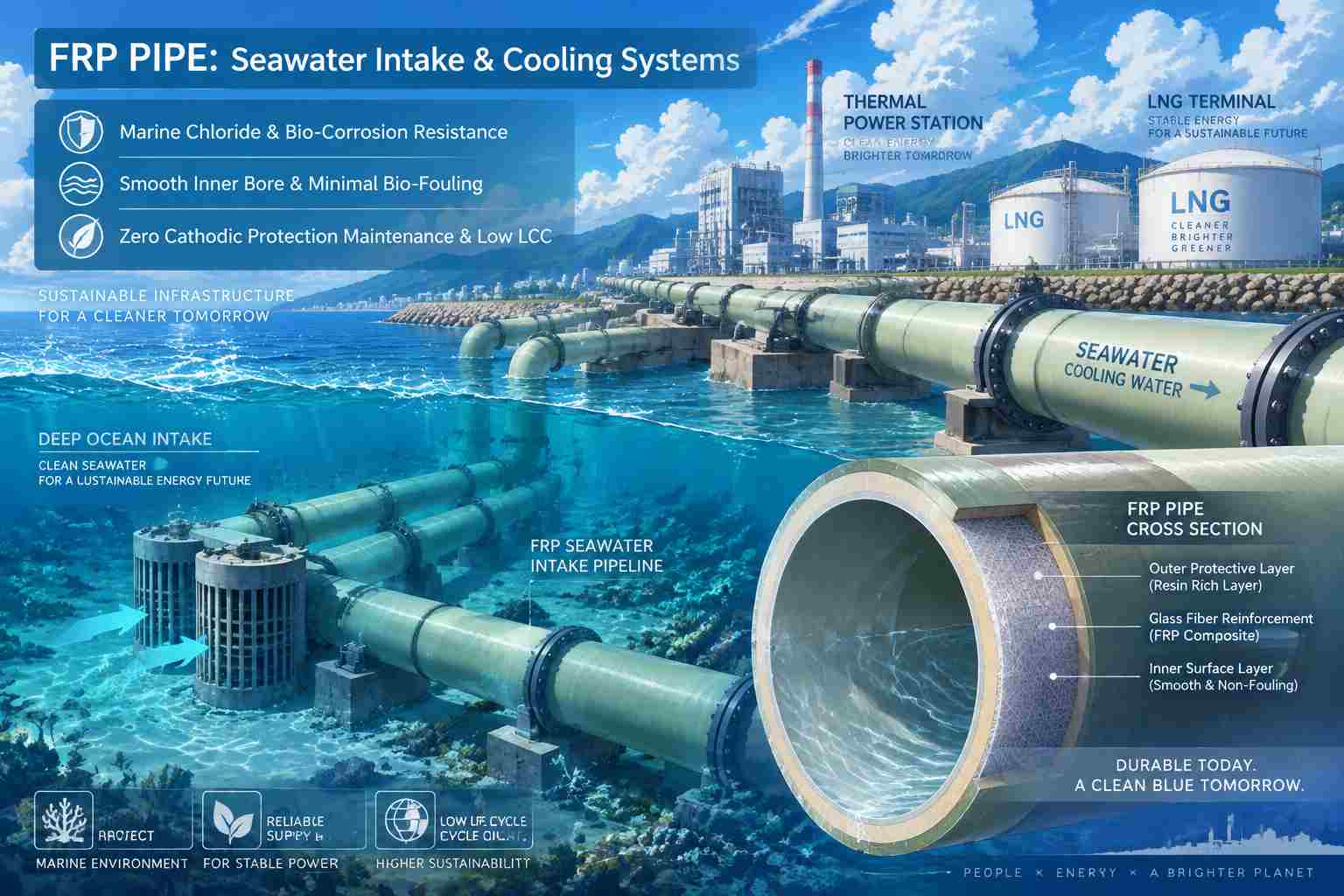
Coastal power stations, LNG terminals, and desalination plants deploy FRP pipe for seawater intake headers, cooling water supply and return lines, and outfall diffusers. These lines are often large diameter and buried or submerged, requiring joints that resist external hydrostatic loads and marine soil conditions. FRP's resistance to chloride attack and marine bio-corrosion addresses the core problem that carbon steel in seawater demands continuous cathodic protection and coating maintenance, while copper-nickel alloys carry high material cost and fouling concerns. The smooth bore also limits marine organism attachment and preserves flow capacity over time. The value delivered is a seawater system that avoids the rapid wall-loss and pitting failures of steel, reduces cathodic protection power and anode replacement costs, and maintains cooling efficiency across the plant's operating life.
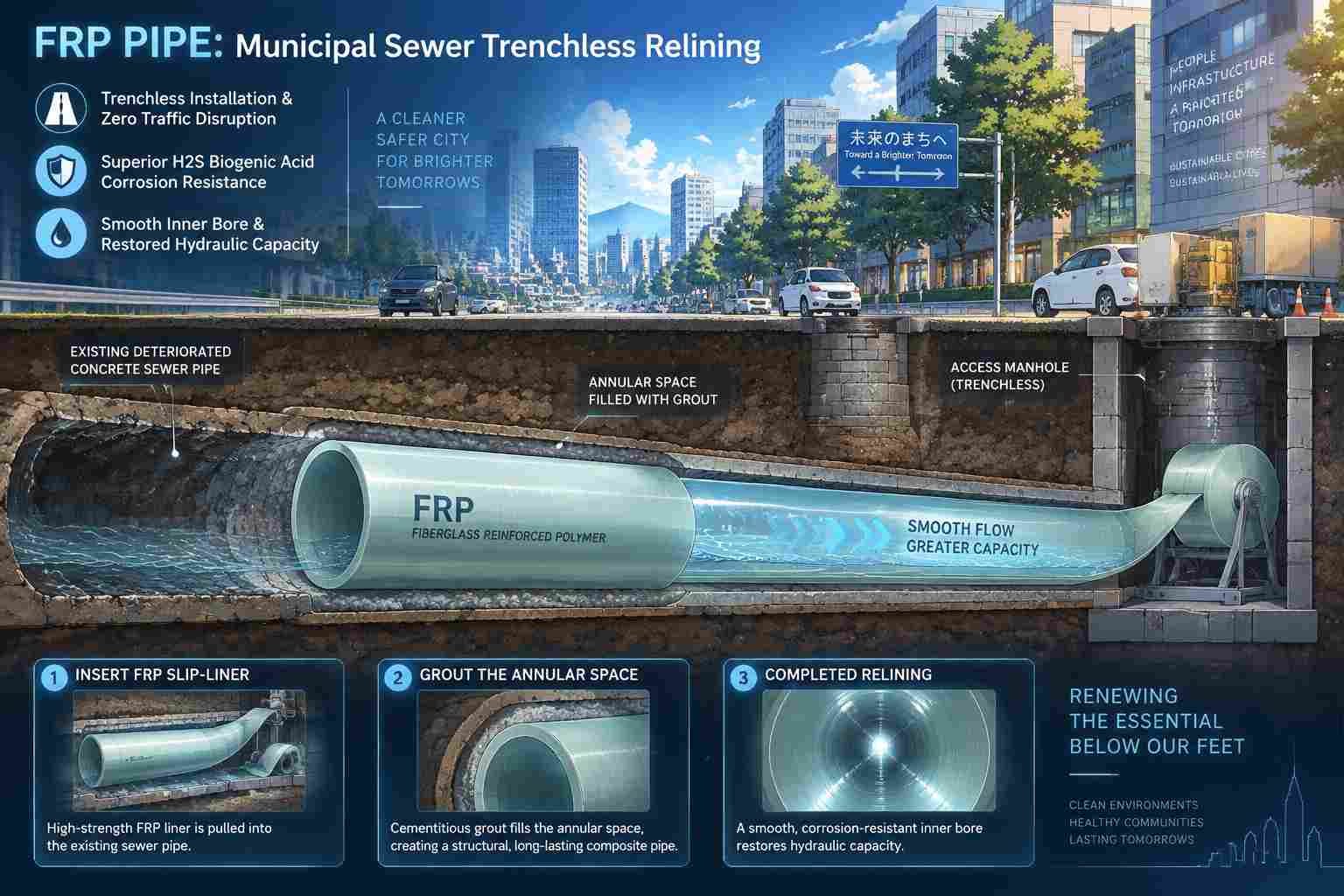
FRP pipe is used in trenchless rehabilitation of aging concrete and cast-iron sewers, where a smaller-diameter FRP liner is pulled or jacked into the existing main and the annular space grouted. The liner restores structural integrity and provides a smooth, corrosion-resistant bore that resists hydrogen sulfide attack—the primary cause of crown corrosion in concrete sewers. The deployment solves the problem of excavating operating city streets, disrupting traffic, and incurring high social and reinstatement costs, while addressing infiltration and exfiltration that overload treatment plants. The practical value is restored hydraulic capacity despite the reduced diameter (thanks to the low friction coefficient), a design life matching new construction, minimized surface disruption, and a rehabilitation cost substantially below full replacement.
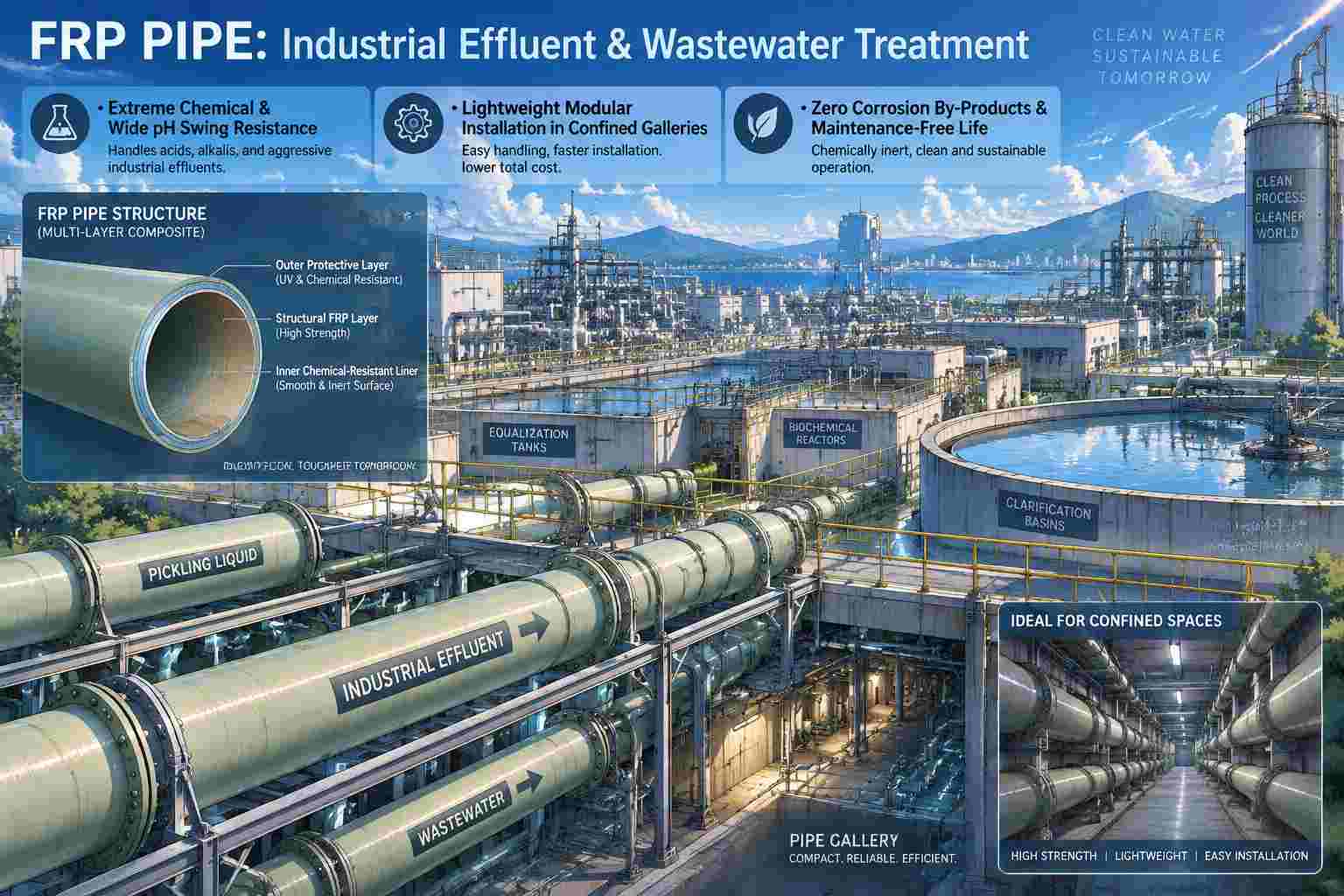
In industrial wastewater treatment, FRP pipe carries aggressive effluent streams—pickling liquors, plating rinse water, paper mill black liquor, and high-sulfide wastewater—between process units, equalization tanks, and treatment stages. These lines are frequently buried or installed in congested pipe galleries, where lightweight FRP sections reduce support requirements and allow installation in confined spaces. The material's resistance to pH swings and oxidizing disinfectants addresses the failure of concrete (sulfate and acid attack) and coated steel (coating breakdown at flanges and welds). The value is reliable conveyance of variable and aggressive waste streams without frequent replacement, lower maintenance intervention in confined and hazardous spaces, and protection of downstream treatment equipment from corrosion product contamination.
Parameter Specifications
|
Product |
FRP pipe |
||||
|
|
|||||
|
Model |
Inner.dia(mm) |
Length(mm) |
Channel Thickness(mm) |
||
|
P=0.6Mpa |
P=1.0Mpa |
P=1.6Mpa |
|||
|
FT-Pp10 |
10 |
1800 |
4.6 |
4.6 |
4.6 |
|
FT-Pp15 |
15 |
||||
|
FT-Pp20 |
20 |
||||
|
FT-Pp25 |
25 |
||||
|
FT-Pp32 |
32 |
||||
|
FT-Pp40 |
40 |
||||
|
FT-Pp50 |
50 |
6000 |
|||
|
FT-Pp65 |
65 |
||||
|
FT-Pp80 |
80 |
||||
|
FT-Pp100 |
100 |
5.9 |
|||
|
FT-Pp125 |
125 |
||||
|
FT-Pp150 |
150 |
5.9 |
|||
|
FT-Pp200 |
200 |
5.9 |
7.2 |
||
|
FT-Pp250 |
250 |
12000 |
8.5 |
||
|
FT-Pp300 |
300 |
7.2 |
9.8 |
||
|
FT-Pp350 |
350 |
8.5 |
11.1 |
||
|
FT-Pp400 |
400 |
12.4 |
|||
|
FT-Pp450 |
450 |
7.2 |
9.8 |
13.7 |
|
|
FT-Pp500 |
500 |
||||
|
FT-Pp600 |
600 |
8.5 |
12.4 |
15.0 |
|
|
FT-Pp700 |
700 |
9.8 |
13.7 |
20.2 |
|
|
FT-Pp800 |
800 |
15.0 |
22.8 |
||
|
FT-Pp900 |
900 |
11.1 |
16.3 |
25.4 |
|
|
FT-Pp1000 |
1000 |
12.4 |
17.3 |
28.0 |
|
|
FT-Pp1200 |
1200 |
13.7 |
|
|
|
|
FT-Pp1400 |
1400 |
16.3 |
|
|
|
|
FT-Pp1500 |
1500 |
|
|
||
|
FT-Pp1600 |
1600 |
17.6 |
|
|
|
|
FT-Pp1800 |
1800 |
18.9 |
|
|
|
|
FT-Pp2100 |
2100 |
22.8 |
|
|
|
|
FT-Pp2400 |
2400 |
25.4 |
|
|
|
|
FT-Pp2600 |
2600 |
26.7 |
|
|
|
|
FT-Pp3000 |
3000 |
30.6 |
|
|
|
|
FT-Pp3300 |
3300 |
33.2 |
|
|
|
|
FT-Pp3600 |
3600 |
35.8 |
|
|
|
|
FT-Pp4000 |
4000 |
39.7 |
|
|
|
Related Products

FRP Flange for Offshore & Chemical Piping | China Exporter Direct
Full-face and raised-face FRP flanges in ANSI 150–300# ratings, drilled to match metal mating flanges. Vinyl ester or epoxy build for brine, acid and seawater lines. Request export pricing.

FRP Pipe for Chemical & Water Transmission | Factory-Direct Exporter
Corrosion-resistant FRP pipe direct from our factory. Suited for chemical processing, seawater intake & sewer rehabilitation. Request export specs & FOB pricing.

China GFRP Pipe Exporter for Geothermal | Factory-Direct Custom Diameters
Professional FRP pipe supplier from China offers high-temp epoxy systems for flue gas desalination & geothermal brines. DN1000-DN4000 jacking pipes available. Full test reports with every export container. Request project-based quote.

FRP Pipe Manufacturer China | Direct Factory Supply for Desalination & Chemical Plants
Source high-strength corrosion-resistant FRP pipes directly from China's experienced exporter. ISO-certified production, OEM diameters 25mm-4000mm, rapid shipping for water treatment & mining projects. Get factory price now.
Contact us immediately to discuss your product project requirements
Navigation
Navigation
Contact Us
Tel.: +86 189 3266 2725
E-mail: sale@hbfortis.com
Add.: No.8-1, Zhenxing Street, Matun Town, Zaoqiang County, Hengshui City, Hebei Province
Get in Touch
Get in Touch