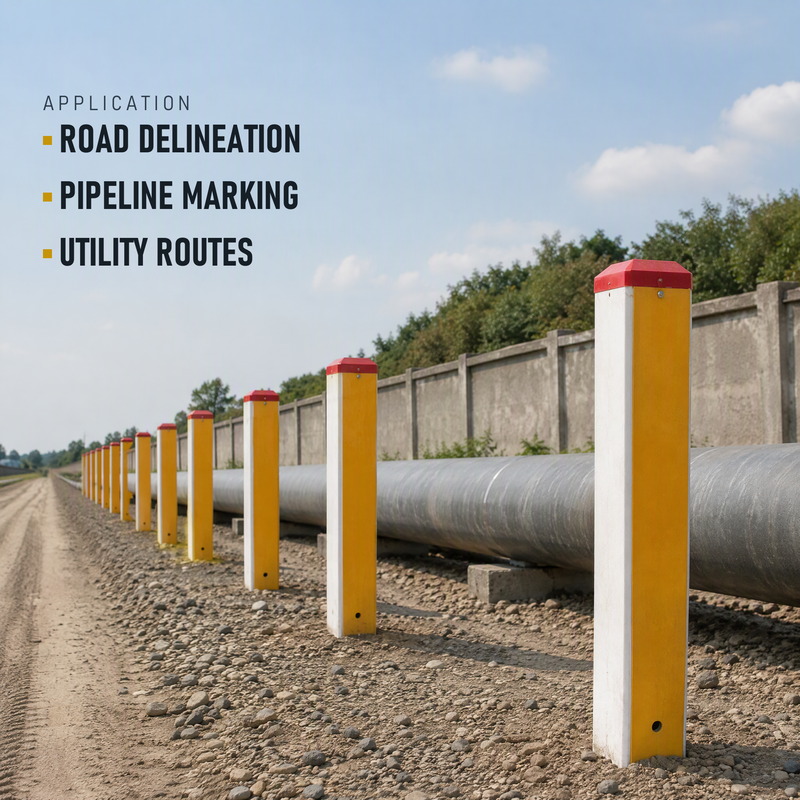
As a direct manufacturer, exporter, and supplier of pultruded FRP marker posts, we produce non-conductive, corrosion-resistant fiberglass-reinforced polymer stakes engineered for underground utility identification, gas and water pipeline routing, telecom cable demarcation, fiber optic right-of-way marking, and boundary or hazard warning in industrial and municipal projects. Our posts are manufactured through continuous pultrusion with UV-stabilized resin systems, offering high tensile strength, dielectric safety, and resistance to rust, rot, and chemical exposure, which eliminates the recurring repainting and replacement costs associated with steel or concrete markers. We support full customization of diameter, wall thickness, length, color, and reflective or UV-resistant decal printing, and can embed project-specific legends, barcodes, or RFID-ready labels for asset management. For export buyers, we provide bulk container loading, protective bundling, and documentation support including material test reports, MSDS, and compliance certificates for destination-market standards, with flexible OEM and private-label options. Whether you are a utility contractor, infrastructure distributor, or procurement agent sourcing for pipeline, telecom, or power grid projects, our factory-direct model shortens the supply chain, keeps lead times predictable, and ensures each FRP marker post meets the specified mechanical and environmental requirements from production line to job site.

Hebei Fortis Technology Co., Ltd Product Brochure
Product Advantages
FRP marker posts resist rust, rot, and chemical degradation in ways that steel and concrete simply cannot match. Steel posts begin corroding within years of installation, requiring periodic rust removal and repainting, while concrete posts crack and spall under freeze-thaw cycles and acidic soil conditions. Pultruded fiberglass posts remain structurally intact and visually legible for 20 years or more with zero maintenance intervention, even when exposed to salt spray, industrial chemicals, or harsh UV radiation. For utility operators managing thousands of markers across a network, this translates directly into eliminated repainting budgets, reduced field crew deployments, and predictable long-term asset performance.
Unlike metal marker posts that conduct electricity and create electrocution hazards near power lines or substations, FRP posts are inherently dielectric. Fiberglass reinforced polymer provides high insulation resistance and maintains stable dielectric properties even under high-frequency conditions, making it the safer choice for marking electrical cable routes, gas pipelines, and telecommunications infrastructure. This non-conductive characteristic is not a secondary benefit—it is a fundamental safety requirement in utility corridors where ground disturbance or equipment contact could otherwise energize a marker and endanger field personnel.
A pultruded FRP marker post weighs approximately one-quarter as much as an equivalent concrete post and significantly less than steel alternatives. This weight advantage cascades through the entire supply chain: lower freight costs per container, reduced handling equipment requirements at the job site, and installation by a single worker using hand tools rather than specialized lifting machinery. For export buyers shipping bulk orders, the freight savings alone can offset a meaningful portion of the material cost difference, while contractors benefit from faster deployment and lower labor hours per unit installed.
Application Scenarios
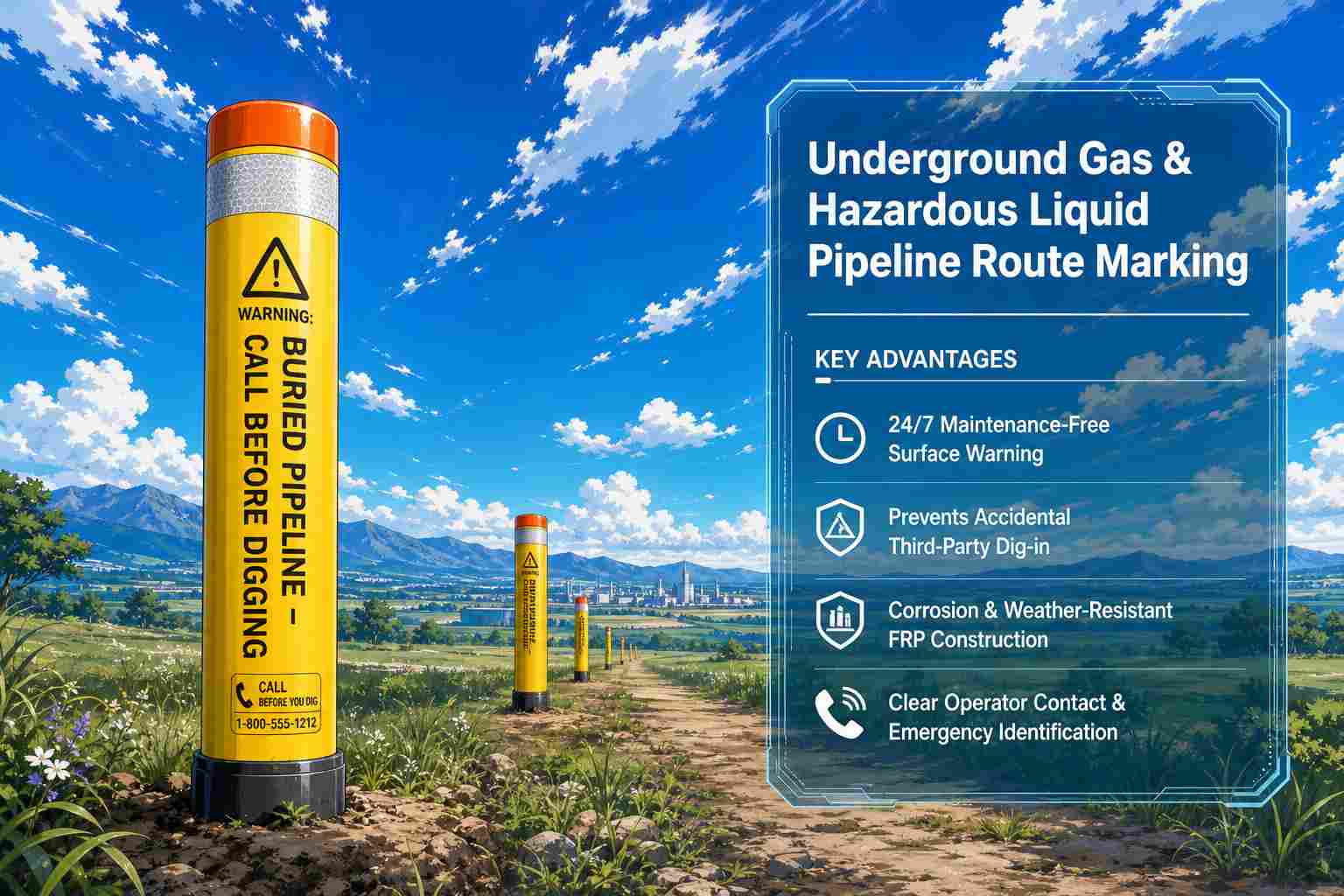
FRP marker posts are deployed along the right-of-way of high-pressure gas transmission and hazardous liquid pipelines, installed at intervals and at turning points to visually identify the buried asset’s path. Each post carries printed information including pipeline operator name, emergency contact number, product transported, and nominal pipe size, enabling third-party excavators and the public to recognize the presence of a buried hazard before ground disturbance begins. The core problem solved is accidental dig-in: without visible surface indication, excavation crews have no way to know a pipeline lies below, and a single strike can cause rupture, fire, or environmental release. The practical value is measured in avoided emergency response costs and regulatory penalties: a post that prompts a call to the 811 one-call system before digging prevents the incident entirely, and the operator gains a continuous, low-cost physical layer of public awareness that functions 24 hours a day without power or maintenance.
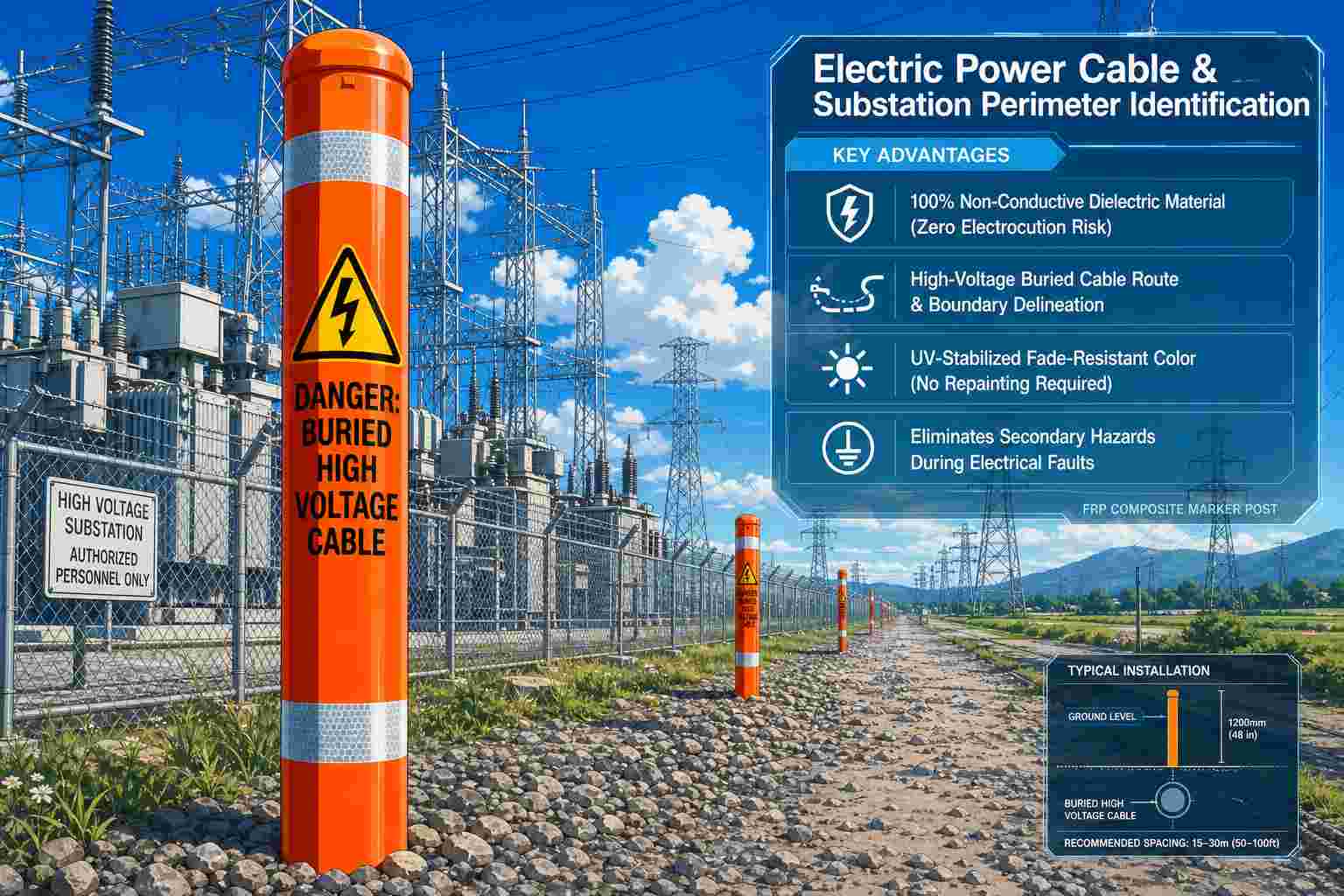
In power distribution and transmission corridors, FRP marker posts identify the route of buried electrical cables and delineate substation boundaries where ground disturbance must be prohibited. The critical performance requirement here is dielectric integrity: FRP is inherently non-conductive, meaning the post itself will not create a conductive path if it contacts an energized conductor or if fault current travels through adjacent soil. This solves a safety failure mode unique to metal markers, which can become energized and present an electrocution hazard to field crews or the public. The practical value extends beyond marking: utility companies using FRP posts in substation and cable-trench applications eliminate the risk that the marker itself becomes a secondary hazard during fault conditions or emergency response, while the posts’ UV-stabilized color coding remains legible for the asset’s service life without repainting.
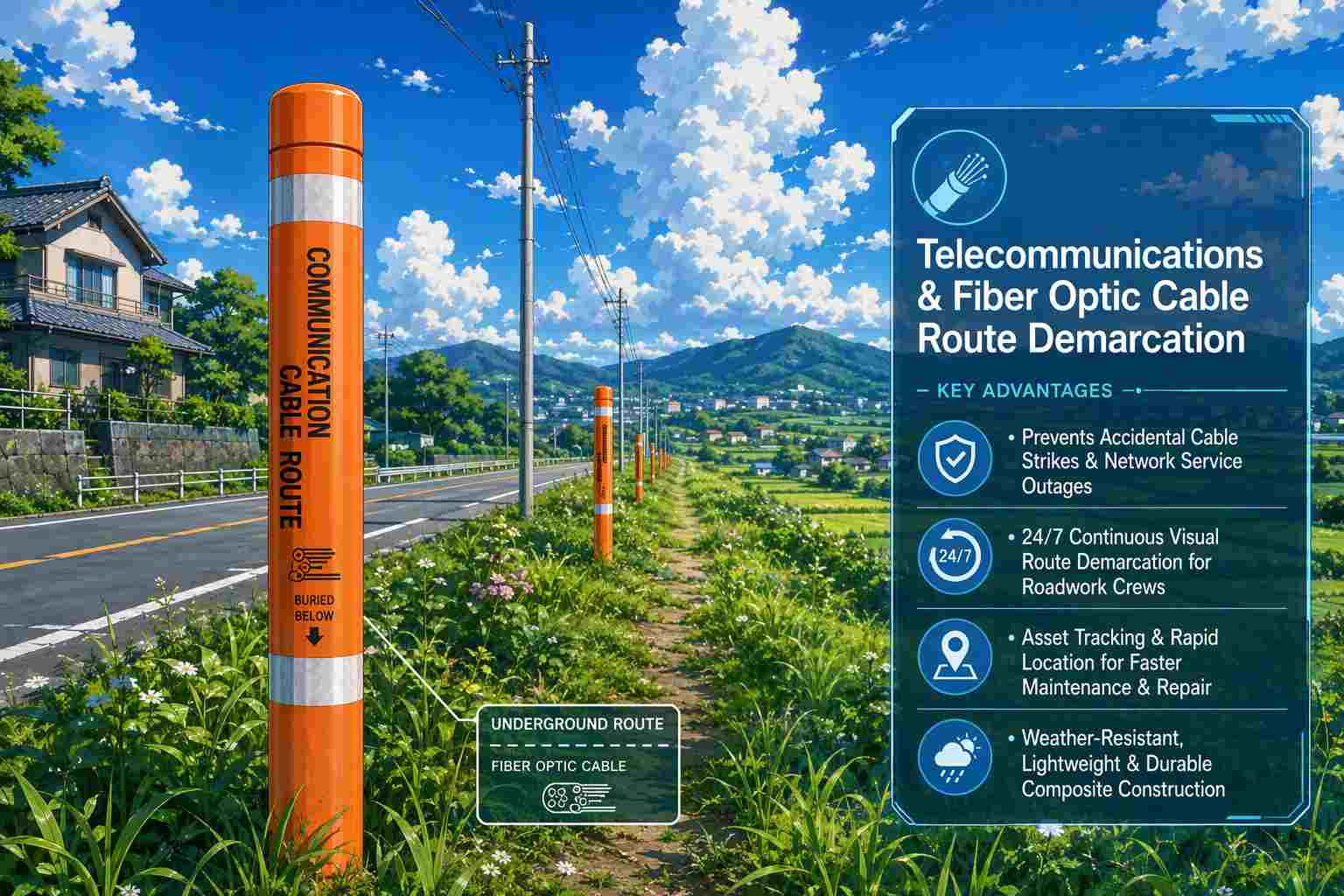
Telecom carriers and fiber network operators deploy FRP marker posts to mark underground duct banks, fiber optic cable routes, and splice points in both urban and rural rights-of-way. The posts are driven directly into soil along the cable path, with printed legends identifying the network operator and cable type, so that contractors performing road work, landscaping, or utility installation can see the corridor before excavation. The problem addressed is the invisibility of buried telecom infrastructure: fiber cables carry high-value data traffic and are easily severed by backhoes, causing service outages affecting thousands of subscribers. The practical value is twofold: the post reduces outage frequency by prompting pre-dig notification, and when combined with custom printing of the carrier’s asset ID or QR code, it supports faster fault localization during restoration, shortening mean time to repair.
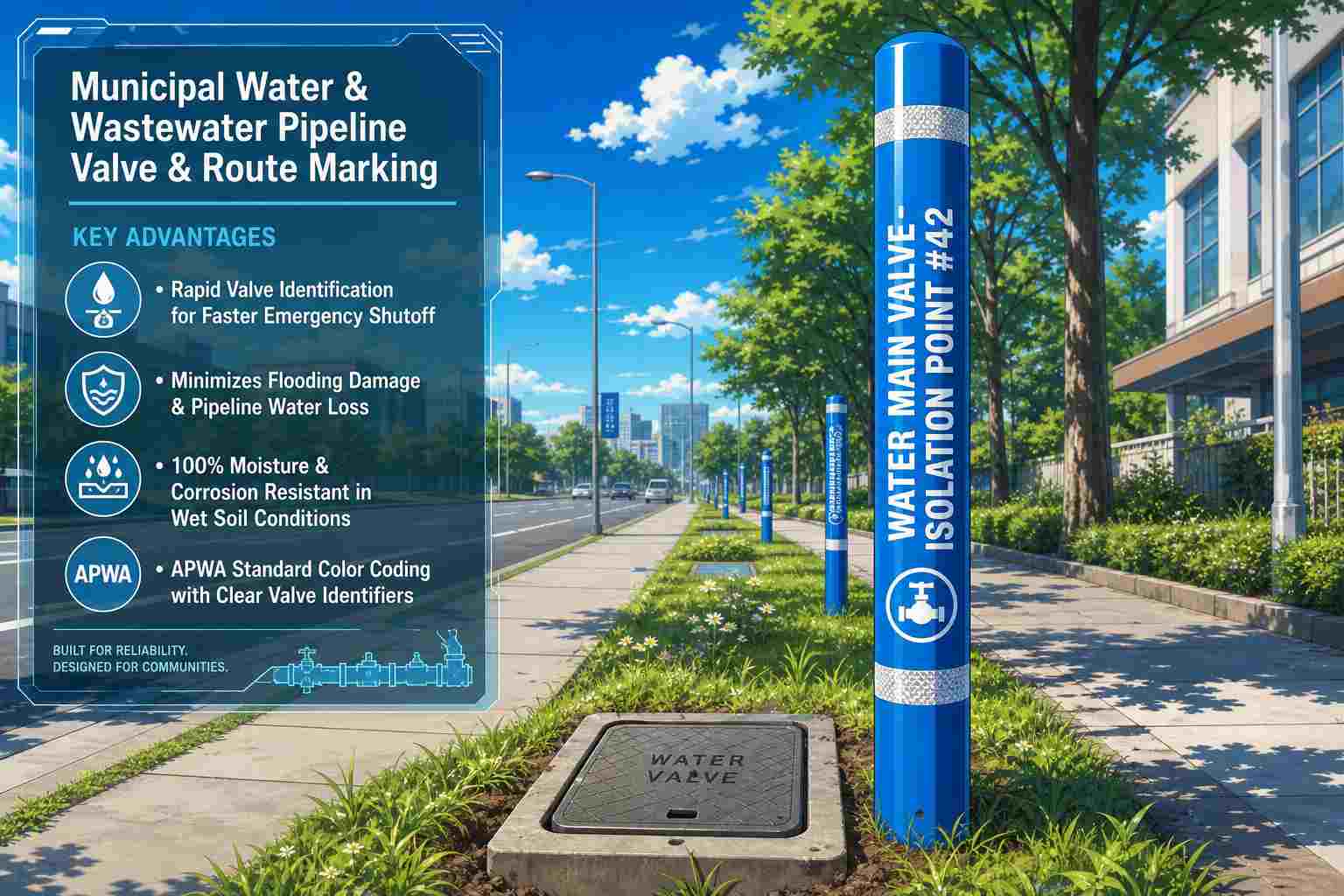
Water utilities install FRP marker posts to identify buried potable water mains, wastewater force mains, and valve boxes, particularly in areas where surface features alone cannot guide maintenance crews to critical isolation points. The posts are color-coded according to the utility’s standard (commonly blue for potable water) and can be printed with valve numbers or hydrant identifiers, allowing field crews to locate shutoff points quickly during main breaks or planned maintenance. The problem solved is response time: in a water main failure, every minute spent searching for the correct valve prolongs property damage and service disruption. The practical value is operational efficiency and reduced water loss—a marked valve box that can be found and operated immediately limits the affected area, and the FRP material’s corrosion resistance ensures the post remains readable in wet soil conditions where steel posts would rust and concrete posts would spall.
Parameter Specifications
|
Product |
FRP marker post |
|||
|
Style |
Square |
Rectangular |
Round |
Triangle |
|
|
|
|
|
|
|
Prompt icon |
Design and customization according to requirements |
|||
|
marked words |
Design and customization according to requirements |
|||
Related Products

FRP Marker Post for Municipal, Electric & Gas | China Exporter
Factory-direct FRP marker posts from China for municipal water, electric cable & natural gas pipeline identification. Non-conductive, maintenance-free, 30-year lifespan. Request export quote.

Fiberglass GFRP FRP Marker post China Supplier for Utility Line Marking | Underground Cable Signs
ourcing FRP marker posts from China? UV-stable square & round poles for gas/water/sewer lines. Bold lettering stays legible 10+ yrs. ASTM D635 self-extinguishing. OEM logo available.

Fiberglass GFRP FRP Marker post for Underground Pipeline and Utility Location
FRP Marker Posts: Precise Identification and Long-lasting Guidance in Modern Engineering

Fiberglass GFRP FRP Marker post for warning Sign pipe FT-MP4
FRP Marker Posts: Precise Identification and Long-lasting Guidance in Modern Engineering
Contact us immediately to discuss your product project requirements
Navigation
Navigation
Contact Us
Tel.: +86 189 3266 2725
E-mail: sale@hbfortis.com
Add.: No.8-1, Zhenxing Street, Matun Town, Zaoqiang County, Hengshui City, Hebei Province
Get in Touch
Get in Touch