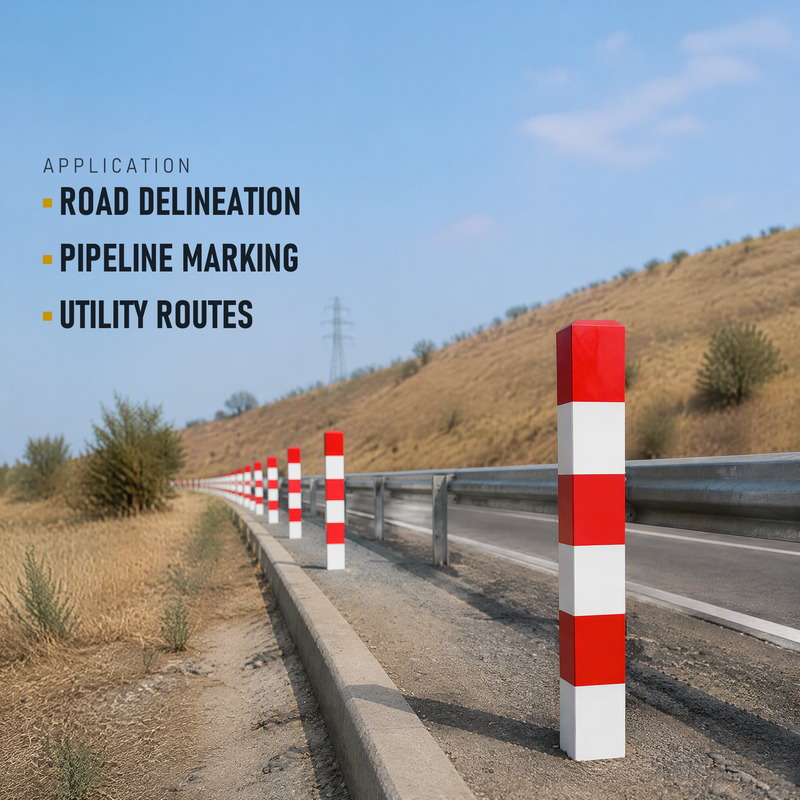
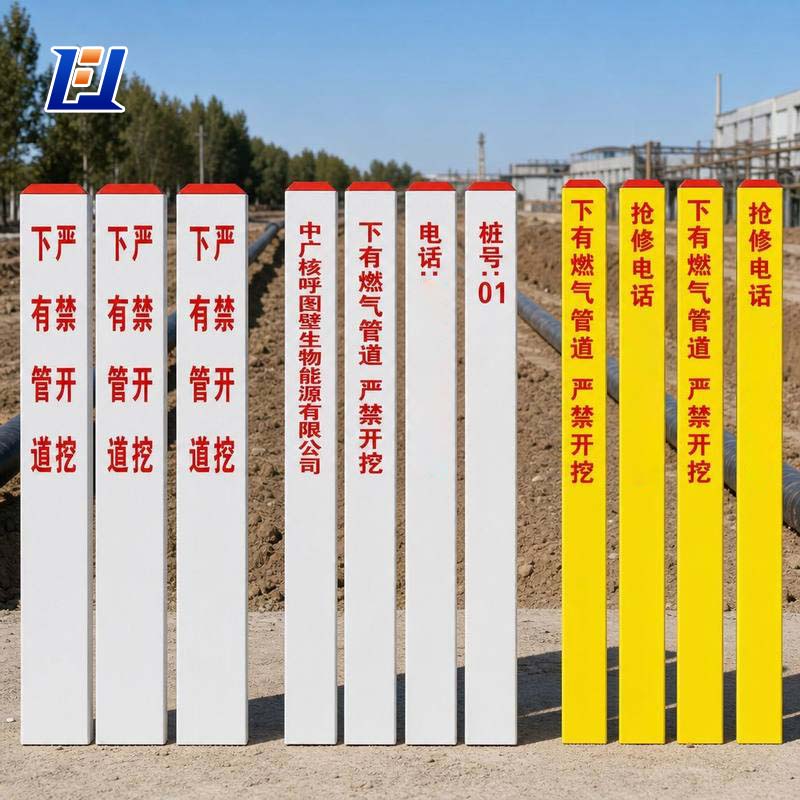
Municipal utility crews and gas pipeline operators face a recurring problem: concrete marker posts crack within a few freeze-thaw cycles, painted legends fade in under two years, and replacement crews must revisit the same sites repeatedly. Our pultruded FRP posts solve this at the material level—the resin matrix and continuous glass reinforcement produce a post that is electrically non-conductive for electric cable routes, chemically inert in sour gas and brackish water environments, and dimensionally stable from -40°C to 80°C. As a China-based factory exporter, we run the pultrusion line, the cut-to-length station, and the UV-cured legend printing under one roof. That means your municipal water department or gas transmission client gets a consistent 72-inch post with your color code and warning text, shipped directly from our production floor rather than through a trading layer.

Hebei Fortis Technology Co., Ltd Product Brochure
Product Advantages
The absence of metal content in FRP marker posts eliminates the primary incentive for theft. Steel and aluminum markers are routinely stolen for scrap value, leaving utility routes unmarked and creating safety liabilities that require replacement and reinstallation. Fiberglass composite has no resale value in the scrap market, making FRP posts unattractive to thieves by design. This passive security feature protects infrastructure continuity without requiring tamper-proof fasteners, locked enclosures, or surveillance—solutions that add cost and complexity to marker deployment.
FRP marker posts maintain their physical dimensions and surface legibility across temperature ranges from -50°C to 80°C, resisting the warping, cracking, and color fade that degrade alternative materials. The low coefficient of thermal expansion of pultruded fiberglass—roughly one-tenth that of metal—ensures that posts driven into the ground remain straight and plumb through seasonal temperature swings, preserving the visibility and professionalism of route marking over decades of service. UV-stabilized resin systems and anti-fading formulations keep color-coded markings distinguishable for regulatory compliance and field identification throughout the post‘s service life.
Beyond passive marking, FRP posts can be manufactured with embedded RFID tags, QR codes, or laser-etched serial numbers that link physical infrastructure to digital asset management systems. Field crews can scan a post to retrieve installation date, maintenance history, utility type, and depth-of-cover data without manually reading and transcribing text. This smart-marking capability transforms a simple identification post into a data node within a utility’s GIS or asset management platform, enabling proactive maintenance scheduling and faster emergency response when excavation near marked infrastructure is reported.
Application Scenarios
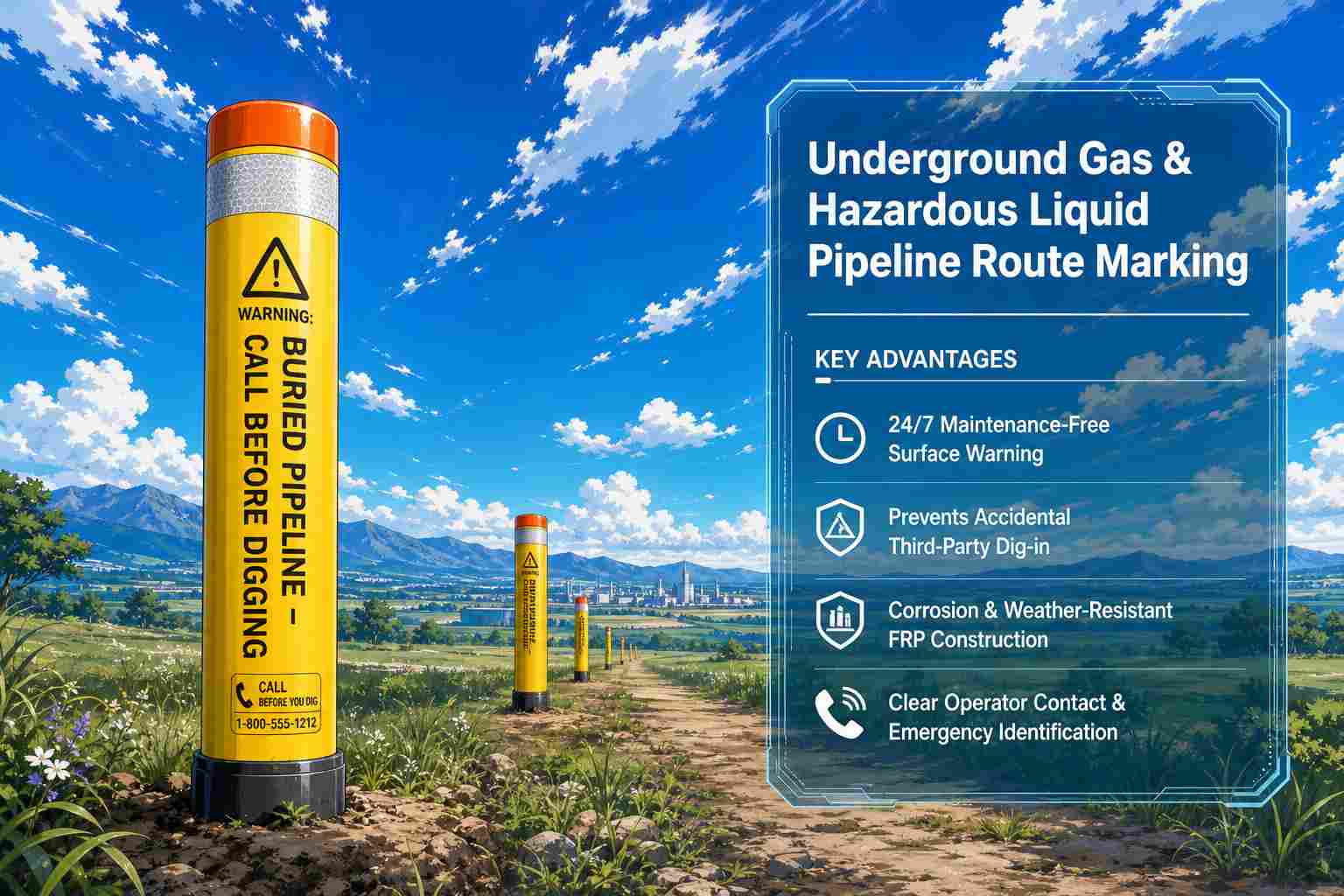
FRP marker posts are deployed along the right-of-way of high-pressure gas transmission and hazardous liquid pipelines, installed at intervals and at turning points to visually identify the buried asset’s path. Each post carries printed information including pipeline operator name, emergency contact number, product transported, and nominal pipe size, enabling third-party excavators and the public to recognize the presence of a buried hazard before ground disturbance begins. The core problem solved is accidental dig-in: without visible surface indication, excavation crews have no way to know a pipeline lies below, and a single strike can cause rupture, fire, or environmental release. The practical value is measured in avoided emergency response costs and regulatory penalties: a post that prompts a call to the 811 one-call system before digging prevents the incident entirely, and the operator gains a continuous, low-cost physical layer of public awareness that functions 24 hours a day without power or maintenance.
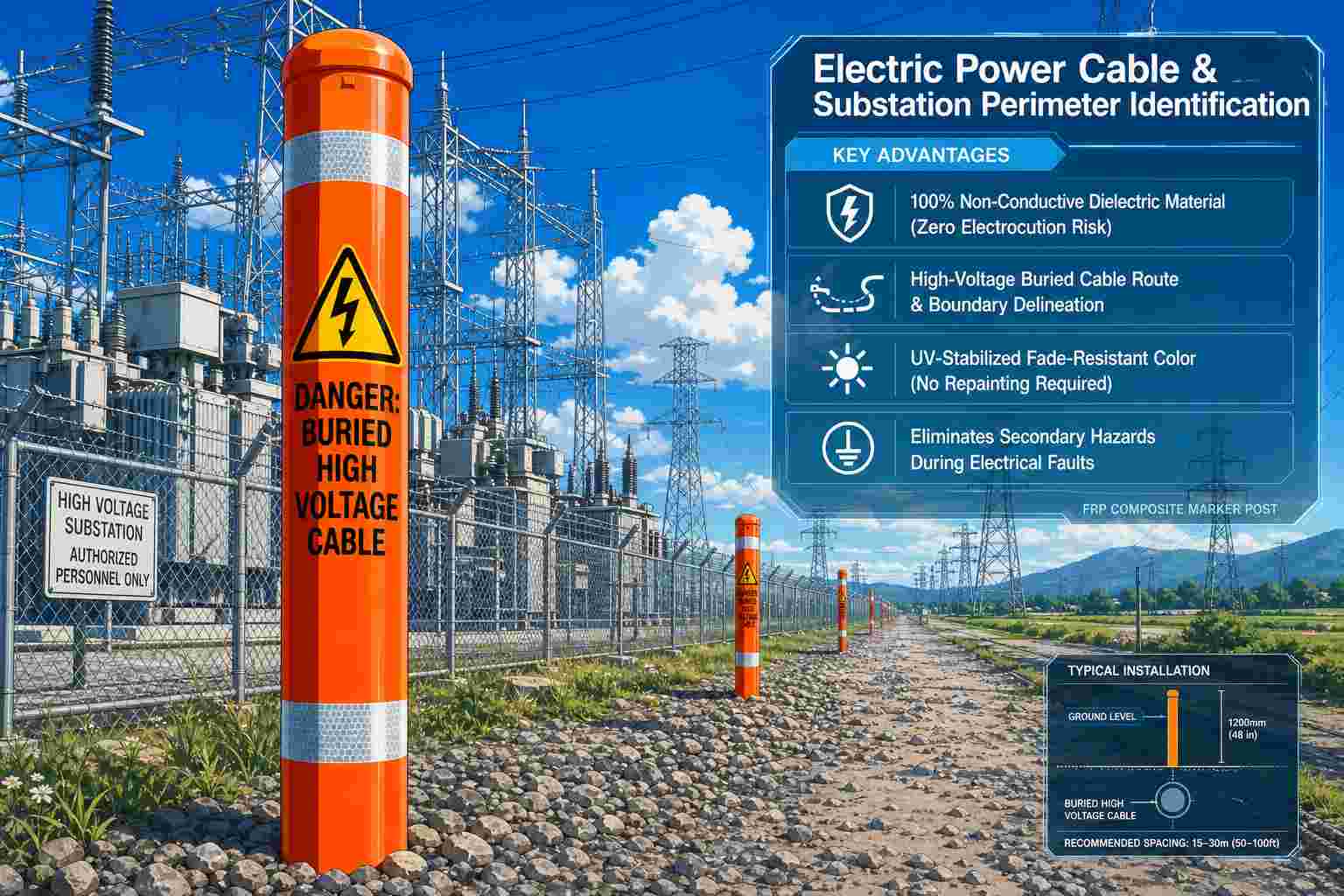
In power distribution and transmission corridors, FRP marker posts identify the route of buried electrical cables and delineate substation boundaries where ground disturbance must be prohibited. The critical performance requirement here is dielectric integrity: FRP is inherently non-conductive, meaning the post itself will not create a conductive path if it contacts an energized conductor or if fault current travels through adjacent soil. This solves a safety failure mode unique to metal markers, which can become energized and present an electrocution hazard to field crews or the public. The practical value extends beyond marking: utility companies using FRP posts in substation and cable-trench applications eliminate the risk that the marker itself becomes a secondary hazard during fault conditions or emergency response, while the posts’ UV-stabilized color coding remains legible for the asset’s service life without repainting.
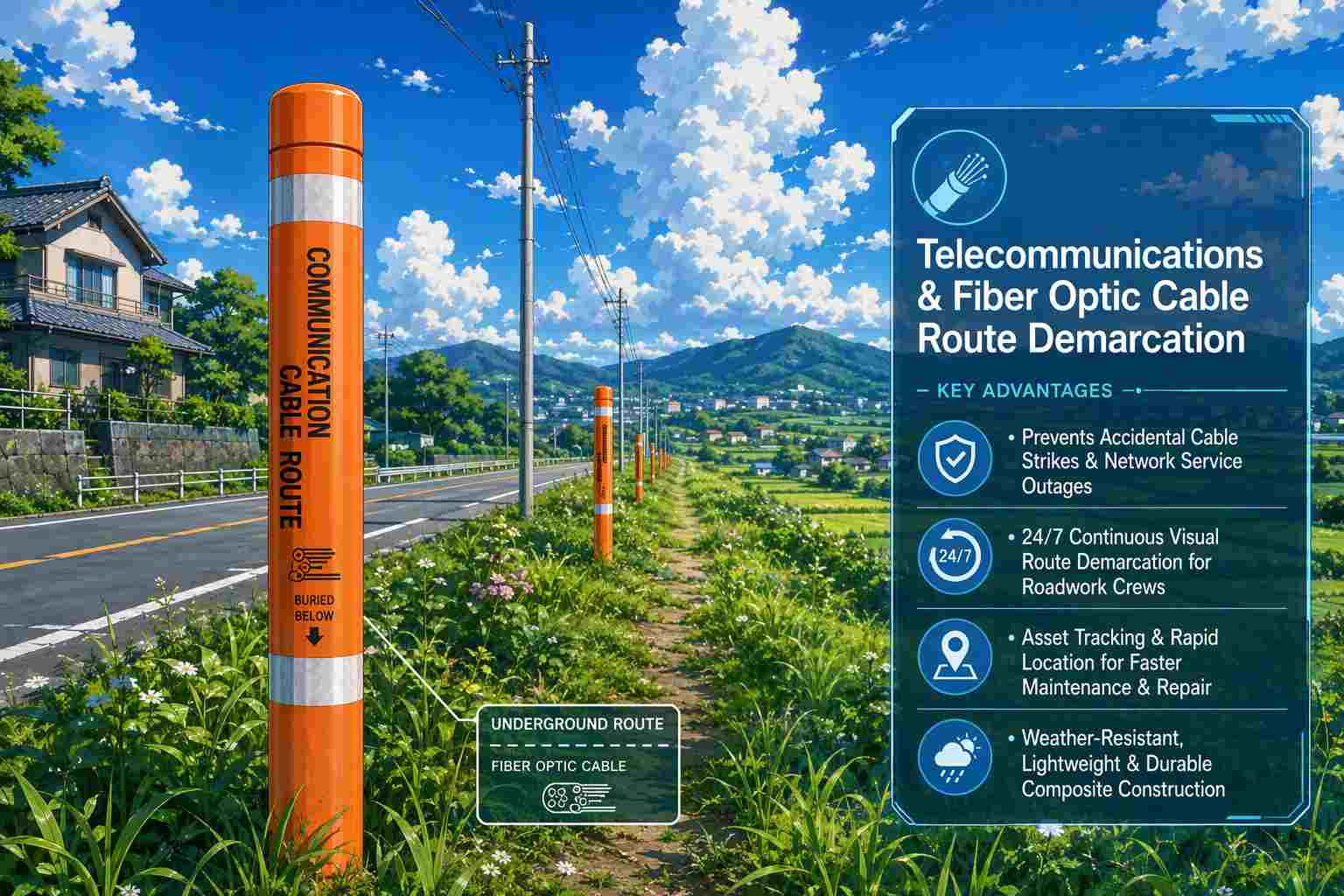
Telecom carriers and fiber network operators deploy FRP marker posts to mark underground duct banks, fiber optic cable routes, and splice points in both urban and rural rights-of-way. The posts are driven directly into soil along the cable path, with printed legends identifying the network operator and cable type, so that contractors performing road work, landscaping, or utility installation can see the corridor before excavation. The problem addressed is the invisibility of buried telecom infrastructure: fiber cables carry high-value data traffic and are easily severed by backhoes, causing service outages affecting thousands of subscribers. The practical value is twofold: the post reduces outage frequency by prompting pre-dig notification, and when combined with custom printing of the carrier’s asset ID or QR code, it supports faster fault localization during restoration, shortening mean time to repair.
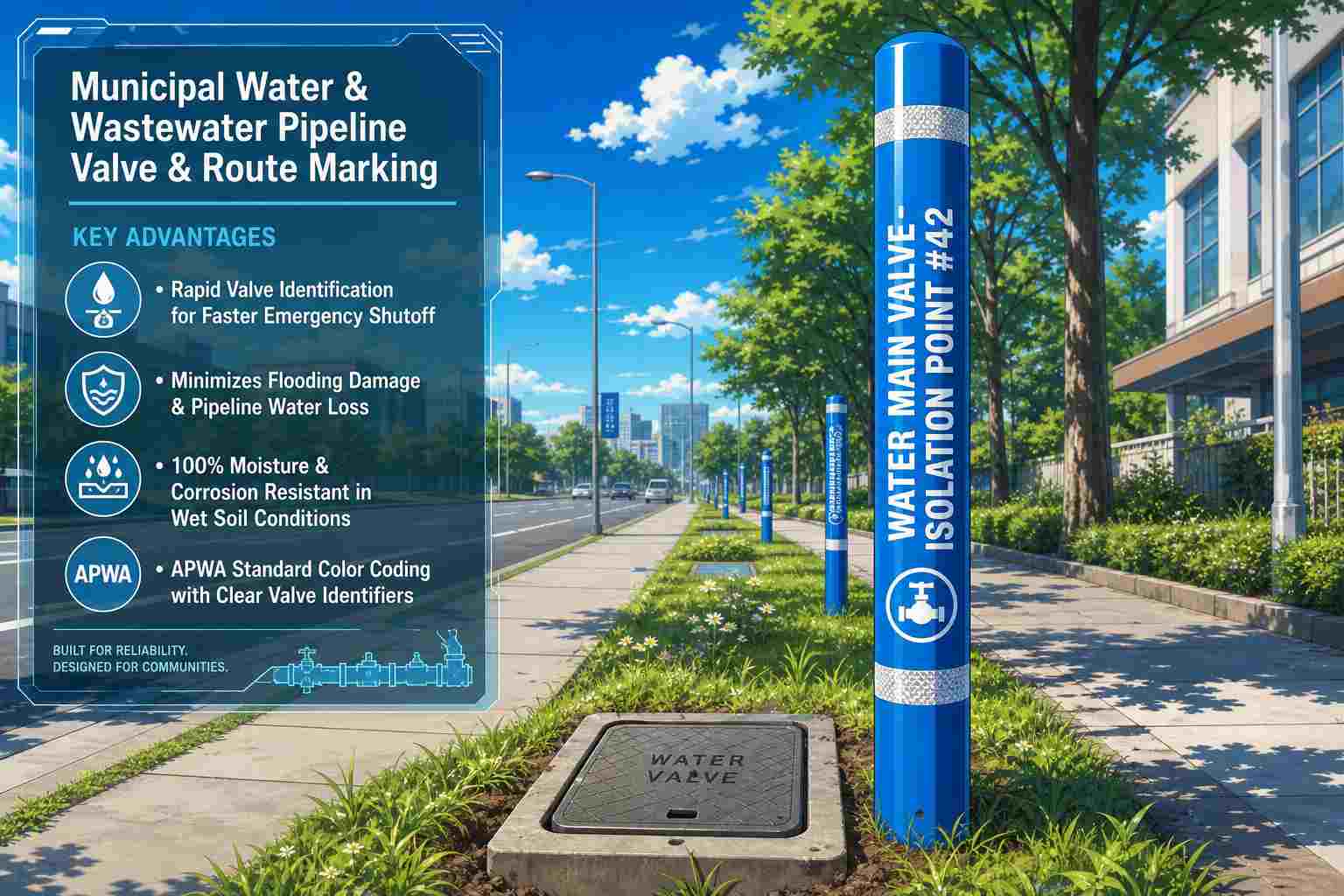
Water utilities install FRP marker posts to identify buried potable water mains, wastewater force mains, and valve boxes, particularly in areas where surface features alone cannot guide maintenance crews to critical isolation points. The posts are color-coded according to the utility’s standard (commonly blue for potable water) and can be printed with valve numbers or hydrant identifiers, allowing field crews to locate shutoff points quickly during main breaks or planned maintenance. The problem solved is response time: in a water main failure, every minute spent searching for the correct valve prolongs property damage and service disruption. The practical value is operational efficiency and reduced water loss—a marked valve box that can be found and operated immediately limits the affected area, and the FRP material’s corrosion resistance ensures the post remains readable in wet soil conditions where steel posts would rust and concrete posts would spall.
Parameter Specifications
|
Product |
FRP marker post |
|||
|
Style |
Square |
Rectangular |
Round |
Triangle |
|
|
|
|
|
|
|
Prompt icon |
Design and customization according to requirements |
|||
|
marked words |
Design and customization according to requirements |
|||
Related Products

FRP Marker Post for Utility & Pipeline Marking | Factory Exporter
Direct factory supplier of FRP marker posts for underground utility, gas, and water pipeline identification. Rust-proof, lightweight, and impact-resistant. Request a bulk quote today.

Fiberglass GFRP FRP Marker post China Supplier for Utility Line Marking | Underground Cable Signs
ourcing FRP marker posts from China? UV-stable square & round poles for gas/water/sewer lines. Bold lettering stays legible 10+ yrs. ASTM D635 self-extinguishing. OEM logo available.

Fiberglass GFRP FRP Marker post for Underground Pipeline and Utility Location
FRP Marker Posts: Precise Identification and Long-lasting Guidance in Modern Engineering

Fiberglass GFRP FRP Marker post for warning Sign pipe FT-MP4
FRP Marker Posts: Precise Identification and Long-lasting Guidance in Modern Engineering
Contact us immediately to discuss your product project requirements
Navigation
Navigation
Contact Us
Tel.: +86 189 3266 2725
E-mail: sale@hbfortis.com
Add.: No.8-1, Zhenxing Street, Matun Town, Zaoqiang County, Hengshui City, Hebei Province
Get in Touch
Get in Touch