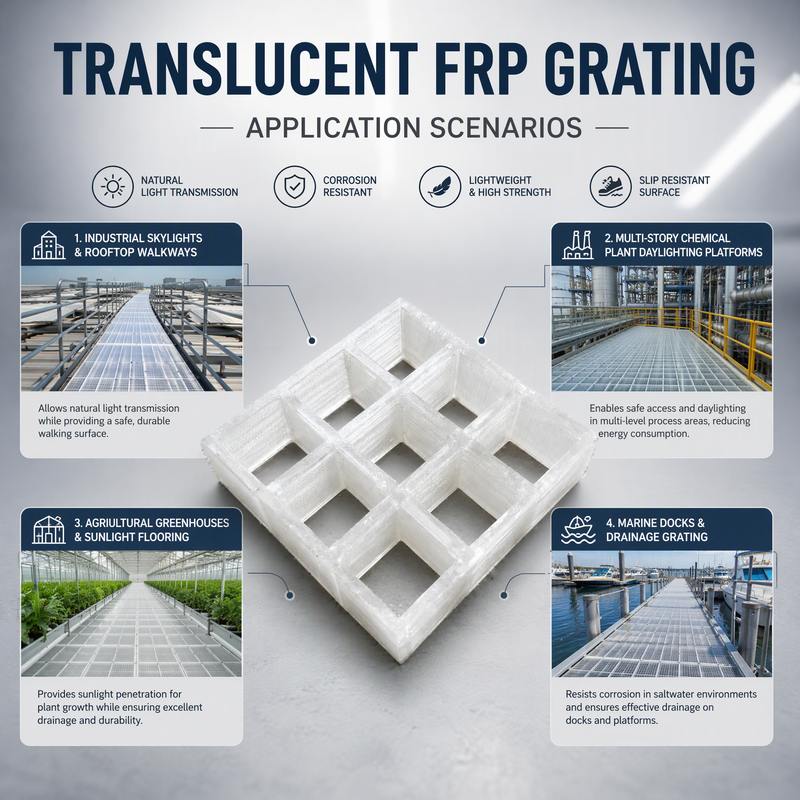
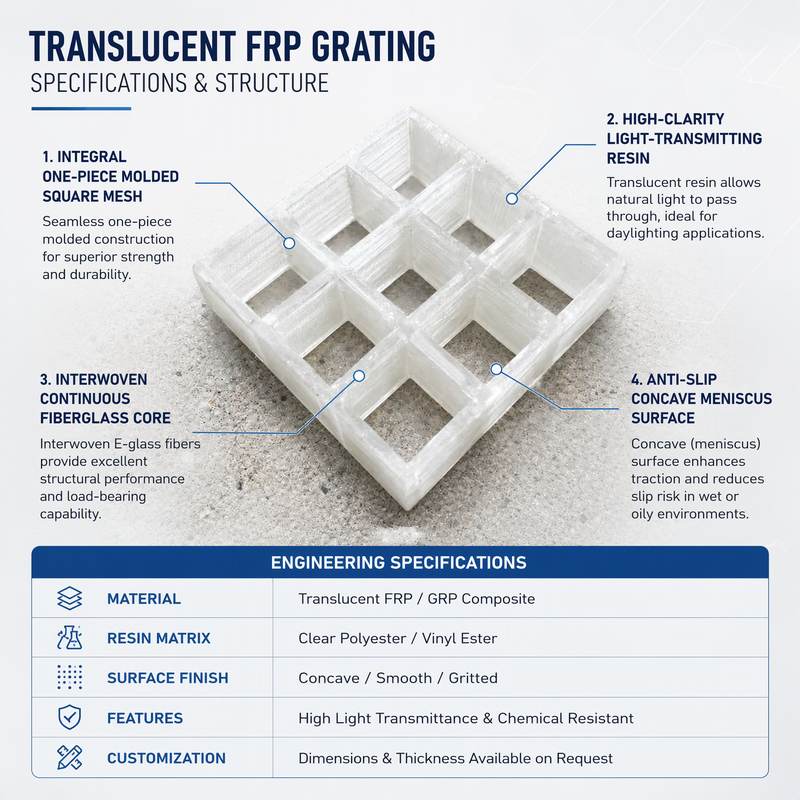
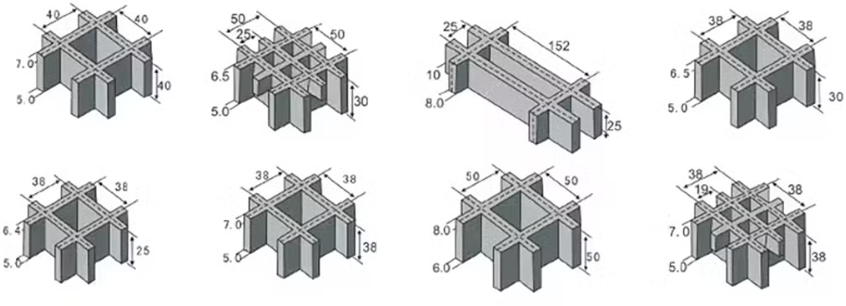
Most FRP grille failures we see in the field are not material failures—they are selection failures, and they usually trace back to a quote that was built from a panel size instead of a service condition. A pultruded panel is the right call for a 1.2-meter unsupported span on a tank platform, but if the buyer cuts a service opening in that same panel without adding edge framing, the bearing bars lose their load path and the deflection shows up within months. A molded panel, by contrast, carries load in both directions and holds its integrity after cutouts, which is why we ask for the span, the cutout layout, the chemical exposure, and the traffic type before we quote—because the resin system has to match the actual environment, not just the panel dimensions. Ortho resin is fine for a dry walkway, but a caustic wash-down area or an acid fume zone calls for isophthalic or vinylester, and a fire-rated platform needs a resin package that actually holds its ASTM E84 Class 1 rating after the grit surface is applied, not just on the raw panel. We also press a closed-mold grit surface into the walking face rather than gluing sand on after cure, because glued grit sheds at the edges where panels are cut and becomes a slip hazard exactly where operators step. Every order leaves our floor with a resin batch record, a bar-profile drawing, and a loading plan that nests panels back-to-back so the grit face is never crushed against another panel in the container. That is the difference between buying a sheet of grating and buying a platform that passes its first inspection and its fifth.

Hebei Fortis Technology Co., Ltd Product Brochure
Product Advantages
Fiberglass grating is electrically non-conductive, which makes it suitable for electrical substations, telecom facilities, and battery rooms where metallic grating would introduce conductivity risks. It is also non-magnetic, so it performs well in sensitive environments such as MRI rooms and electronic manufacturing areas without interfering with equipment.
FRP grille can be produced with fire-retardant resin systems meeting standards such as ASTM E84 Class 1 or equivalent, giving specifiers a documented flame-spread rating for industrial and commercial applications. This allows the product to satisfy fire-safety requirements in platforms, escape routes, and process areas without falling back to steel alternatives.
Molded and pultruded constructions cover a wide range of load and span requirements, and panels can be cut, edged, and fitted with clips or hold-down fasteners to match specific drawings. Custom sizes, mesh patterns, colors, and resin types—including vinyl ester for severe chemical service—are available at the factory level, so buyers get a product matched to the application rather than a compromise from a standard catalog.
FRP grille holds its shape through temperature variation better than many thermoplastic alternatives, maintaining panel fit and joint alignment in outdoor and process environments. This stability supports consistent performance on walkways and platforms where expansion and contraction could otherwise loosen connections or create trip hazards over time.
Application Scenarios
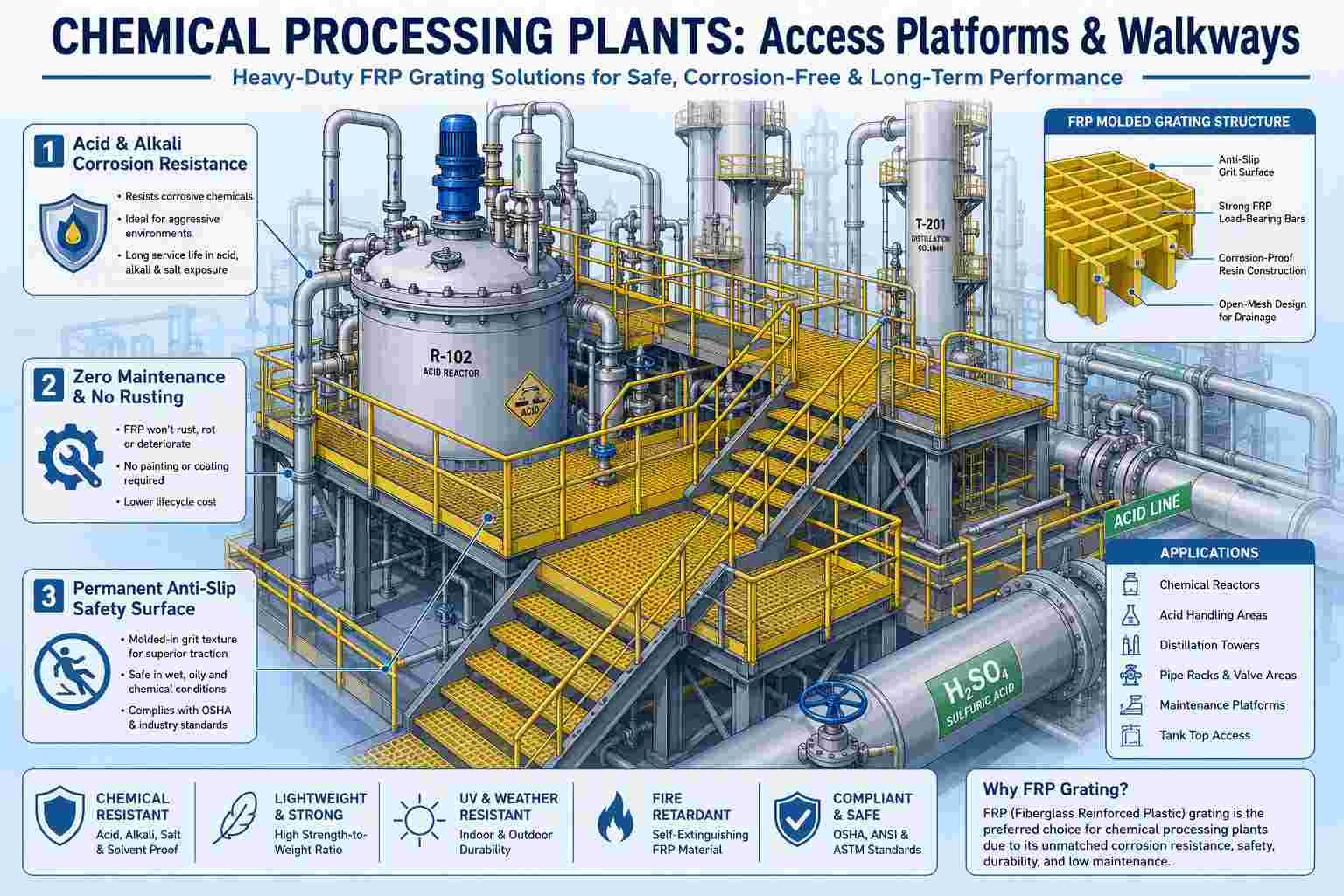
FRP grille is deployed as elevated access platforms, equipment maintenance walkways, and stair treads throughout chemical processing facilities where acids, alkalis, and solvents are routinely handled. The grille’s vinyl ester or ISO-polyester resin systems resist chemical attack that would cause galvanized steel to rust and require repainting within two to three years. The core problem this solves is the recurring maintenance burden and safety hazard of corroded steel walkways in splash zones and fume-exposed areas. The practical value is a walkway surface that remains structurally sound and slip-resistant for decades without sandblasting, scraping, or recoating—reducing maintenance downtime and eliminating the risk of platform failure due to hidden corrosion beneath paint.
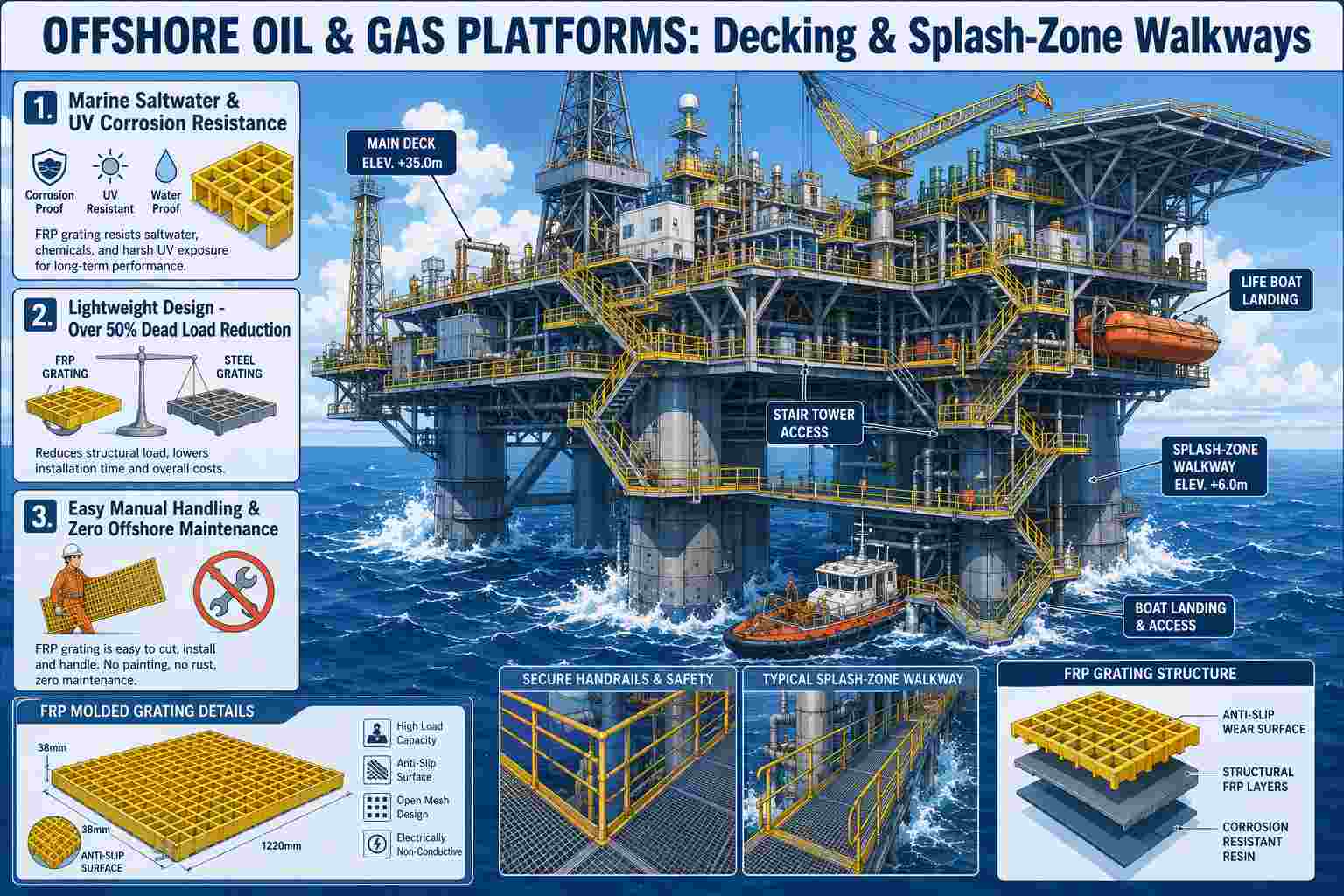
FRP grille is used on offshore floating facilities, drilling rigs, and production platforms for main deck flooring, stair towers, boat landings, and splash-zone walkways where saltwater, drilling fluids, and UV exposure are constant. The lightweight nature of FRP—less than half the weight of steel grating—reduces platform dead load, allowing more processing equipment or lighter lifting requirements. The problem solved is the rapid corrosion of steel in marine environments combined with the logistical difficulty of transporting and installing heavy replacement materials offshore. The practical value includes easier manual removal for under-deck maintenance, reduced worker injury during material handling, and extended service life without the coating maintenance that steel requires in salt-laden air.
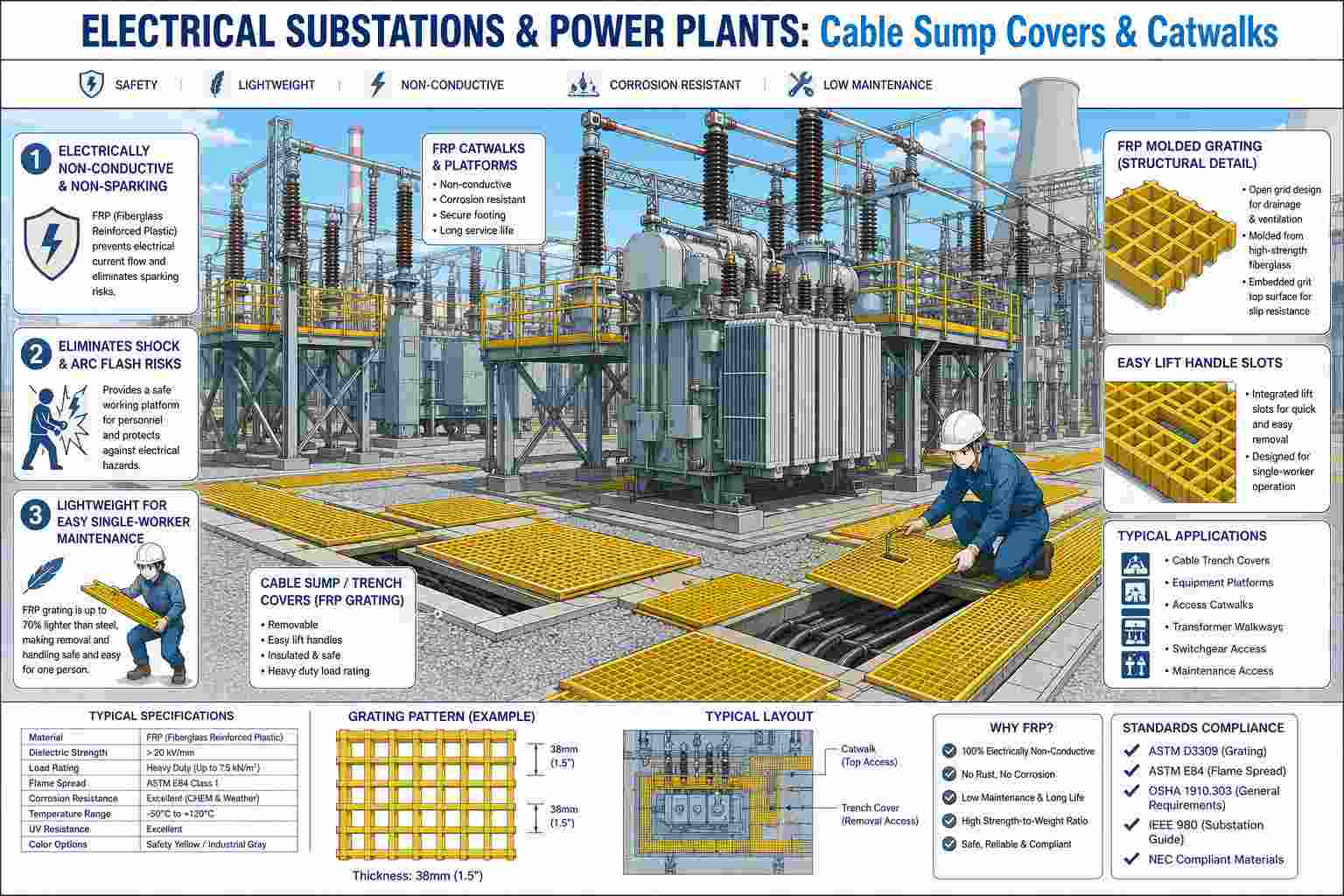
FRP grille is deployed as removable sump covers over underground cables and equipment at transformer substations, as well as catwalks and access platforms in power generation facilities. The material is electrically non-conductive and non-sparking, eliminating the shock and ignition risks present with steel grating near energized equipment. The problem addressed is the safety hazard of conductive walkway surfaces in electrical environments and the difficulty of manually removing heavy steel covers for routine maintenance access. The practical value is a lightweight cover that a single worker can lift for equipment inspection, combined with the assurance that accidental contact will not create a conductive path or friction spark in a critical utility installation.
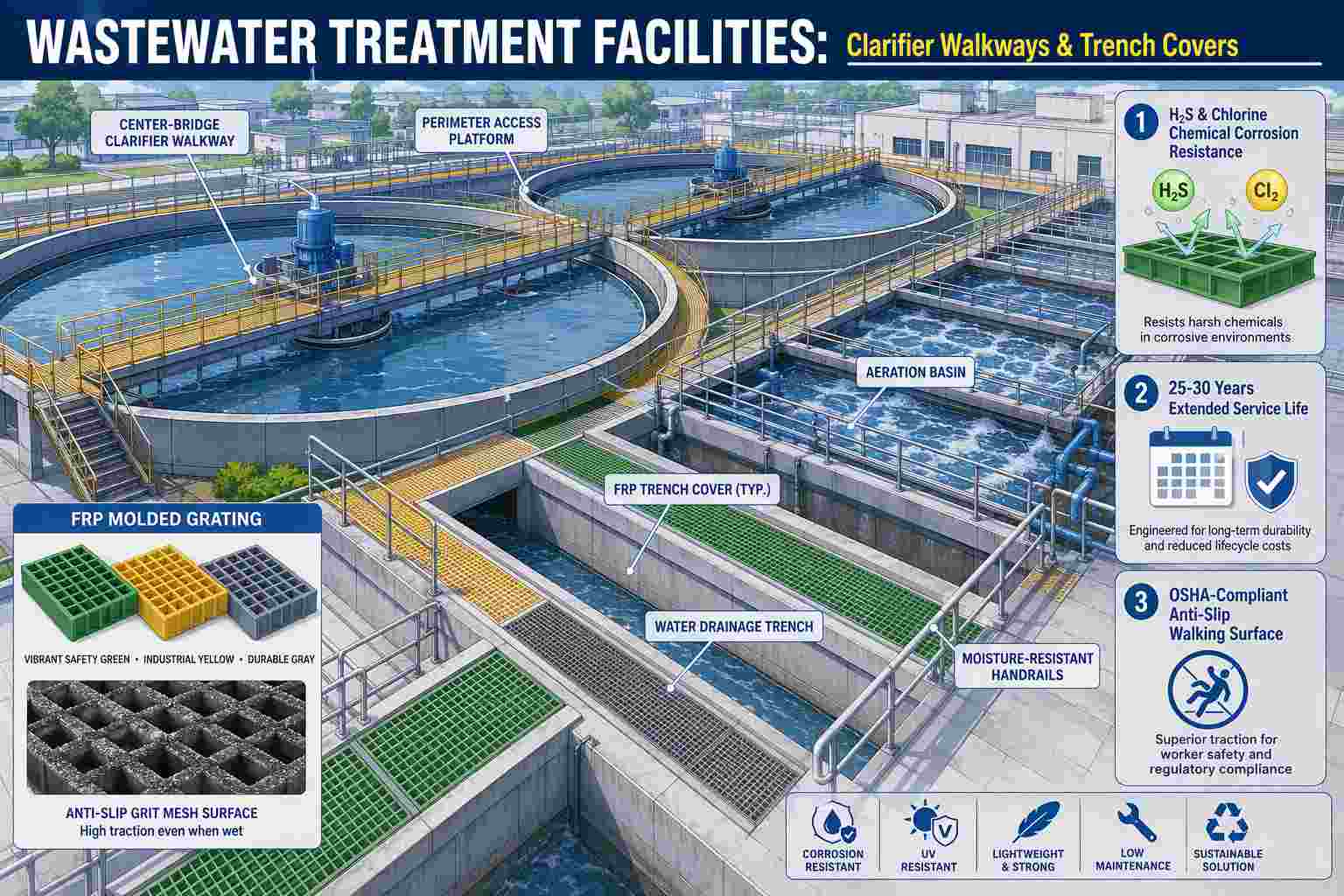
In municipal and industrial wastewater plants, FRP grille serves as clarifier walkways, aeration basin access platforms, and trench covers exposed to hydrogen sulfide, chlorine, and constant moisture. Hydrogen sulfide environments degrade galvanized steel within five to seven years, while molded FRP panels resist this attack and maintain OSHA-compliant slip resistance without applied coatings. The problem addressed is the shortened service life of metal grating in wet, sulfide-rich conditions and the safety risk of slippery, corroded walking surfaces. The value delivered is a 25- to 30-year service life versus the 10- to 15-year repaint-and-replace cycle of steel, lowering total cost of ownership for municipal projects operating under tight maintenance budgets.
Parameter Specifications
|
Product |
FRP Grille |
||
|
|
|||
|
Type |
Mesh size(mm) |
Thickness(mm) |
Length×Width(mm) |
|
FT-G3825a |
38×38 |
25 |
1220×3660 |
|
FT-G3825b |
38×38 |
25 |
1225×4005 |
|
FT-G3830a |
38×38 |
30 |
1220×3660 |
|
FT-G3830b |
38×38 |
30 |
1225×4005 |
|
FT-G3838a |
38×38 |
38 |
1220×3660 |
|
FT-G3838b |
38×38 |
38 |
1225×4005 |
|
FT-G3840a |
38×38 |
40 |
1220×3660 |
|
FT-G3840b |
38×38 |
40 |
1225×4005 |
|
FT-G3850a |
38×38 |
50 |
1220×3660 |
|
FT-G3850b |
38×38 |
50 |
1225×4005 |
|
FT-G4025a |
40×40 |
25 |
1220×3660 |
|
FT-G4025b |
40×40 |
25 |
1225×4005 |
|
FT-G4030a |
40×40 |
30 |
1220×3660 |
|
FT-G4030b |
40×40 |
30 |
1225×4005 |
|
FT-G4038a |
40×40 |
38 |
1220×3660 |
|
FT-G4038b |
40×40 |
38 |
1225×4005 |
|
FT-G4040a |
40×40 |
40 |
1220×3660 |
|
FT-G4040b |
40×40 |
40 |
1225×4005 |
|
FT-G4050a |
40×40 |
50 |
1220×3660 |
|
FT-G4050b |
40×40 |
50 |
1225×4005 |
|
FT-G5025a |
50×50 |
25 |
1220×3660 |
|
FT-G5025b |
50×50 |
25 |
1225×4005 |
|
FT-G5030a |
50×50 |
30 |
1220×3660 |
|
FT-G5030b |
50×50 |
30 |
1225×4005 |
|
FT-G5038a |
50×50 |
38 |
1220×3660 |
|
FT-G5038b |
50×50 |
38 |
1225×4005 |
|
FT-G5040a |
50×50 |
40 |
1220×3660 |
|
FT-G5040b |
50×50 |
40 |
1225×4005 |
|
FT-G5050a |
50×50 |
50 |
1220×3660 |
|
FT-G5050b |
50×50 |
50 |
1225×4005 |
|
FT-Gnn |
customized |
customized |
customized |
Related Products

FRP Grille for Walkways, Platforms & Trench Covers | Factory-Direct Exporter & Supplier
Source FRP grille direct from a China factory exporter. Molded & pultruded grating for walkways, platforms, trench covers. Custom sizes, fast export.

FRP Grating Factory Direct Power Plants Access Platforms manufactured in China
Direct from our factory. We supply molded & pultruded FRP grating for wastewater treatment, offshore platforms & chemical plants. Request a quote for corrosion-proof walkways today.

FRP Grating Factory Direct Chemical Plant & Walkway Supply
Source factory for molded & pultruded FRP grating. Corrosion-proof for wastewater & offshore platforms. Direct export pricing. Get a quote with load specs.

Fiberglass GFRP FRP Grating for Offshore Platforms | China Exporter FT-G5050D
Skip stock rolls. Get engineered FRP grating with ISO fire-retardant & slip-proof grit top. Direct mill support for marine & chemical EPC projects. Lead time 15 days. Request load-table drawing.
Contact us immediately to discuss your product project requirements
Navigation
Navigation
Contact Us
Tel.: +86 189 3266 2725
E-mail: sale@hbfortis.com
Add.: No.8-1, Zhenxing Street, Matun Town, Zaoqiang County, Hengshui City, Hebei Province
Get in Touch
Get in Touch