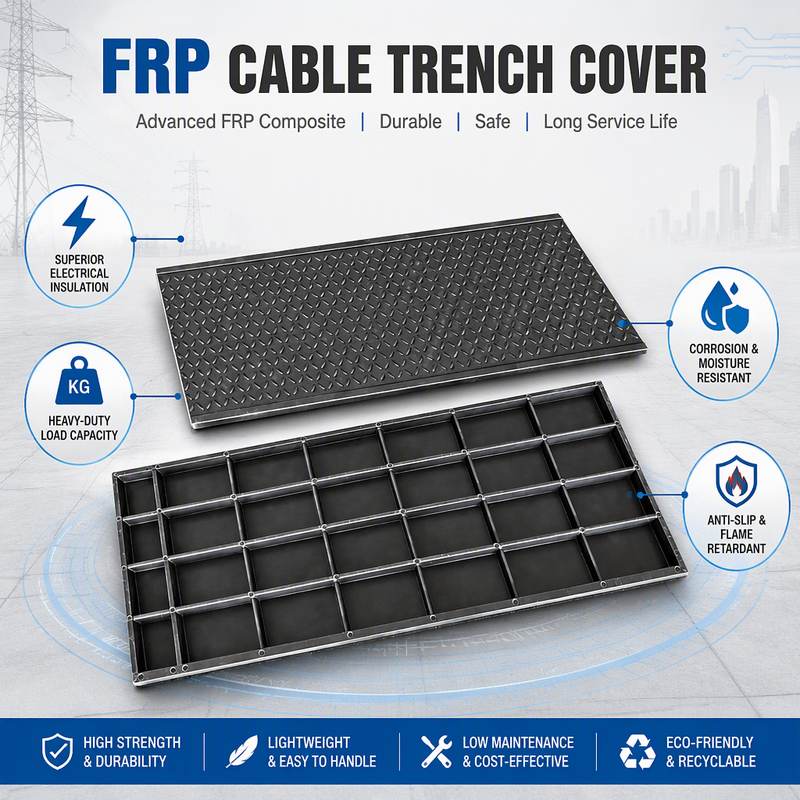
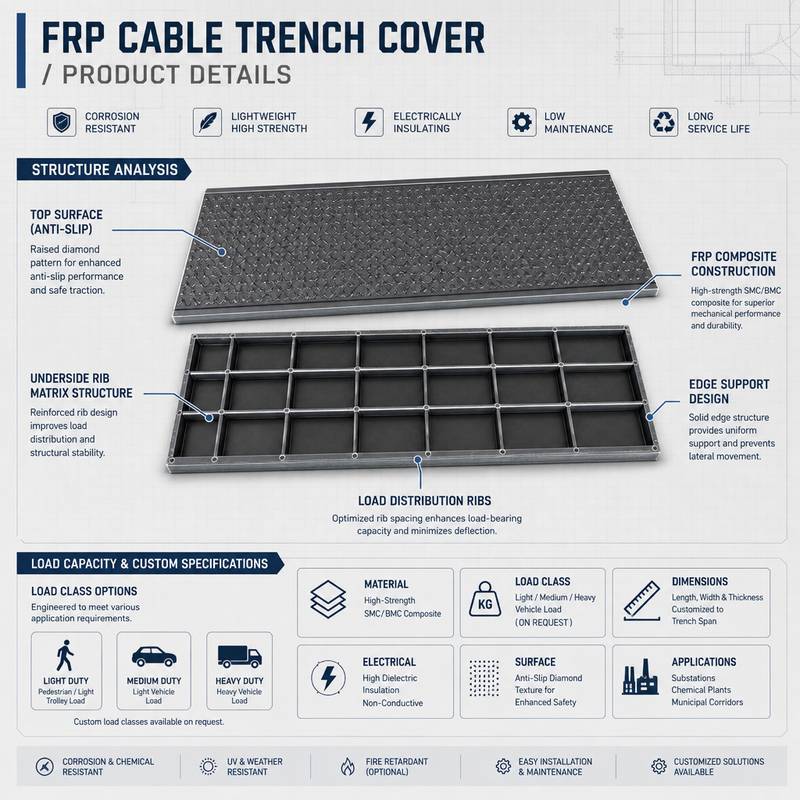
As a China-based manufacturer dedicated solely to FRP cable trench covers, we compression-mold SMC composite lids for substations, data centers, EV charging hubs, and renewable energy sites where non-conductive materials remove the need for grounding and resist chemical attack in buried service. Our tooling library covers trench widths from 300mm to 1000mm and load classes from A15 pedestrian duty to EN124 D400 vehicular ratings, with custom rib profiles and hinge/lock inserts available through OEM programs. Every batch is accompanied by third-party test reports for flexural strength, water absorption, and electrical insulation, and we maintain ISO 9001 process control across molding, trimming, and curing. For exporters and EPC contractors, we consolidate mixed-SKU orders into nestable pallets to cut container freight, provide HS code and certificate-of-origin documentation for smooth customs clearance, and support project submittals with CAD drawings and load calculations. Shipments move regularly to North America, the EU, the Middle East, and Southeast Asia, and our engineering team works directly with specifiers to match cover dimensions, surface patterns, and color coding to site requirements—keeping lead times predictable for importers who need factory-direct consistency rather than trading-company markups.

Hebei Fortis Technology Co., Ltd Product Brochure
Product Advantages
Unlike steel or cast-iron covers, FRP cable trench covers are inherently non-conductive, which removes the need for bonding and grounding in substations, switchyards, and other energized environments. This simplifies installation, reduces associated labor and copper costs, and lowers the risk of stray currents or accidental contact during maintenance. For specifiers working under strict electrical safety codes, a composite cover that isolates the trench from the surrounding grounding grid is often the deciding factor in material selection.
Fiberglass reinforced polymer withstands exposure to soil moisture, deicing salts, hydrogen sulfide, and a wide range of industrial chemicals that would rapidly degrade galvanized or painted steel. Because the material does not rust or require periodic re-coating, covers retain their structural integrity and appearance over long service periods, even in coastal, wastewater, and chemical plant applications. This translates into lower lifecycle maintenance costs and fewer replacement cycles for asset owners managing large trench networks.
SMC compression-molded covers deliver load ratings up to EN124 D400 while weighing roughly one-quarter to one-third of comparable cast-iron alternatives. The reduced weight allows single-person handling during installation and inspection, cuts crane or lifting-equipment requirements, and significantly lowers container freight costs for export orders. For importers and EPC contractors, the lighter shipping profile directly improves landed cost without compromising vehicular or pedestrian load performance.
Application Scenarios
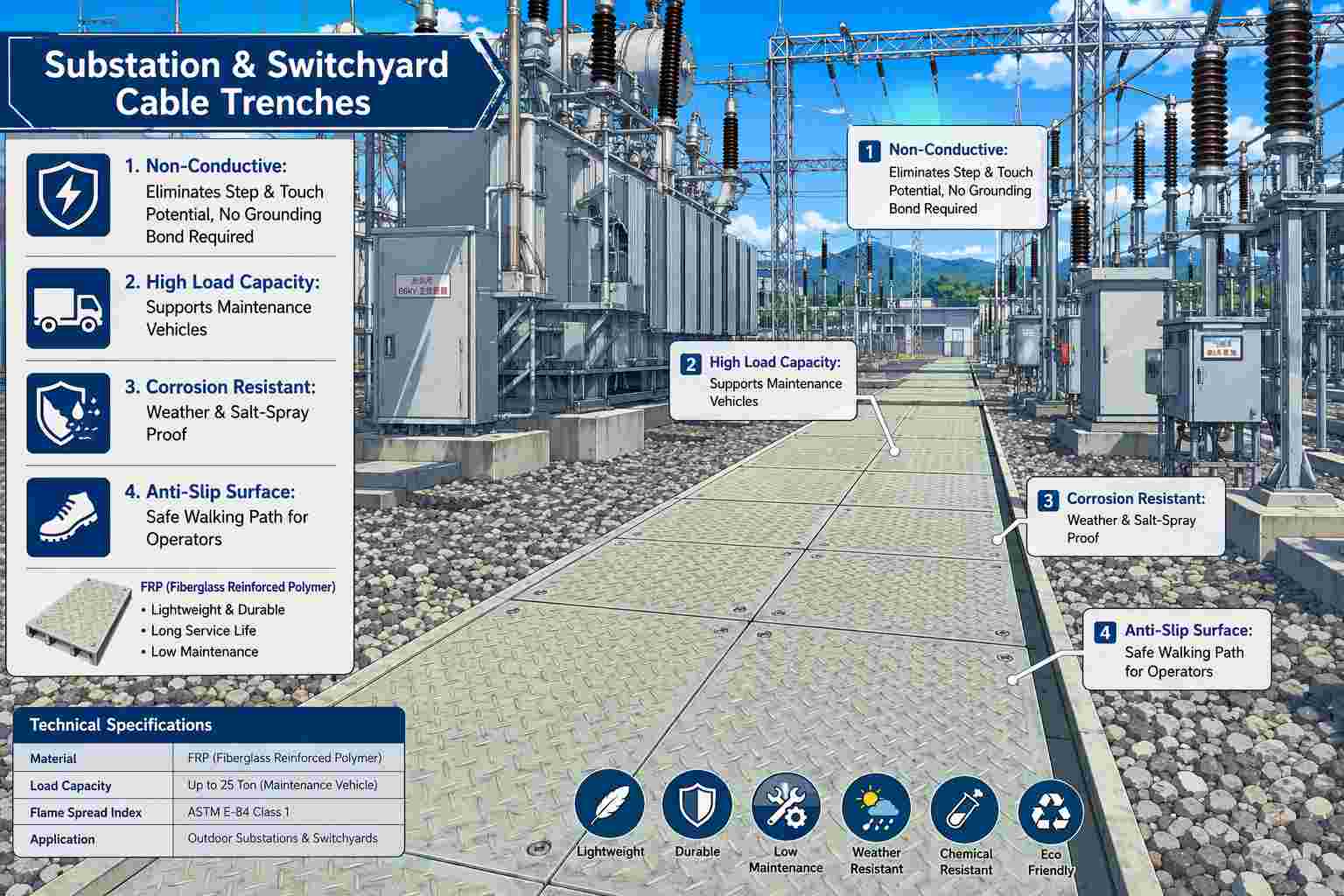
FRP cable trench covers are deployed across the cable corridors that run between transformers, switchgear, and control buildings within high-voltage substations. The covers must support occasional maintenance vehicle traffic while remaining non-conductive to eliminate any risk of bridging the step and touch potential gradients that exist around energized equipment. Traditional steel covers require bonding to the station grounding grid, adding installation complexity and inspection burden; FRP covers remove that requirement entirely. The practical value lies in simplifying the grounding design, reducing copper conductor costs, and giving operators a safe walking surface that remains slip-resistant even when wet. In coastal or flood-prone substations, the corrosion resistance of FRP also means the covers will not degrade from salt spray or standing water, extending replacement cycles well beyond what galvanized steel would deliver.
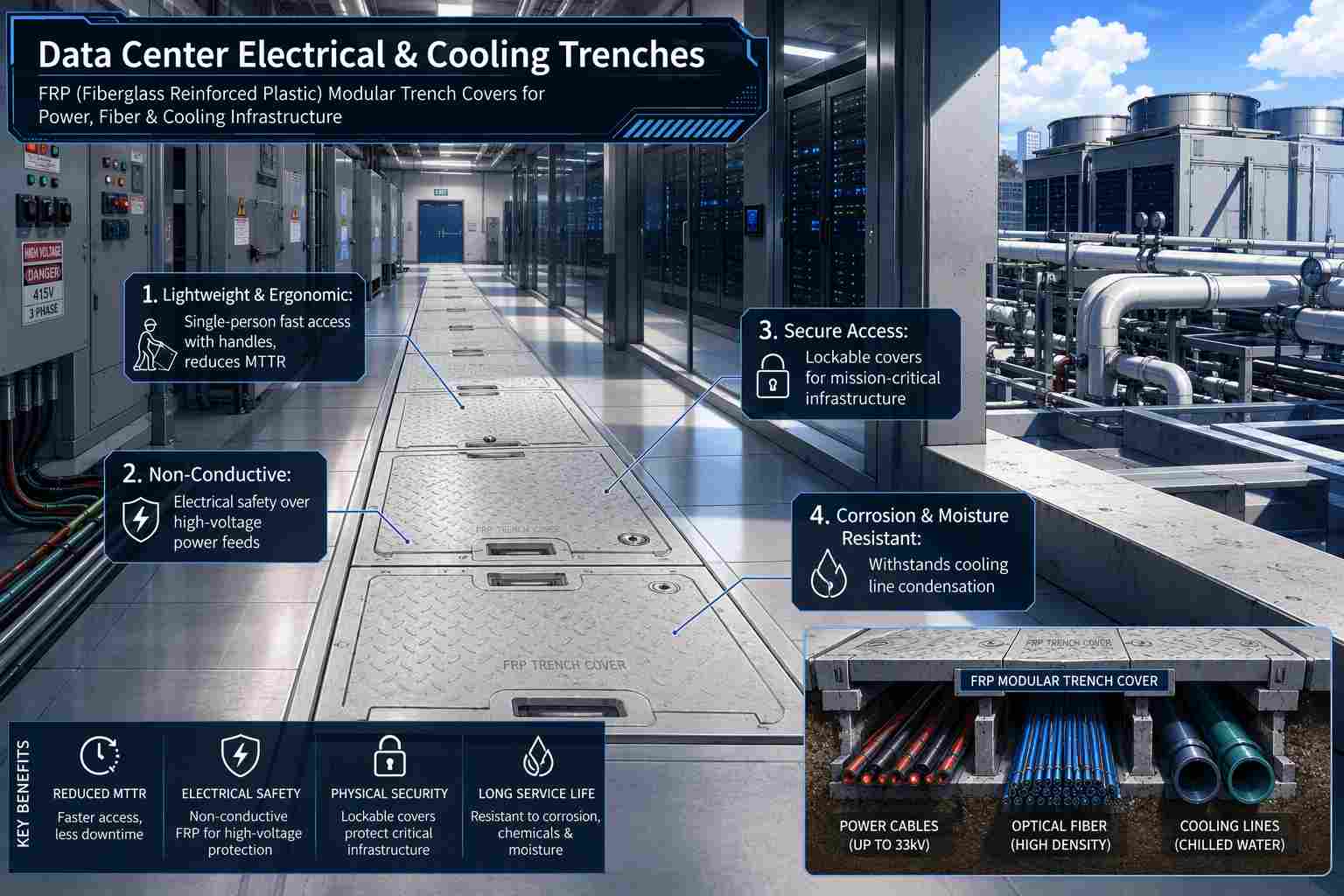
Hyperscale and colocation data centers run extensive underground trench networks carrying power distribution cabling, fiber optic routes, and cooling water services between the substation yard, electrical rooms, and mechanical yards. FRP covers are specified here for three converging reasons: they are light enough for a single maintenance technician to remove without lifting equipment, they can be locked or interlocked to control access in high-security environments, and they are non-conductive when running above energized cabling. The problem they solve is downtime risk—when a cooling pump or power feed needs inspection, the trench must open quickly and safely. A cast-iron cover of equivalent load rating would require two people and a lifting aid; an FRP cover with ergonomic handles allows faster access and reduces the risk of back injury or dropped covers damaging the cables below. The actual value is measured in reduced mean time to repair and lower workplace injury exposure for facility maintenance teams.
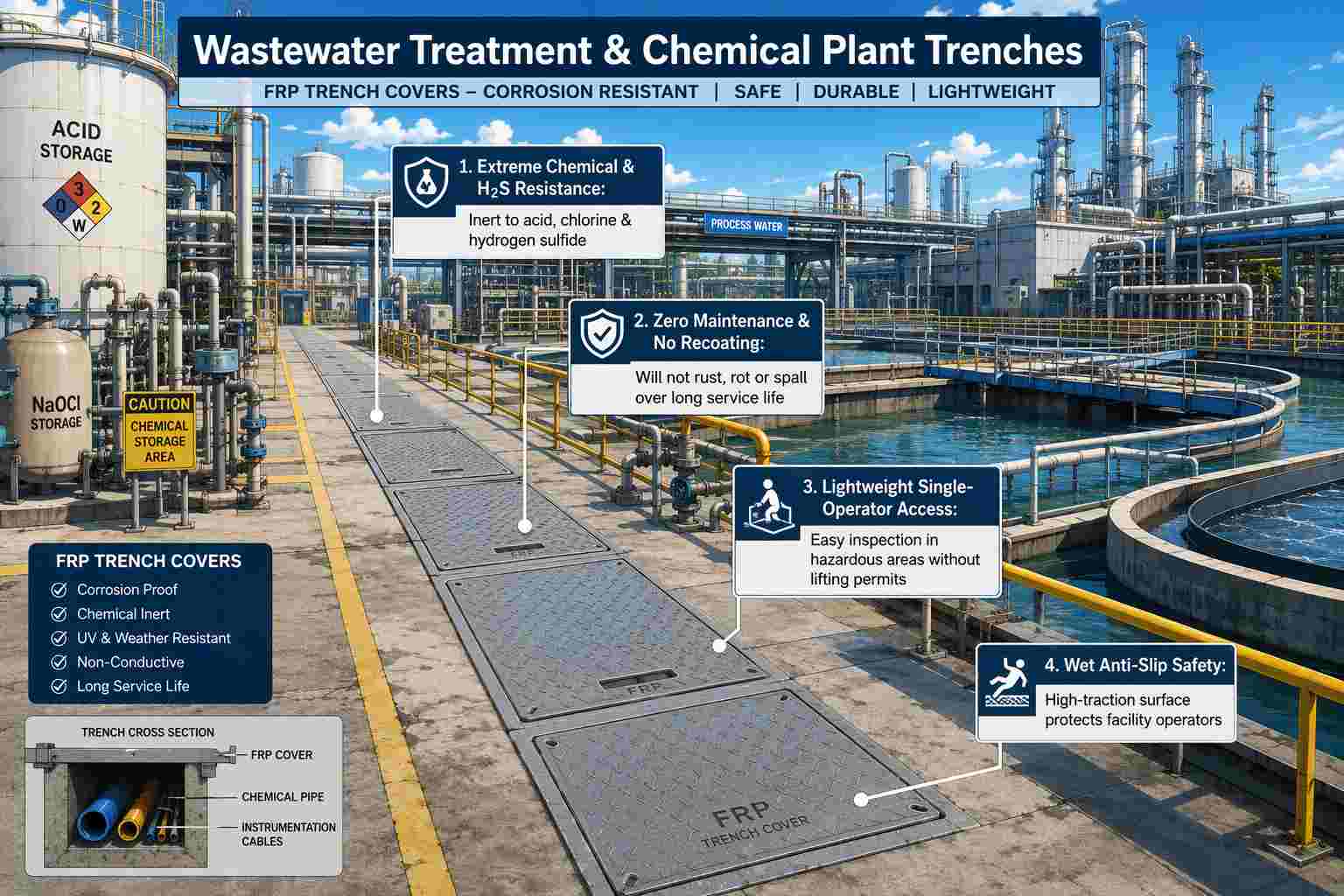
Wastewater treatment plants and chemical processing facilities expose trench covers to hydrogen sulfide, chlorine, acids, and continuous moisture—conditions that destroy galvanized steel within a few years and cause concrete covers to spall and crack. FRP covers are inherently inert to these attack mechanisms, with no coating to chip or sacrificial zinc layer to deplete. The deployment challenge in these facilities is not load rating but access frequency: operators need to inspect valves, meters, and cable junctions regularly, often in confined or hazardous areas where heavy lifting is prohibited. Lightweight FRP covers with anti-slip tread allow routine inspection without confined-space lifting permits or additional personnel. The practical value is a maintenance regime that does not require periodic cover replacement or recoating, and a safer inspection workflow in environments where every unnecessary manual handling task carries elevated risk.
Parameter Specifications
|
Product |
FRP manhole cover |
|||||||
|
|
||||||||
|
Model |
Type |
manhole cover |
manhole cover base |
bearing capacity (tonne) |
||||
|
|
|
A |
B |
D |
C |
F |
E |
|
|
FT-M600L |
Light |
φ600 |
35 |
760 |
660 |
20 |
100 |
5 |
|
FT-M600N |
Normal |
φ600 |
35 |
760 |
660 |
20 |
100 |
15 |
|
FT-M600H |
Heavy |
φ600 |
35 |
810 |
660 |
20 |
110 |
30 |
|
FT-M600UH |
Super-Heavy |
φ600 |
35 |
810 |
660 |
20 |
100 |
30+ |
|
FT-M700L |
Light |
φ700 |
38 |
810 |
750 |
20 |
100 |
5 |
|
FT-M700N |
Normal |
φ700 |
38 |
810 |
750 |
20 |
100 |
15 |
|
FT-M700H |
Heavy |
φ700 |
38 |
920 |
750 |
20 |
120 |
30 |
|
FT-M700UH |
Super-Heavy |
φ700 |
38 |
920 |
750 |
20 |
100 |
30+ |
|
FT-M800L |
Light |
φ800 |
38 |
860 |
850 |
20 |
110 |
5 |
|
FT-M800N |
Normal |
φ800 |
38 |
860 |
850 |
20 |
110 |
15 |
|
FT-M800H |
Heavy |
φ800 |
38 |
930 |
850 |
20 |
120 |
30 |
|
FT-M800UH |
Super-Heavy |
φ800 |
38 |
930 |
850 |
20 |
120 |
30+ |
Related Products

FRP Manhole Cover for Municipal & Telecom | China Factory Exporter
Factory-direct FRP manhole covers from China. Lightweight, anti-theft & corrosion-resistant for municipal, telecom & utility projects. Get a quote today.

FRP Molded Cover Exporter for Chemical Plants, Water Treatment Factory-Direct Supply
Factory-direct FRP molded covers for chemical, water treatment, marine and industrial applications. Custom sizes, corrosion-resistant, bulk export supply. Get a quote.

FRP Molded Cover Exporter Custom Fiberglass Covers for Chemical, Marine & Construction Applications
As a direct FRP molded cover exporter, we supply custom fiberglass covers for chemical plants, marine decks, and construction sites. Factory-direct pricing, OEM sizes, fast export delivery.

FRP Molded Cover Exporter for Substations | Custom GRP Cable Trench Covers
Factory-direct FRP molded cover exporter for substations. GRP cable trench covers, equipment enclosures & transformer pads—corrosion-resistant, custom sizes, bulk OEM export.
Contact us immediately to discuss your product project requirements
Navigation
Navigation
Contact Us
Tel.: +86 189 3266 2725
E-mail: sale@hbfortis.com
Add.: No.8-1, Zhenxing Street, Matun Town, Zaoqiang County, Hengshui City, Hebei Province
Get in Touch
Get in Touch