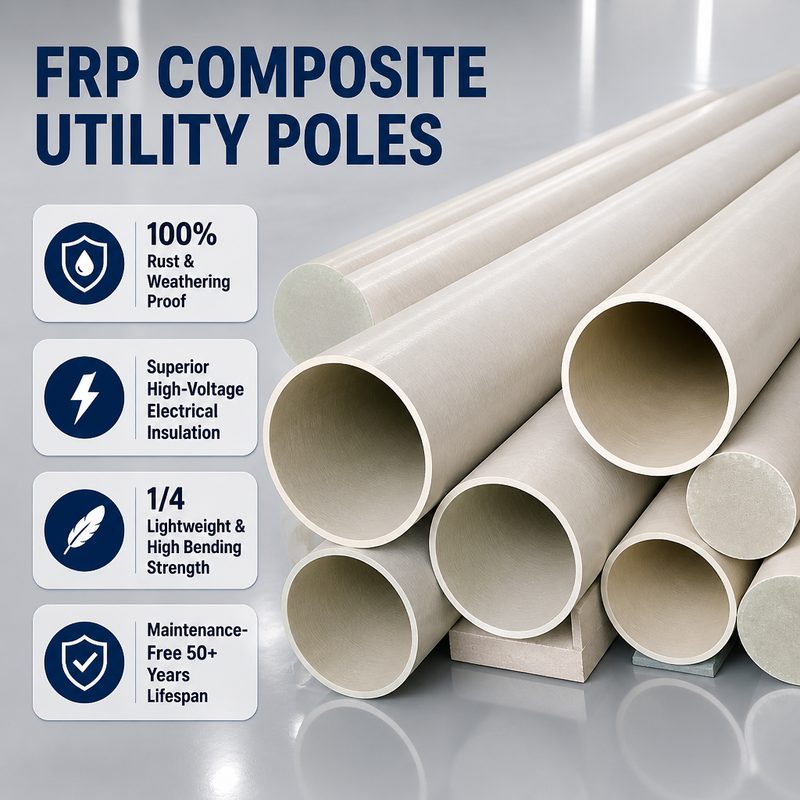
As a direct factory exporter of fiberglass utility poles, we manufacture and ship composite distribution and transmission poles for utilities, EPC contractors, and telecom infrastructure developers operating in coastal corrosion zones, storm-vulnerable grids, wetland and floodplain routes, and remote or inaccessible terrain where wood, steel, and concrete poles underperform. Our FRP poles are pultruded and filament-wound in-house, with customizable voltage classes, heights, wall thicknesses, and climbing provisions, and are engineered to resist salt spray, UV degradation, insect attack, and extreme wind loads while cutting installation costs through a high strength-to-weight ratio that reduces crane and labor requirements. Every pole is backed by in-house mechanical load testing, third-party inspection coordination, and full export documentation, including material certificates, test reports, and packing lists tailored to destination-port requirements. Because we sell mill-direct rather than through trading intermediaries, buyers gain transparent factory pricing, shorter lead times, flexible MOQ for pilot projects, and direct access to our engineering team for specification reviews and drawing approvals. Whether you are hardening a coastal distribution line, replacing rotting wood poles along a wetland right-of-way, or sourcing a repeatable composite pole supply for a multi-site rural electrification program, our export team manages the process from raw material traceability through container loading supervision—so your procurement cycle stays short, your site stays on schedule, and your specification stays exactly as approved.

Hebei Fortis Technology Co., Ltd Product Brochure
Product Advantages
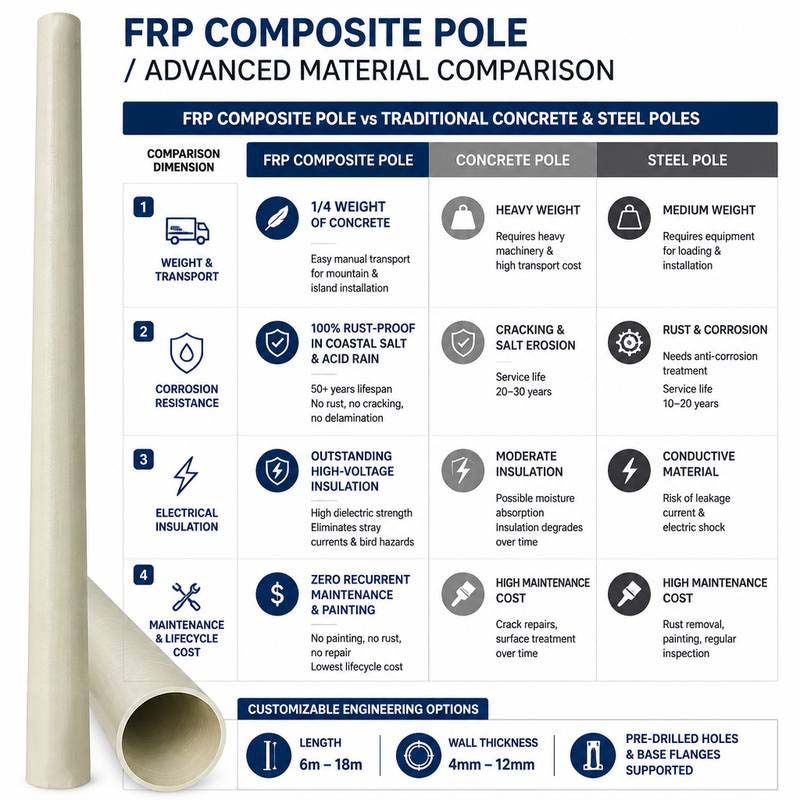
The most immediate economic advantage of fiberglass utility poles lies in their exceptional strength-to-weight ratio. Pultruded fiberglass profiles are typically stronger than structural steel on a pound-for-pound basis, yet they weigh only a fraction of the equivalent wood, steel, or concrete pole. Industry data indicates that FRP poles can be roughly one-third the weight of a comparable steel pole and significantly lighter than wood, with some sources citing weights as low as one-seventh that of a same-spec concrete pole. This dramatic weight reduction translates directly into lower logistics and installation costs: smaller cranes or even manual erecting methods become feasible in remote or congested sites, and fewer personnel are needed for handling and setting. For export buyers sourcing poles for projects in difficult terrain, this means reduced freight volume, simplified unloading at destination ports, and faster on-site deployment.
Unlike wood poles that decay and require chemical treatment, or steel poles that rust in humid and coastal environments, fiberglass utility poles are impervious to rot, corrosion, and biological attack. The inert resin matrix used in pultruded FRP poles does not absorb water, and the material is immune to termite damage and woodpecker intrusion—a documented cause of structural weakening in wooden poles even in developed utility networks. This resistance extends to a broad range of soil-borne chemicals and salt spray, making fiberglass poles particularly suitable for coastal distribution lines, wetland routes, and industrial zones where traditional materials degrade prematurely. Because the material requires no preservative treatment, no repainting, and no galvanizing, the total cost of ownership over the pole’s service life is substantially lower than that of treated wood or coated steel alternatives.
Application Scenarios
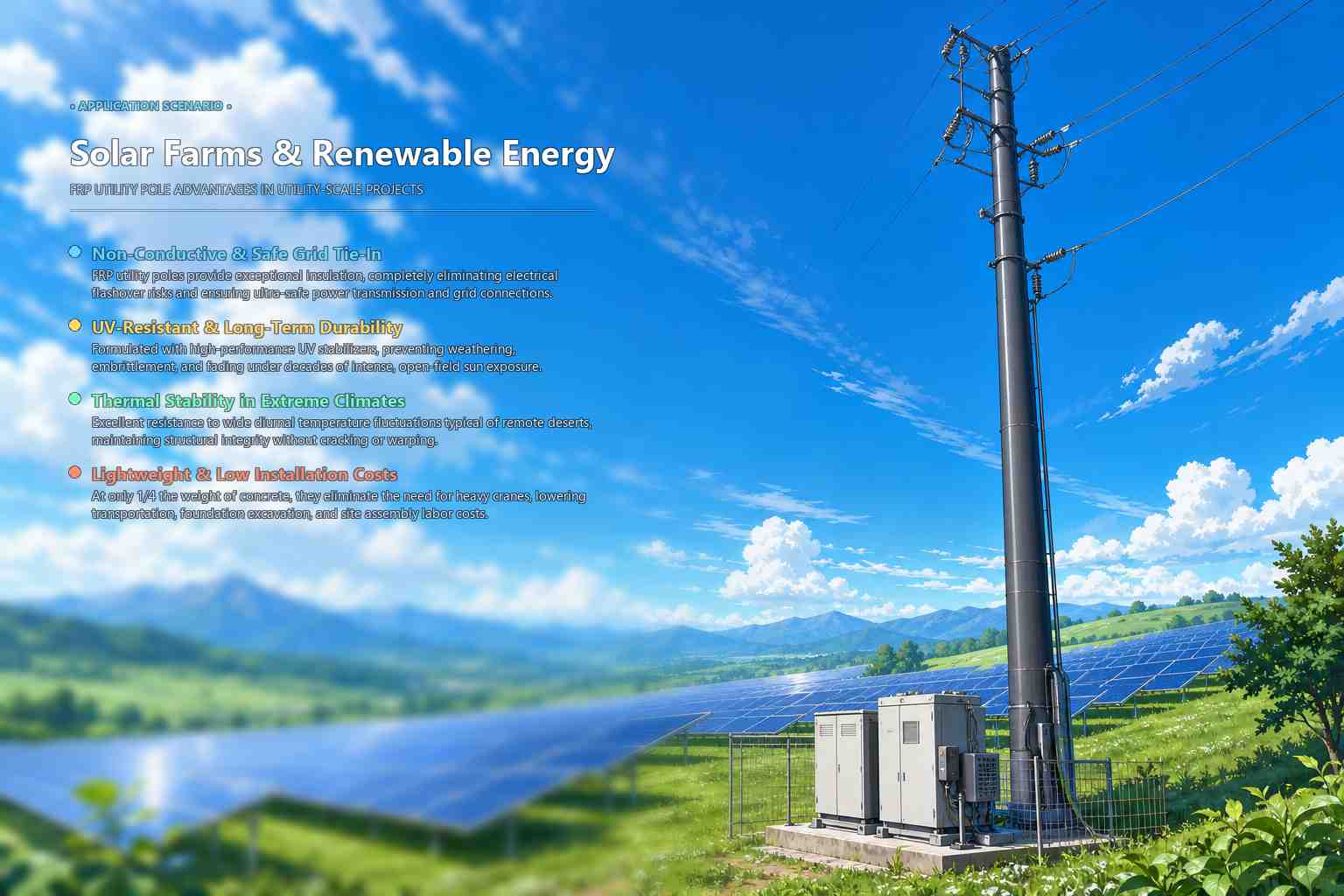
Solar power plants and renewable energy sites often use FRP utility poles for panel array supports, inverter station connections and grid tie-in lines. The poles are non-conductive, UV-resistant and unaffected by the temperature fluctuations typical of large open installations. Their lightweight nature also reduces foundation requirements and installation costs, making them an efficient solution for utility-scale solar farms, especially in remote or environmentally sensitive locations.
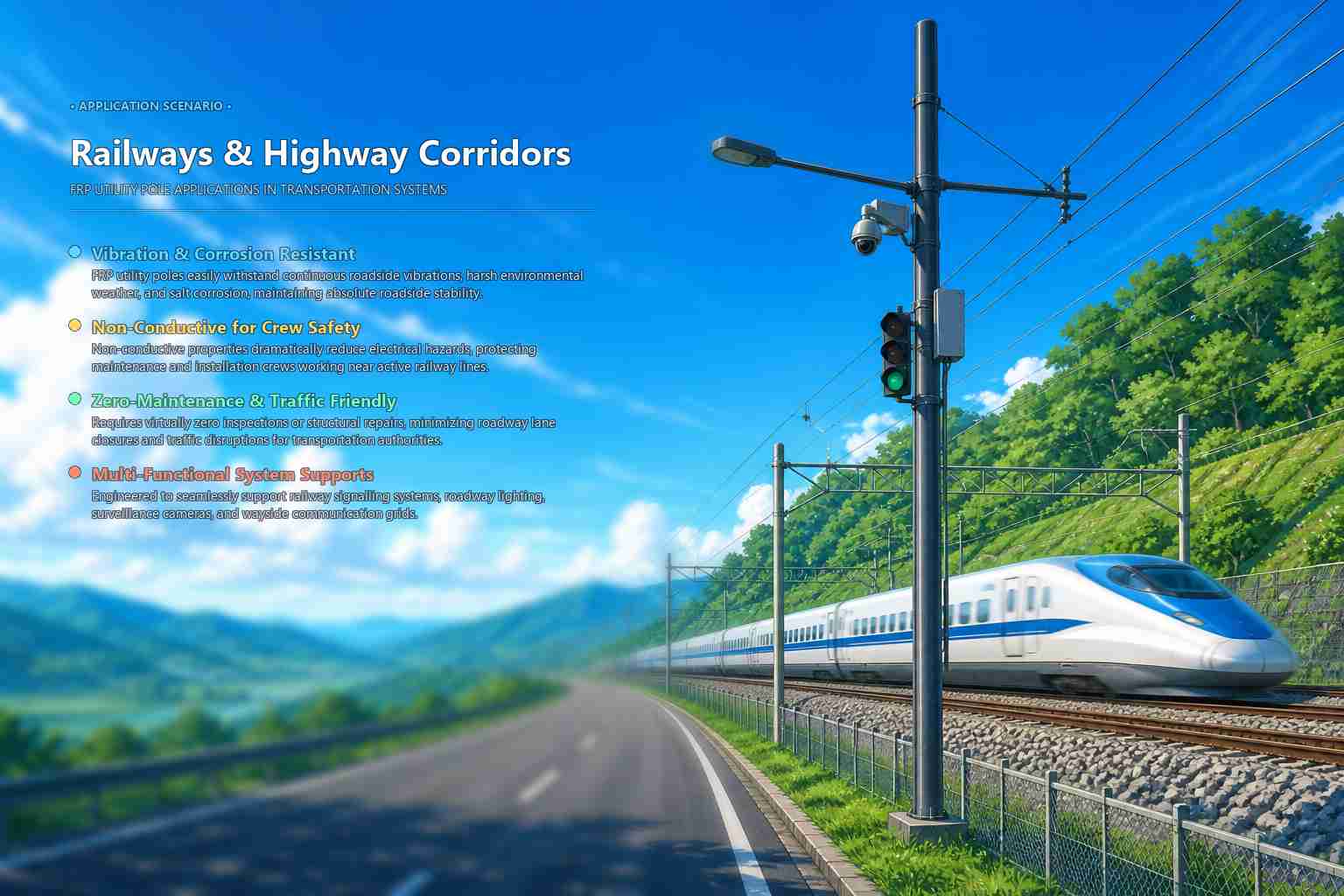
Along railways, highways and toll roads, FRP utility poles support signaling systems, lighting, cameras, communication equipment and emergency power lines. Their resistance to vibration, weather and corrosion keeps them stable in high-traffic environments, while their non-conductive properties improve safety for maintenance crews working near electrical systems. Transportation authorities also value their low maintenance profile, which minimizes traffic disruption during inspection or repair work.
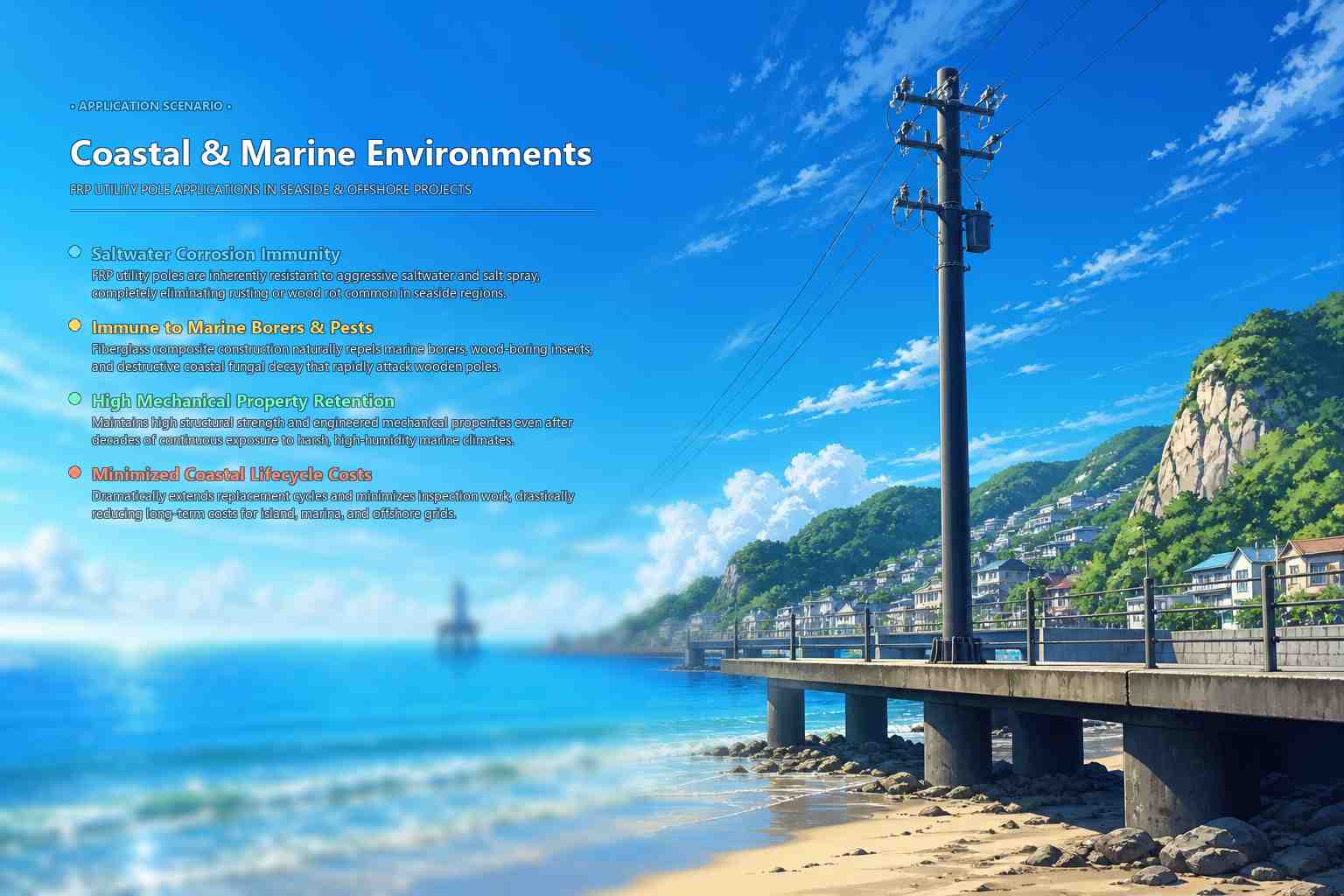
In coastal regions, salt spray and high humidity rapidly degrade wooden and steel poles. FRP utility poles are inherently resistant to saltwater corrosion, making them a preferred choice for seaside towns, ports, marinas, offshore platforms and island electrification projects. They do not rust, rot or attract marine borers, and they maintain their mechanical properties even after years of exposure to aggressive marine conditions, which significantly reduces replacement cycles and maintenance costs.
Parameter Specifications
|
Product |
FRP Utility Pole |
|||
|
Category |
Item |
Performance Requirements |
||
|
Mechanical Properties |
Tensile Strength |
≥500 MPa |
||
|
Flexural Strength |
≥500 MPa |
|||
|
Compressive Strength |
≥300 MPa |
|||
|
Physical Properties |
Flame Resistance |
V-1/0 Grade |
||
|
Chemical Resistance |
Acid Resistance (80°C, 5wt% HCl solution, 28 days) |
No powdering, no cracks, flexural modulus retention rate ≥80% |
||
|
Alkali Resistance (80°C, 10wt% NaOH solution, 7 days) |
No powdering, no cracks, flexural modulus retention rate ≥50% |
|||
|
Salt Resistance (80°C, 3wt% NaCl solution, 28 days) |
No powdering, no cracks, flexural modulus retention rate ≥85% |
|||
|
Aging Resistance |
Artificial Climate Aging (Method A-1, irradiance, cycle 1, 300h) |
No powdering, no cracks, flexural modulus retention rate ≥85% |
||
|
Hygrothermal Aging (60°C, 93%RH, 12h~25°C/93%RH, 28 days) |
No powdering, no cracks, flexural modulus retention rate ≥85% |
|||
|
Constant Humidity and Heat Aging (60°C/93%RH, 28 days) |
No powdering, no cracks, flexural modulus retention rate ≥85% |
|||
|
High-Temperature Resistance (300°C~400°C) |
No powdering, no cracks, flexural modulus retention rate ≥80% |
|||
|
Electrical Properties |
Surface Resistivity |
≥1.0 × 10^10 Ω |
||
|
Volume Resistivity |
≥1.0 × 10^10 Ω•m |
|||
|
Density |
solid |
≤0.25 g/cm³ |
||
|
hollow |
≤2 g/cm³ |
|||
|
Model |
Length (m) |
Top Diameter (mm) |
Standard load (P) |
Standard bending moment (kN.m) |
|
Z Ø190×8×I×FH |
8 |
190 |
3 |
19.35 |
|
Z Ø190×9×I×FH |
9 |
190 |
3 |
21.75 |
|
Z Ø190×10×I×FH |
10 |
190 |
3 |
24.15 |
|
Z Ø190×12×I×FH |
12 |
190 |
3 |
29.25 |
|
Z Ø190×15×I×FH |
15 |
190 |
3 |
36.75 |
|
Z Ø190×18×I×FH |
18 |
190 |
3 |
/ |
|
Z Ø190×8×K×FH |
8 |
190 |
4 |
25.80 |
|
Z Ø190×9×K×FH |
9 |
190 |
4 |
29.00 |
|
Z Ø190×10×K×FH |
10 |
190 |
4 |
32.20 |
|
Z Ø190×12×K×FH |
12 |
190 |
4 |
39.00 |
|
Z Ø190×15×K×FH |
15 |
190 |
4 |
49.00 |
|
Z Ø190×18×K×FH |
18 |
190 |
4 |
61.00 |
|
Z Ø190×8×M×FH |
8 |
190 |
6 |
38.70 |
|
Z Ø190×9×M×FH |
9 |
190 |
6 |
43.50 |
|
Z Ø190×10×M×FH |
10 |
190 |
6 |
48.30 |
|
Z Ø190×12×M×FH |
12 |
190 |
6 |
58.50 |
|
Z Ø190×15×M×FH |
15 |
190 |
6 |
73.50 |
|
Z Ø190×18×M×FH |
18 |
190 |
6 |
91.50 |
|
Z Ø230×8×M×FH |
8 |
230 |
6 |
38.70 |
|
Z Ø230×9×M×FH |
9 |
230 |
6 |
43.50 |
|
Z Ø230×10×M×FH |
10 |
230 |
6 |
48.30 |
|
Z Ø230×12×M×FH |
12 |
230 |
6 |
58.50 |
|
Z Ø230×15×M×FH |
15 |
230 |
6 |
73.50 |
|
Z Ø230×18×M×FH |
18 |
230 |
6 |
91.50 |
Related Products

Composite Utility Pole Supplier for Rural Electrification Projects | China Factory-Direct Export
Buy composite utility poles direct from a China factory for rural electrification and distribution line builds. Consistent specs, export documentation handled, stable lead times.

Fiberglass Utility Poles for Storm-Prone Grids & Rural Electrification | China Factory Direct Export
GFRP utility poles from a direct China factory exporter. Ideal for coastal power lines, telecom networks & storm-prone areas. Lightweight, anti-corrosion, long lifespan. Get a quote.

GFRP Utility Pole for Overhead Distribution & Coastal Power Lines | Direct Factory Exporter
GFRP utility poles for overhead distribution, coastal power lines & telecom networks. Direct factory exporter, custom lengths, fast global shipping.

FRP Utility Pole Exporter for Coastal Projects Factory-Direct Supply
As a China-based FRP utility pole manufacturer and exporter, we supply pultruded fiberglass poles for power distribution, telecom networks and coastal infrastructure. Factory-direct pricing, custom lengths, IEC/ASTM compliance. Request a quote today.
Contact us immediately to discuss your product project requirements
Navigation
Navigation
Contact Us
Tel.: +86 189 3266 2725
E-mail: sale@hbfortis.com
Add.: No.8-1, Zhenxing Street, Matun Town, Zaoqiang County, Hengshui City, Hebei Province
Get in Touch
Get in Touch