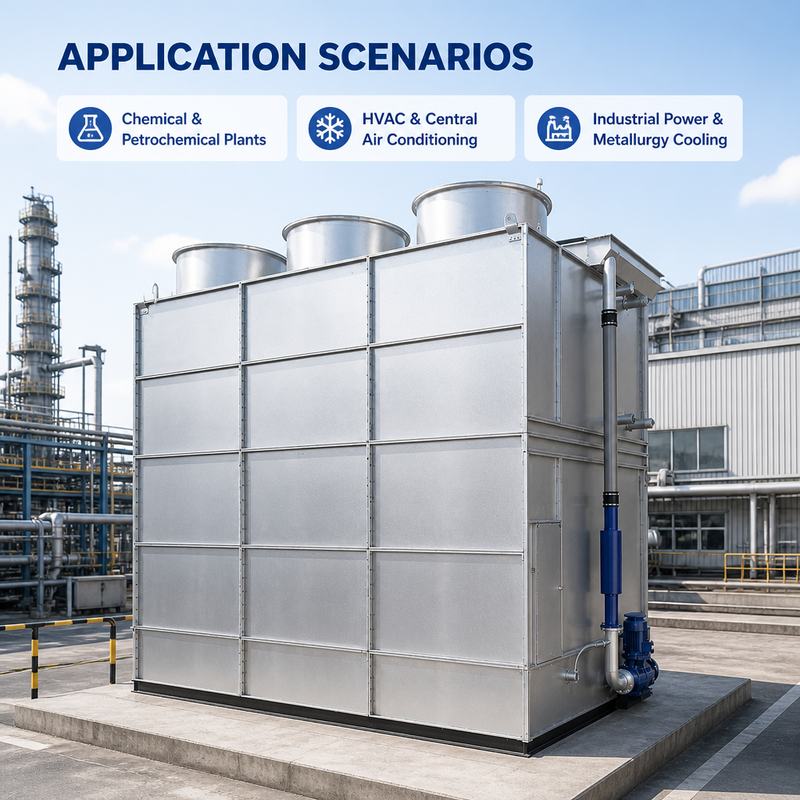
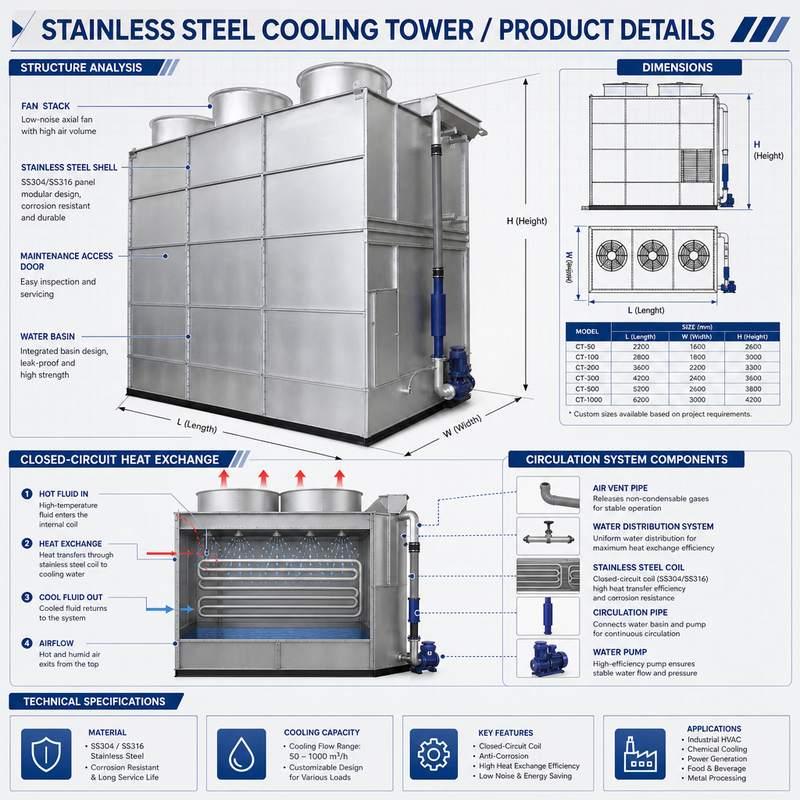
As a vertically integrated stainless steel cooling tower factory rather than a trading intermediary, we control every production stage in-house—from incoming material verification of SUS304/316L coils and CNC laser cutting, through automated tube-sheet welding and fill media assembly, to hydrostatic pressure testing and thermal performance validation on our own test bench before any unit is crated for export. This direct-export model removes intermediary markups while keeping critical parameters traceable: drift loss rates, chloride-corrosion resistance in coastal and high-humidity sites, noise levels measured at 1.5 m from the tower casing, and motor IP ratings matched to the destination country's grid and climate. Our facility operates under ISO 9001 and CE/PED-compliant welding procedures, with third-party inspection (SGS, TÜV, BV) welcomed at any production milestone, and every shipment is accompanied by a material certificate, performance curve, and installation drawing set. For EPC contractors, HVAC distributors, and industrial end users sourcing for refinery cooling, data-center heat rejection, or process-water loops, we provide factory-priced mechanical drawings within 48 hours of receiving thermal duty and site ambient conditions, plus a documented performance guarantee backed by our in-house testing lab and a 24-month warranty on stainless steel structural integrity.

Hebei Fortis Technology Co., Ltd Product Brochure
Product Advantages
The defining advantage of a stainless steel cooling tower is its immunity to the zinc-loss cycle that governs galvanized units. In chloride-bearing make-up water, coastal salt fog, or industrial atmospheres laced with SO₂ and H₂S, galvanized steel begins shedding its protective layer within the first two to three years, exposing bare carbon steel to pitting and crevice attack. SUS304 and SUS316L constructions eliminate that failure mode entirely: the passive chromium-oxide film self-repairs after scratching, and 316L's molybdenum content resists chloride pitting even where make-up water chlorides exceed 500 mg/L. For operators in desalination-adjacent plants, chemical-processing sites, or seaside data centers, this translates into a structure that does not require re-coating, does not leach zinc into blowdown (avoiding heavy-metal discharge penalties), and retains its wall thickness decades after a galvanized tower would have been relined or scrapped.
Stainless steel's smooth, non-porous surface and resistance to scale adhesion permit higher tube-side and distribution velocities without erosion risk. Where galvanized or mild-steel basins demand conservative flow rates to protect the coating, stainless basins and coils tolerate velocities that keep suspended solids in suspension and prevent the settlement that seeds biofilm growth. The practical result is a lower fouling factor sustained over the operating year, which directly reduces condenser approach temperatures and the compressor or chiller lift required to reject the same heat load. In closed-circuit and hybrid configurations, this translates into measurable pumping-head savings and fewer chemical dosing cycles, because the tower is not fighting a progressively roughening heat-transfer surface.
Application Scenarios
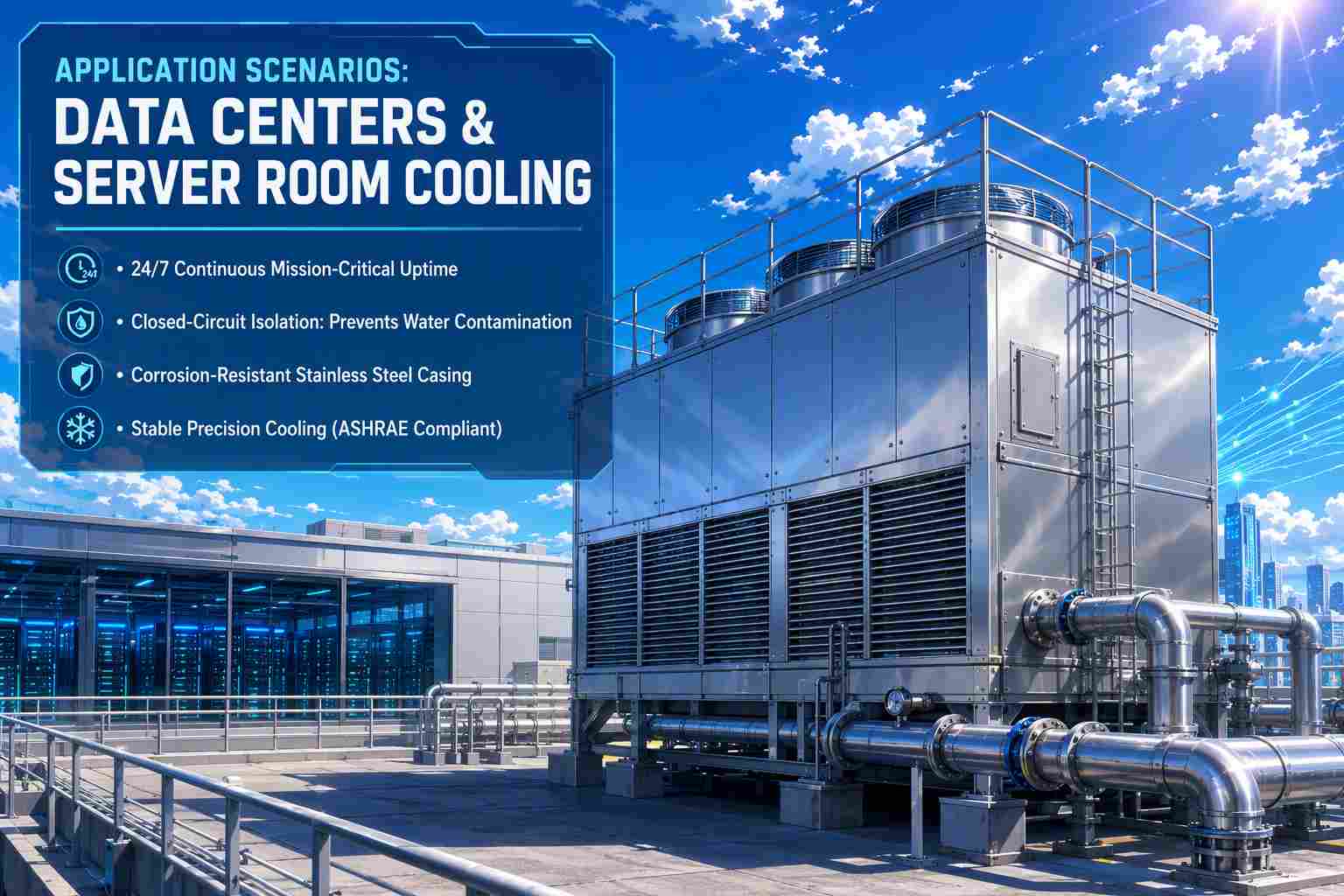
Data centers run continuous, high-density compute loads that generate concentrated heat around the clock, and any interruption in cooling can trigger server throttling or outright shutdowns. The stainless steel cooling tower is typically deployed on the rooftop or in an adjacent mechanical yard, tied into a closed-loop chilled water system that feeds CRAH units and rear-door heat exchangers inside the white space. Its closed circuit design keeps the process water isolated from airborne dust and contaminants, protecting precision cooling equipment from fouling. The stainless steel casing resists the humid, chemically treated water environment that corrodes galvanized towers in coastal or urban data center locations. The practical value is clear: stable approach temperatures that keep rack inlet conditions within ASHRAE guidelines, reduced unplanned downtime risk, and a cooling asset that does not need replacement midway through the facility's operational life.
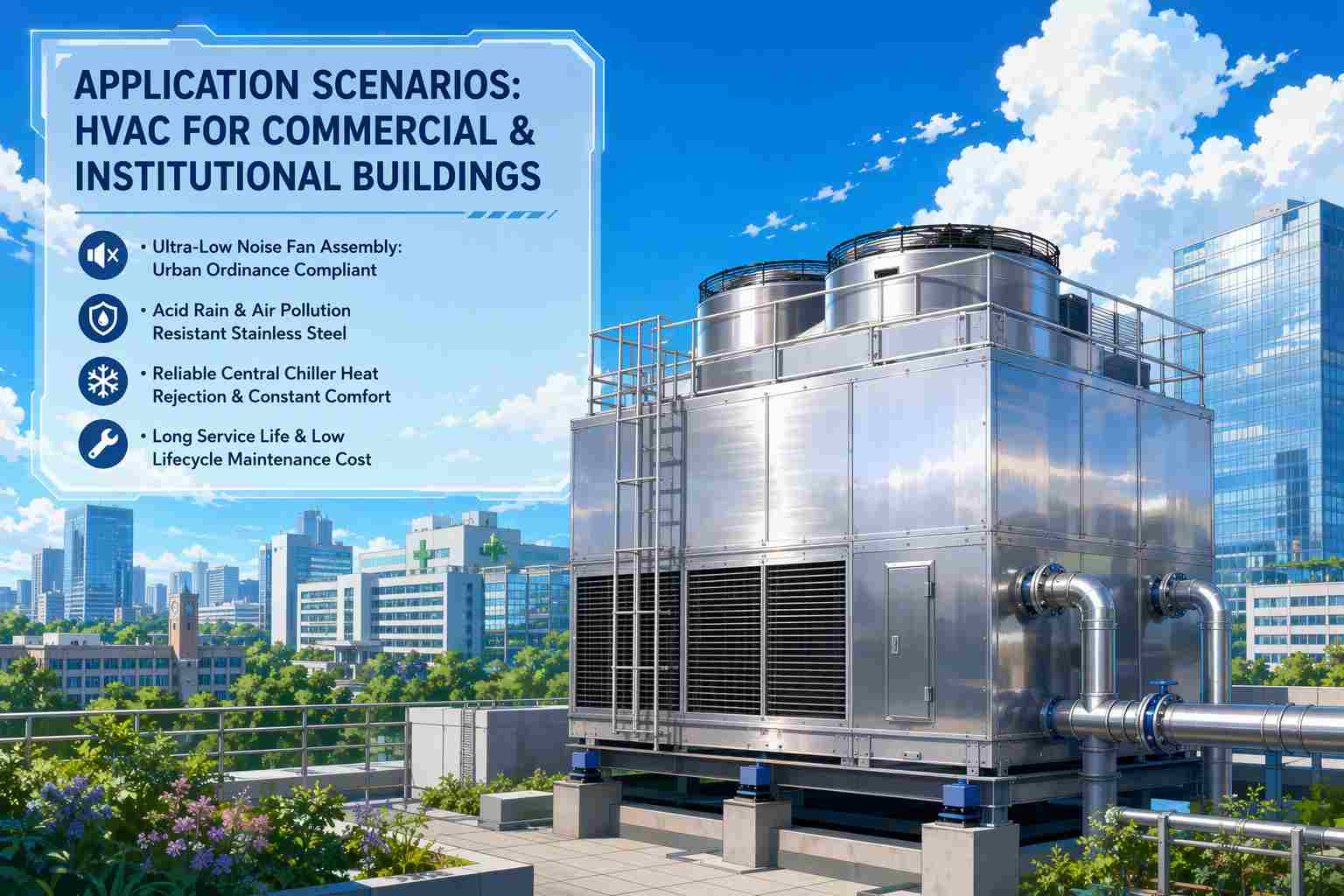
Large office towers, hospitals, universities, and shopping complexes rely on centralized chiller plants to maintain indoor comfort across thousands of square meters, and the cooling tower is the heat rejection point that keeps the entire system running. The stainless steel cooling tower is deployed on the building roof or in a ground-level mechanical enclosure, connected to condenser water loops serving centrifugal or screw chillers. Its low-noise fan assembly is a decisive advantage in urban and residential-adjacent locations where sound ordinances and tenant complaints constrain equipment selection. Stainless steel construction extends service life in cities with poor air quality or acid rain, where galvanized towers deteriorate faster than their rated lifespan suggests. The practical value for building owners and facility managers is predictable indoor comfort, lower long-term maintenance spending, and a cooling asset that supports energy efficiency targets without requiring early capital replacement.
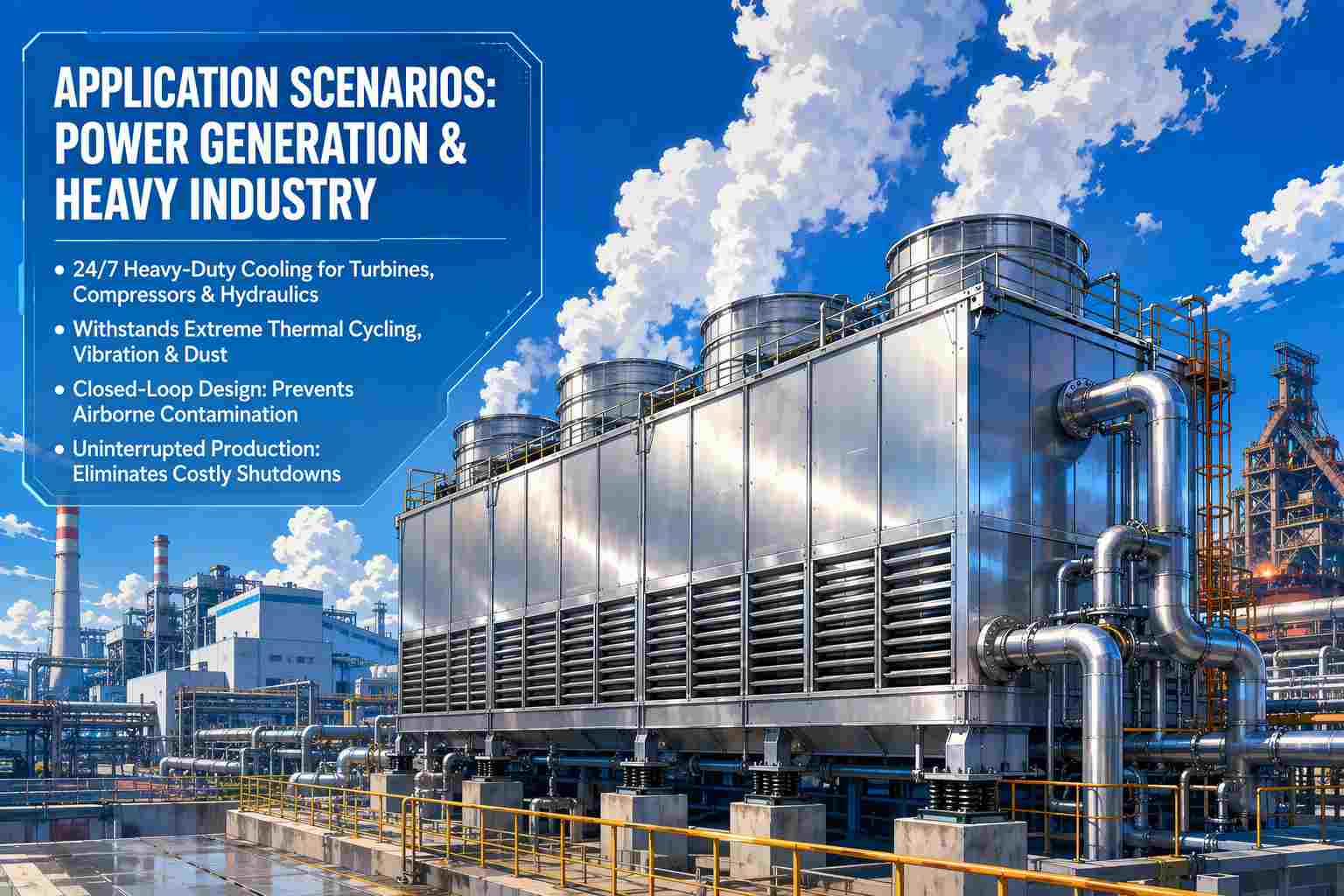
Power plants, steel mills, cement facilities, and heavy manufacturing operations generate enormous heat loads that require dependable, large-capacity cooling around the clock. The stainless steel cooling tower is deployed as part of the plant's auxiliary cooling water system, serving turbine lube oil coolers, generator air coolers, compressor intercoolers, and hydraulic systems. In these settings, the tower must tolerate vibration, dust, temperature swings, and continuous duty without faltering. Stainless steel construction handles the thermal cycling and water chemistry variations that cause galvanized towers to fail prematurely, while the closed circuit design keeps critical equipment cooling loops free from airborne particulate contamination. The practical value is uninterrupted production — because a cooling tower failure in a power plant or steel mill does not simply inconvenience operations, it forces load reductions or full shutdowns. A stainless steel tower delivers the reliability that high-value industrial processes require.
Parameter Specifications
|
|
||||||||||
|
Product |
Square Cross Flow Cooling Tower |
|||||||||
|
Model |
τ=28℃ |
Main Dimensions (mm) |
Air Volume m³/h |
Fan Diameter (mm) |
Motor Installed Capacity (kw) |
Weight (t) |
τ=28℃ |
Noise at standard point |
||
|
Total Height |
Length× |
self-weight |
operating weight |
|||||||
|
AHBLD/HBLD-300 |
300 |
4514 |
7250× 3810 |
167000 |
3400 |
7.5 |
5.85 |
13.38 |
/ |
59.0 |
|
AHBLD/HBLD-500 |
500 |
5230 |
8033× 4650 |
260000 |
4200 |
11.0 |
9.2 |
17.24 |
/ |
61.5 |
|
AHBLD/HBLD-700 |
700 |
5319 |
8930× 6640 |
370000 |
5000 |
18.5 |
12.95 |
26.05 |
/ |
62.6 |
|
AHBLCD/HBLCD-300 |
300 |
6230 |
10650× 3810 |
167000 |
3400 |
7.5 |
7.05 |
14.18 |
/ |
52.5 |
|
AHBLCD/HBLCD-500 |
500 |
7030 |
11640× 4650 |
260000 |
4200 |
11.0 |
10.8 |
18.84 |
/ |
53.7 |
|
AHBLCD/HBLCD-700 |
700 |
7180 |
12540× 6640 |
370000 |
5000 |
18.5 |
14.75 |
26.81 |
/ |
54.5 |
|
AHBLG/HBLG-300 |
/ |
4514 |
7250× 3810 |
200000 |
3400 |
11.0 |
6.13 |
13.66 |
300 |
64.5 |
|
AHBLG/HBLG-500 |
/ |
5230 |
8033× 4650 |
320000 |
4200 |
18.5 |
9.42 |
17.46 |
500 |
65.0 |
|
AHBLG/HBLG-700 |
/ |
5319 |
8930× 6640 |
450000 |
5000 |
30.0 |
13.19 |
26.29 |
700 |
66.0 |
|
The standard point noise is measured at a distance equal to the equivalent diameter of the air inlet window or its shield equivalent diameter, and 1.5 meters above the ground. The equivalent diameter Dₘis calculated by the formula: Dₘ= 1.13×Length×Width |
||||||||||
|
Payment |
T/T, Western Union. |
|||||||||
|
Service |
Customize and design the size and style according to requirements |
|||||||||
Related Products

Square Cross Flow HBLG-500 FRP Cooling Tower | Data Center & Industrial | Factory Export
Direct factory exporter of HBLG-500 square cross flow towers. UV-stabilized FRP body for data centers & chemical plants. Low pumping head, ISO export packing.

Square Cross Flow FRP Cooling Tower for Industrial HVAC | China Supplier
Square cross flow FRP cooling tower built for industrial HVAC and light manufacturing. Low water quality tolerance, easy basin access, factory-direct pricing from China. Get specs.

FRP Integrated Cooling Tower for Chemical & HVAC | Factory Direct CE certificate
Source directly from a China-based FRP cooling tower manufacturer. Corrosion-resistant integrated units engineered for chemical processing, data centers & HVAC. Request a factory quote.

FRP Integrated Cooling Tower for Chemical & Power Plant | Factory-direct Supplier
Factory-direct FRP integrated cooling towers for corrosive industrial plants. As a China-based exporter, we supply modular towers with corrosion-resistant shells for power & HVAC projects. Get a quote.
Contact us immediately to discuss your product project requirements
Navigation
Navigation
Contact Us
Tel.: +86 189 3266 2725
E-mail: sale@hbfortis.com
Add.: No.8-1, Zhenxing Street, Matun Town, Zaoqiang County, Hengshui City, Hebei Province
Get in Touch
Get in Touch