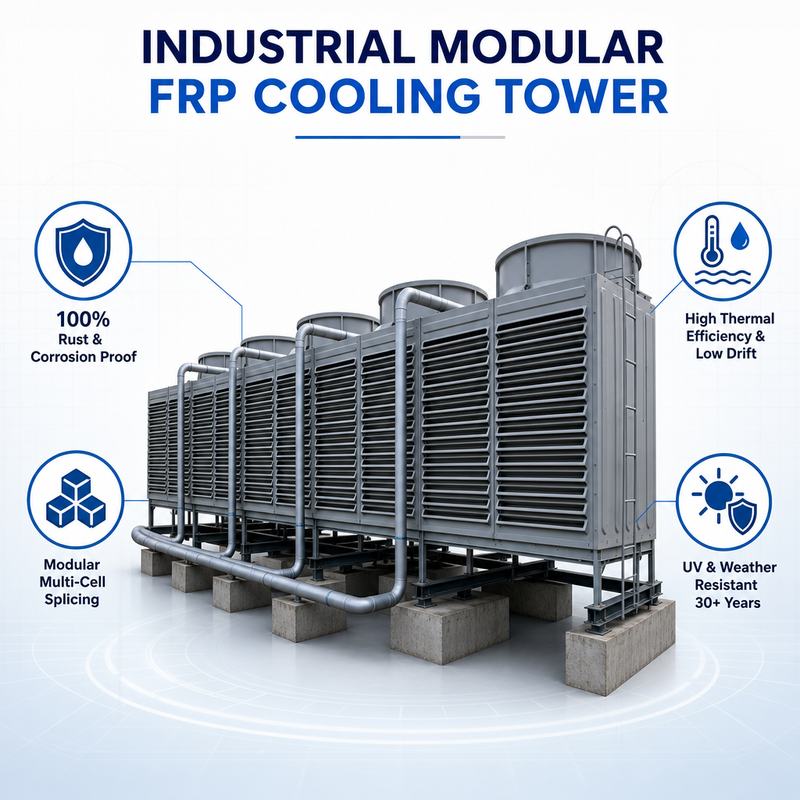
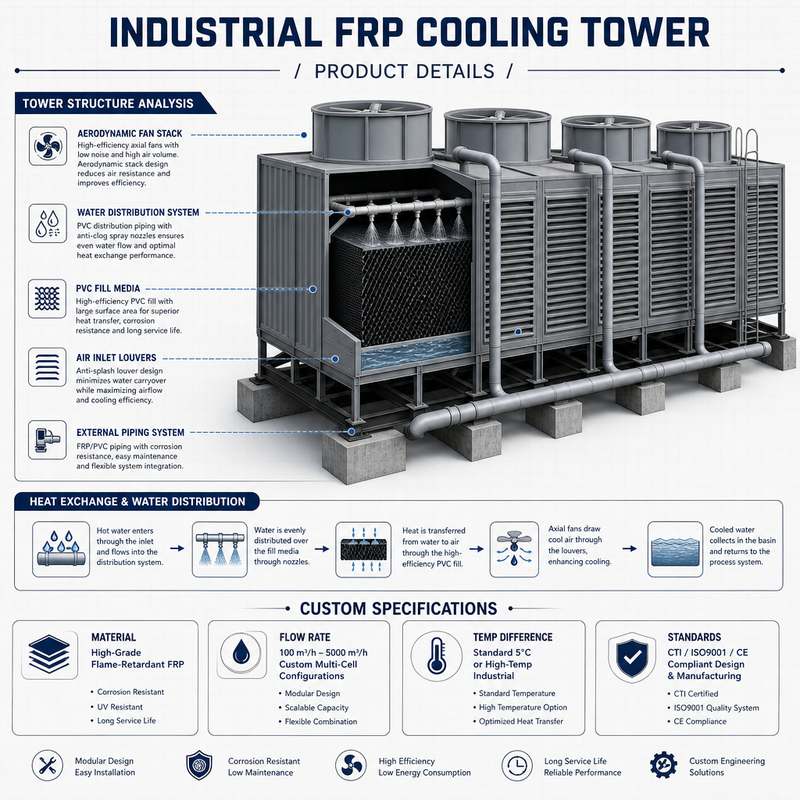
Most square cross flow towers force maintenance crews to climb into the basin to reach the fill media. Our design addresses this with a front-access fill removal path: the drift eliminators and fill sheets slide out from the air inlet face without dismantling the distribution basins above, and each fill sheet is supported on removable stainless hangers rather than bonded into the casing, so a single damaged sheet can be swapped in under an hour without cutting or re-glassing the FRP structure. For plants with limited water treatment—where scale and suspended solids accumulate faster than a counterflow unit would tolerate—this cross flow configuration keeps the gravity-fed distribution nozzles accessible from the exterior and allows visual inspection of water flow across the fill without shutting down the fan. The FRP panels are molded from isophthalic resin with a UV-stabilized gelcoat surface, and structural members are pultruded rather than hand-laid, which keeps wall thickness consistent across every unit and allows replacement sections to match the original mold dimensions rather than a "close enough" field-cut approximation. Units are available with CTI thermal performance certification and CE marking documentation for EU-bound shipments, and we welcome third-party inspection at our factory before crating, so buyers can verify panel thickness, resin content, and fan assembly tolerances against the approved drawings rather than relying on a certificate alone.

Hebei Fortis Technology Co., Ltd Product Brochure
Product Advantages
Axial fan and motor selections can be specified for reduced sound pressure levels, making the tower suitable for commercial HVAC, hospitals, hotels, and mixed-use developments where noise ordinances or tenant comfort impose strict limits. Fan stack geometry and inlet louver spacing are optimised to minimise turbulence and airflow separation, which lowers static pressure losses and reduces fan power draw at the design duty point. For projects pursuing energy benchmarks, the combination of low fan power and gravity-fed distribution—with no pump head for spray water—contributes measurable electrical savings over the operating life of the equipment.
The square planform allows towers to be arranged in multi-cell blocks or placed tight against walls and structural columns, which is often impossible with round or elongated counterflow units. For rooftop HVAC retrofits and mechanical rooms where the available slab area is fixed by the existing building, this geometry lets a replacement tower match or improve on the original cooling capacity without structural modification. Multi-cell arrangements share a common basin and inlet plenum, reducing the number of piping connections and the overall footprint per unit of cooling duty.
The cross flow layout places the fill media and drift eliminators directly behind the air inlet louvers, so maintenance crews can slide out individual fill sheets from outside the casing without entering the basin or dismantling the hot water distribution deck above. Each sheet rests on removable stainless hangers rather than being bonded into the FRP structure, which means a single damaged or fouled sheet can be pulled and replaced in under an hour by two technicians working from the inlet face. For facilities running continuous HVAC or light manufacturing loads, this accessibility turns what is typically a full-day shutdown into a short, scheduled interruption that can be planned around production.
Application Scenarios
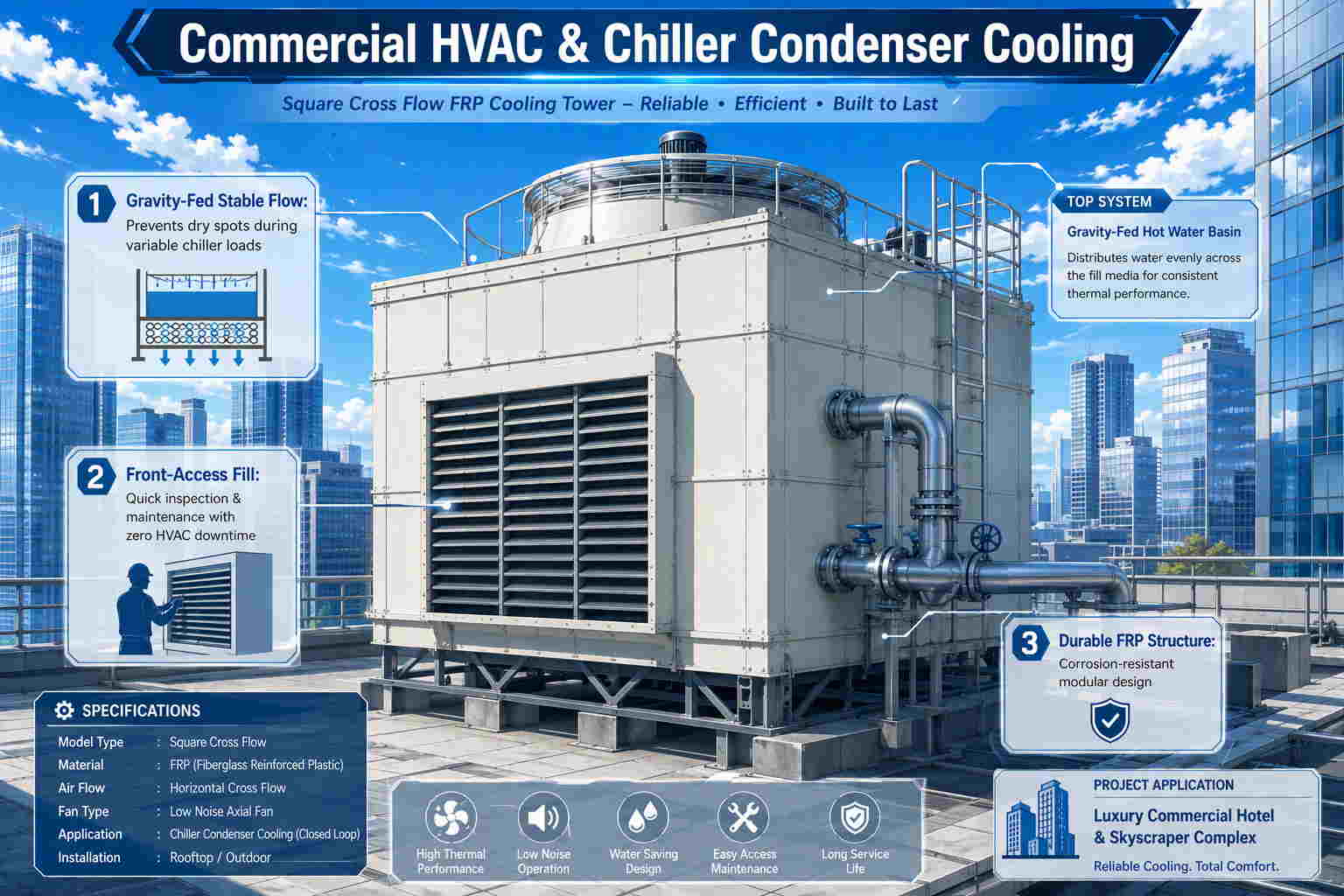
Square cross flow FRP towers are commonly specified for central air-conditioning and mechanical ventilation systems in hotels, office buildings, hospitals, and mixed-use developments. In these deployments, the tower rejects heat from chiller condensers, operating on a continuous but often variable load as building occupancy and outdoor temperatures fluctuate. The cross flow configuration’s gravity-fed distribution basin maintains stable water flow even at reduced demand, preventing dry spots in the fill that would degrade cooling efficiency during part-load operation. For facility managers, the practical value lies in the front-access fill design: routine inspection and replacement of fouled fill sheets can be performed from the air inlet face without entering the basin or shutting down the chiller plant, which is critical for buildings where HVAC downtime directly affects tenant comfort and lease obligations.
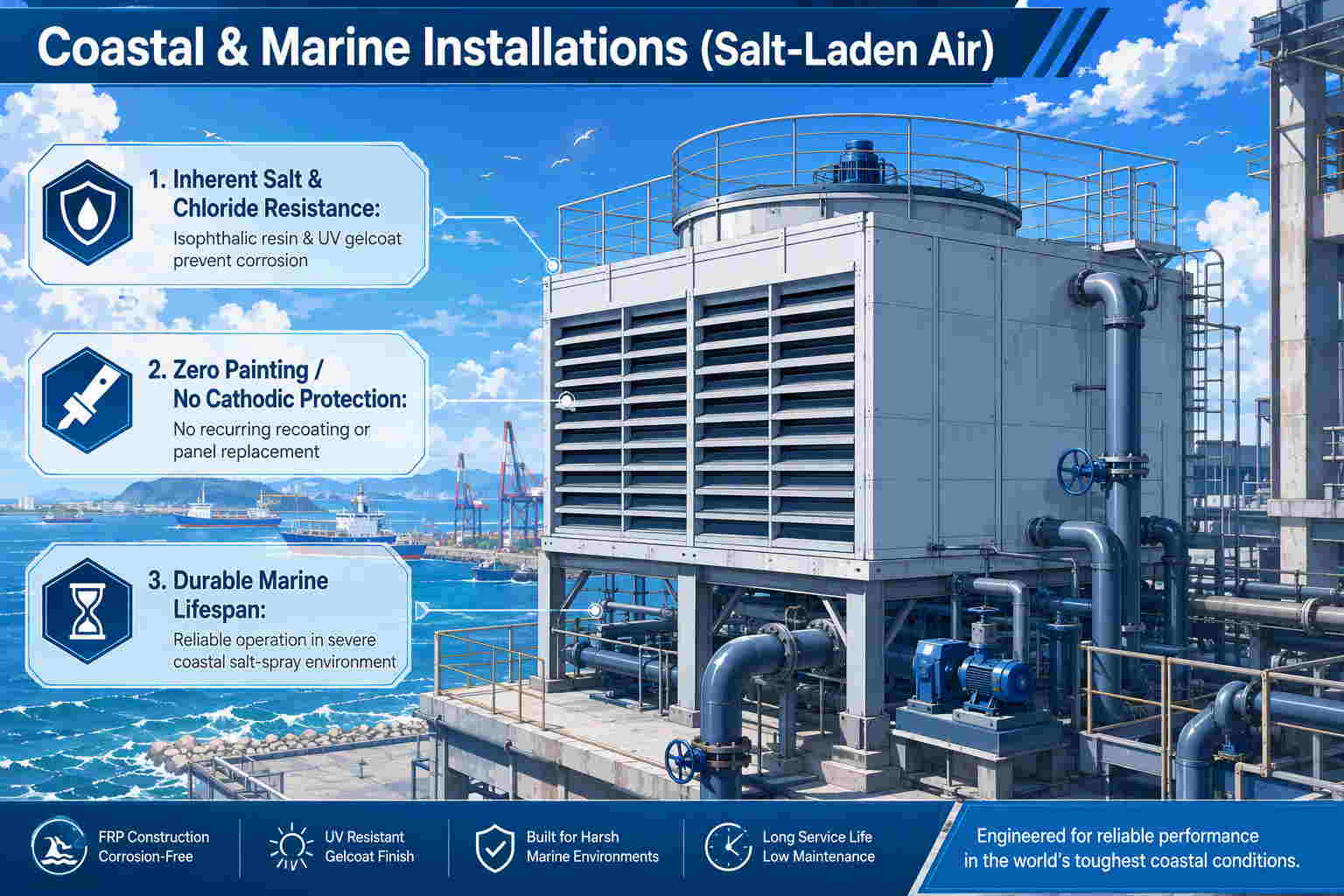
Facilities located near coastlines—port operations, seaside resorts, offshore support bases, and coastal manufacturing plants—face an atmospheric corrosion environment that rapidly degrades galvanised steel and concrete cooling towers. The FRP construction of the square cross flow tower provides inherent resistance to chlorides and salt spray, with isophthalic resin and UV-stabilised gelcoat protecting the casing and structural members from both atmospheric attack and sunlight degradation. Unlike steel towers that require periodic recoating and eventual panel replacement, the FRP shell maintains its integrity without cathodic protection or paint systems. For owners of coastal assets, this translates to a cooling tower that does not become a recurring maintenance liability tied to the corrosive marine atmosphere.
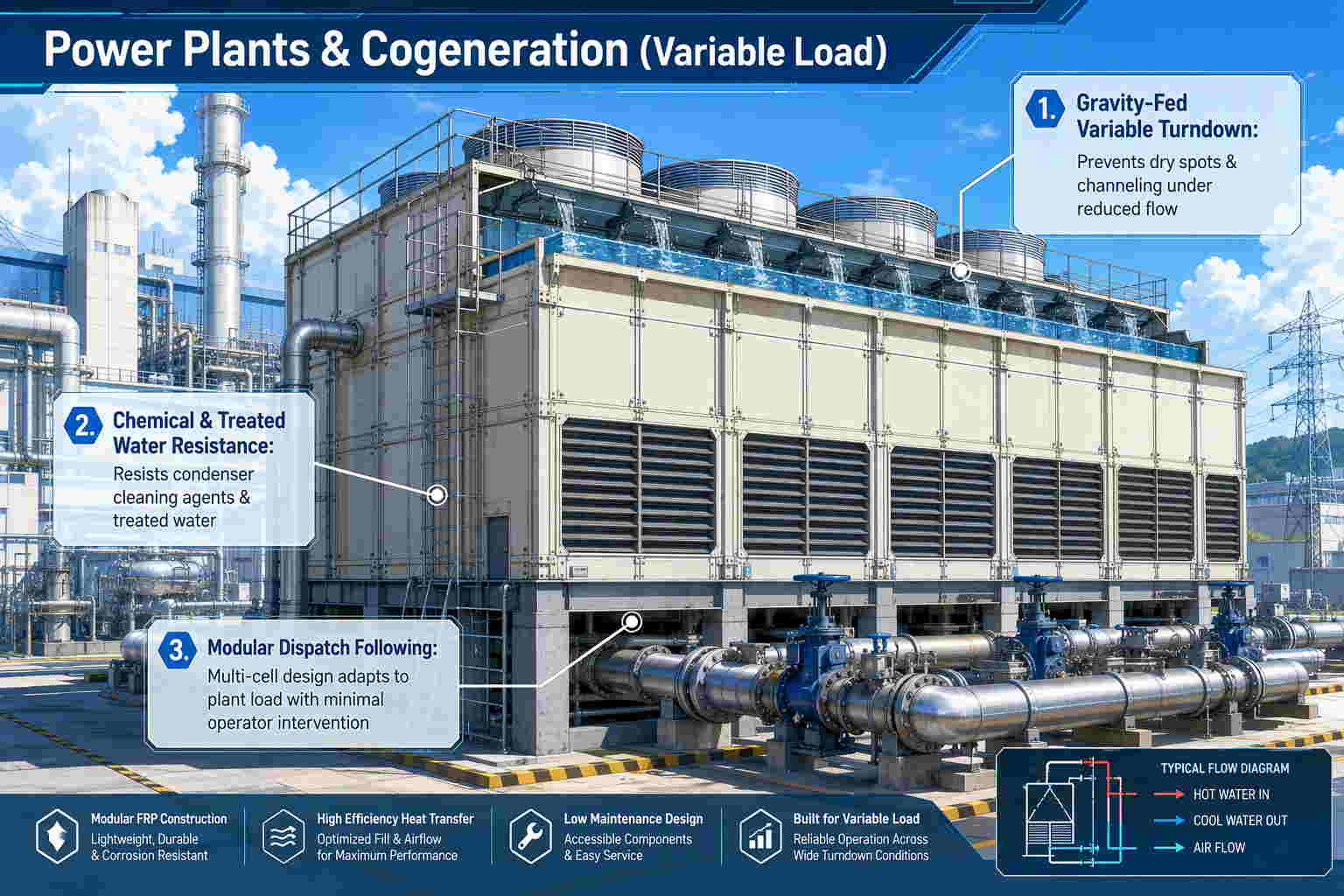
Small power plants, cogeneration units, and waste-to-energy facilities use cooling towers to reject heat from condensers and auxiliary systems, often under variable load as generation dispatch changes. The square cross flow FRP tower's gravity distribution system maintains even water coverage across the fill at reduced flow rates, avoiding the dry-fill and channeling problems that can occur in pressurised spray systems when flow is turned down. The FRP construction resists the corrosion caused by treated cooling water and the occasional chemical cleaning used in power plant condenser systems, and the modular cell arrangement allows the tower to be sized for future capacity while operating efficiently at current load. The practical benefit is a cooling tower that follows the plant's dispatch profile without requiring constant operator intervention to adjust water distribution.
Parameter Specifications
|
|
||||||||||
|
Product |
Square Cross Flow Cooling Tower |
|||||||||
|
Model |
τ=28℃ |
Main Dimensions (mm) |
Air Volume m³/h |
Fan Diameter (mm) |
Motor Installed Capacity (kw) |
Weight (t) |
τ=28℃ |
Noise at standard point |
||
|
Total Height |
Length× |
self-weight |
operating weight |
|||||||
|
AHBLD/HBLD-300 |
300 |
4514 |
7250× 3810 |
167000 |
3400 |
7.5 |
5.85 |
13.38 |
/ |
59.0 |
|
AHBLD/HBLD-500 |
500 |
5230 |
8033× 4650 |
260000 |
4200 |
11.0 |
9.2 |
17.24 |
/ |
61.5 |
|
AHBLD/HBLD-700 |
700 |
5319 |
8930× 6640 |
370000 |
5000 |
18.5 |
12.95 |
26.05 |
/ |
62.6 |
|
AHBLCD/HBLCD-300 |
300 |
6230 |
10650× 3810 |
167000 |
3400 |
7.5 |
7.05 |
14.18 |
/ |
52.5 |
|
AHBLCD/HBLCD-500 |
500 |
7030 |
11640× 4650 |
260000 |
4200 |
11.0 |
10.8 |
18.84 |
/ |
53.7 |
|
AHBLCD/HBLCD-700 |
700 |
7180 |
12540× 6640 |
370000 |
5000 |
18.5 |
14.75 |
26.81 |
/ |
54.5 |
|
AHBLG/HBLG-300 |
/ |
4514 |
7250× 3810 |
200000 |
3400 |
11.0 |
6.13 |
13.66 |
300 |
64.5 |
|
AHBLG/HBLG-500 |
/ |
5230 |
8033× 4650 |
320000 |
4200 |
18.5 |
9.42 |
17.46 |
500 |
65.0 |
|
AHBLG/HBLG-700 |
/ |
5319 |
8930× 6640 |
450000 |
5000 |
30.0 |
13.19 |
26.29 |
700 |
66.0 |
|
The standard point noise is measured at a distance equal to the equivalent diameter of the air inlet window or its shield equivalent diameter, and 1.5 meters above the ground. The equivalent diameter Dₘis calculated by the formula: Dₘ= 1.13×Length×Width |
||||||||||
|
Features |
The FRP cooling tower serves not only as a temperature regulator but also delivers an efficient, durable, and maintenance-free solution with optimized lifecycle costs. By harnessing the unique properties of FRP materials, it fundamentally addresses the critical challenges of corrosion and lifespan limitations in harsh operating environments, making it the go-to choice for cooling systems in modern industrial and commercial facilities. |
|||||||||
|
Application
|
Central air conditioning system: refrigeration station for commercial buildings, hotels and hospitals. |
|||||||||
|
Industrial refrigeration: process cooling for food processing, chemical, pharmaceutical and plastic industries. |
||||||||||
|
Power industry: auxiliary cooling system for thermal power plant and nuclear power plant. |
||||||||||
|
Manufacturing industry: circulating water cooling for metallurgical and mechanical processing plants. |
||||||||||
|
Data center: Provides cooling water for server rooms. |
||||||||||
|
Payment |
T/T, Western Union. |
|||||||||
|
Service |
Customize and design the size and style according to requirements |
|||||||||
Related Products

Square Cross Flow HBLG-500 FRP Cooling Tower | Data Center & Industrial | Factory Export
Direct factory exporter of HBLG-500 square cross flow towers. UV-stabilized FRP body for data centers & chemical plants. Low pumping head, ISO export packing.

Stainless Steel Cooling Tower for HVAC & Industrial Process | Factory-Direct Export
Direct from our ISO-certified factory: SUS304/316L stainless steel cooling towers engineered for corrosive environments & HVAC plants. Request export quote & specs.

FRP Integrated Cooling Tower for Chemical & HVAC | Factory Direct CE certificate
Source directly from a China-based FRP cooling tower manufacturer. Corrosion-resistant integrated units engineered for chemical processing, data centers & HVAC. Request a factory quote.

FRP Integrated Cooling Tower for Chemical & Power Plant | Factory-direct Supplier
Factory-direct FRP integrated cooling towers for corrosive industrial plants. As a China-based exporter, we supply modular towers with corrosion-resistant shells for power & HVAC projects. Get a quote.
Contact us immediately to discuss your product project requirements
Navigation
Navigation
Contact Us
Tel.: +86 189 3266 2725
E-mail: sale@hbfortis.com
Add.: No.8-1, Zhenxing Street, Matun Town, Zaoqiang County, Hengshui City, Hebei Province
Get in Touch
Get in Touch