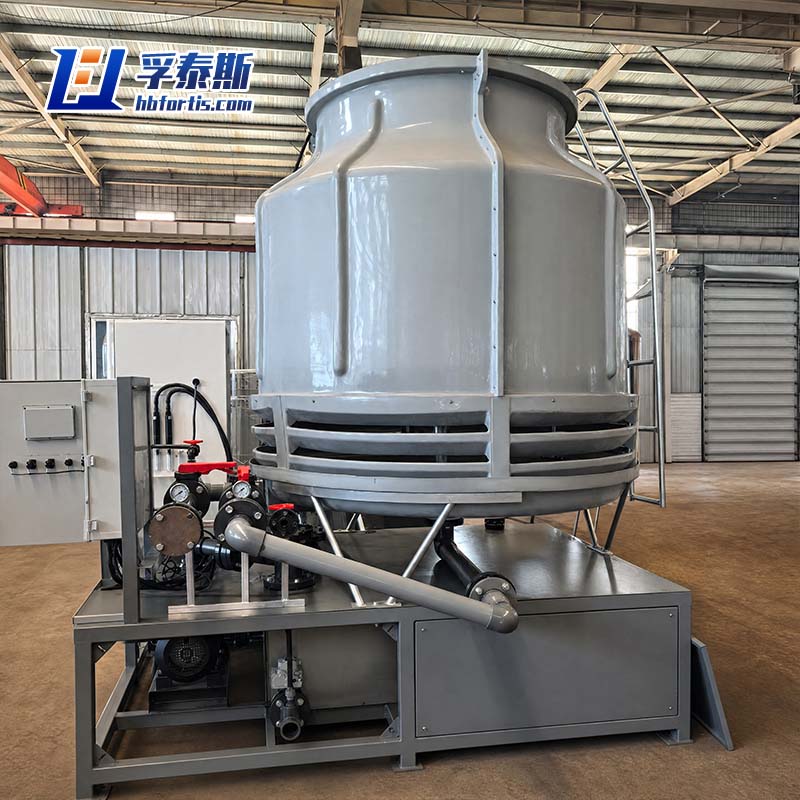
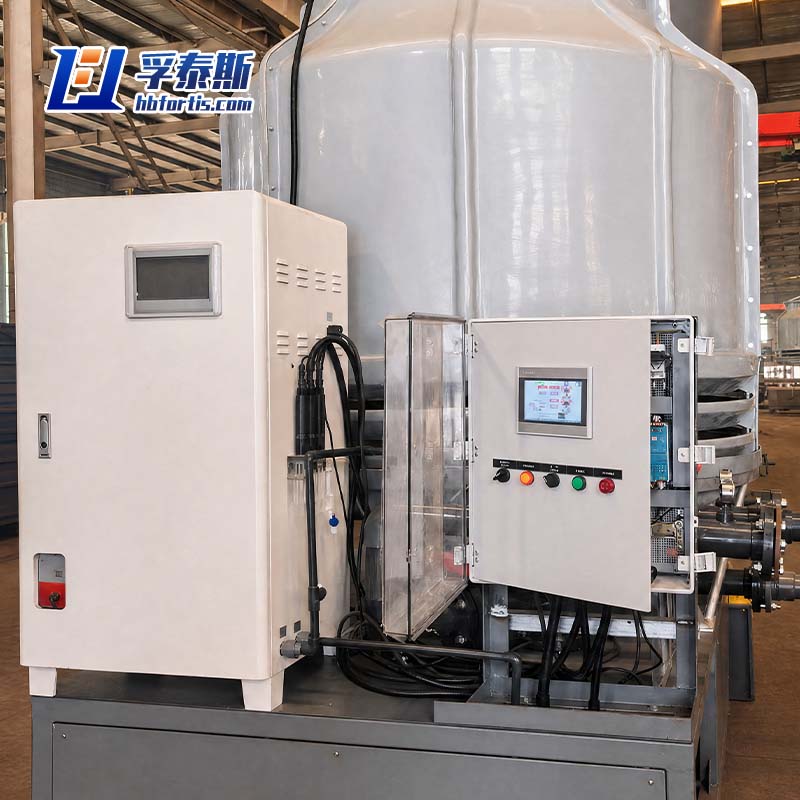
We are a Chinese fiberglass manufacturing plant that builds FRP integrated cooling towers as single pre-assembled units — basin, internal piping, fill, and fan stack molded and factory-tested before shipment — for HVAC rooftop systems, industrial process cooling, and plant retrofits where slab space and structural load are fixed constraints. Because we mold the shell in-house from corrosion-resistant FRP rather than assembling bolted panels, our towers hold up in coastal, chemical, and food-processing environments where galvanized steel units rust within a few seasons, and the compact integrated envelope cuts on-site rigging and connection work to a fraction of what field-erected towers demand. As a direct exporter rather than a trading intermediary, we handle thermal selection ourselves: send your inlet and outlet water temperatures, flow rate, design wet-bulb condition, and site power specification, and our engineering team returns a selection drawing with dimensional data and an FOB or CIF quotation — usually within one working day. We also specify motor voltage, frequency, and enclosure rating per destination market, provide low-noise fan and motor configurations for hospital, office, and municipal rooftop installations, and pack each unit sea-worthy so multiple towers load efficiently into 20ft or 40ft containers. Non-standard requests — custom resin grades, modified basin depths, alternative voltage packages — are handled in-house without the relay delays that come from routing requirements through a trader to a third-party factory, which is why contractors, MEP consultants, and facility owners sourcing FRP integrated cooling towers for export projects work with us directly from the first heat-load calculation through to container loading.

Hebei Fortis Technology Co., Ltd Product Brochure
Product Advantages
Unlike field-erected towers that arrive as loose panels and require skilled crews to bolt, seal, and align on the roof, our FRP integrated cooling tower leaves the plant as a single pre-assembled unit with the basin, internal piping, and fan stack already fitted and factory-tested. Overseas contractors receive a drop-in module: rig it into position, connect the inlet/outlet flanges and power supply, and commission. This typically removes several days of site work per unit and eliminates the risk of field-assembly leaks at panel joints — a common failure point in bolted fiberglass towers.
The tower body is molded from fiberglass-reinforced polyester in a single continuous shell rather than assembled from separate wall sections, so there are no gasketed seams for moisture and chlorides to attack. The resin formulation is selected for resistance to cooling-water chemistry and coastal air, making the unit suitable for seaside installations, chemical plants, and food-processing environments where galvanized steel towers show rust within a few seasons. The smooth molded interior also resists biofilm buildup, which supports more stable thermal performance between cleaning cycles.
As the manufacturing plant rather than a trading intermediary, we handle the thermal selection in-house: send your required inlet and outlet water temperatures, flow rate, wet-bulb design condition, and site power specification, and our engineering team returns a selection drawing with dimensional data and an FOB or CIF quotation — typically within one working day. Because the design and production sit under one roof, non-standard requests such as custom voltage packages, alternative resin grades, or modified basin depths are handled without the back-and-forth delays that occur when a trader must relay requirements to a third-party factory.
Application Scenarios
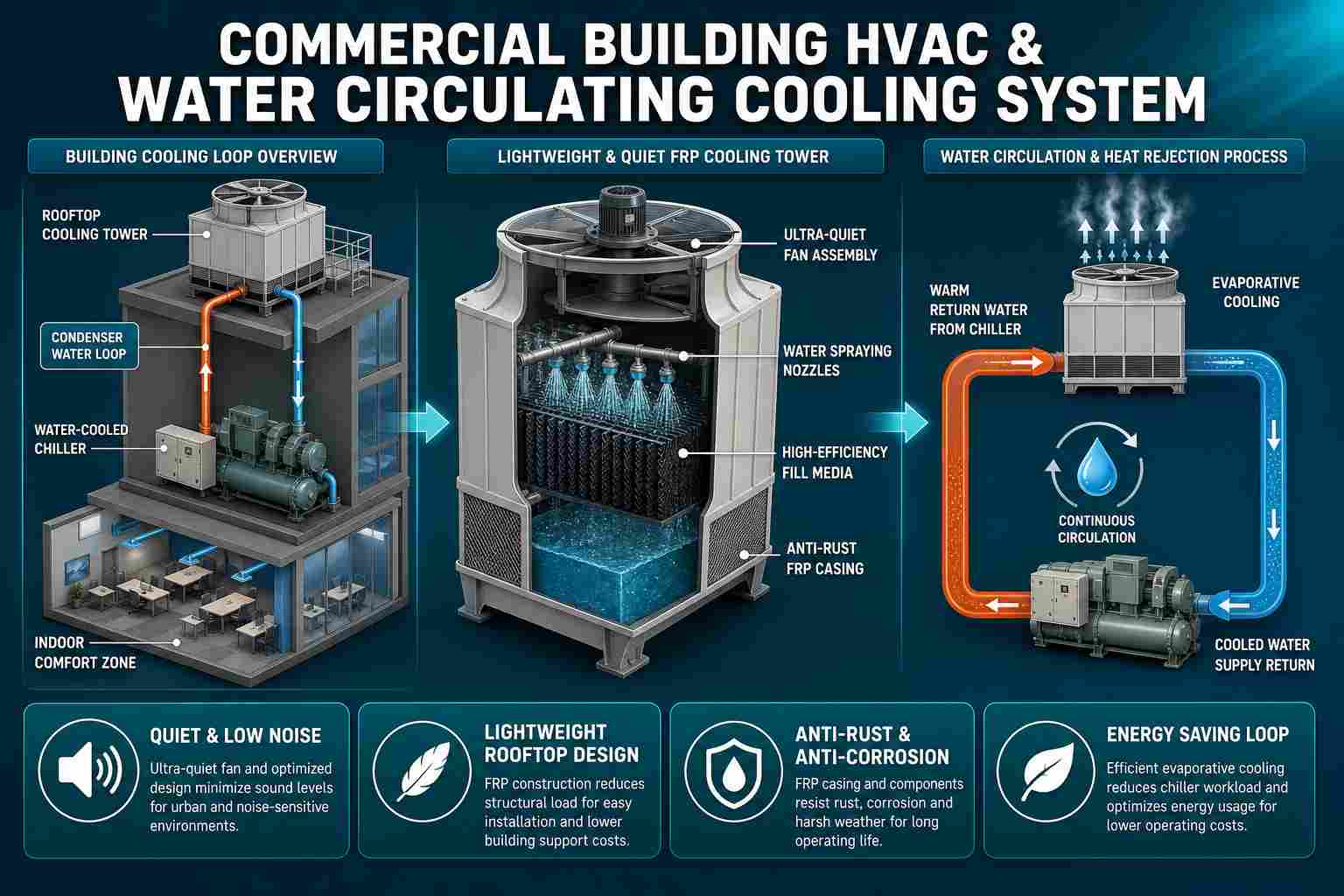
In HVAC and commercial building cooling systems, the FRP cooling tower works by taking warm return water from chillers or air-conditioning condensers, spraying it over the fill media where air flow induces evaporation and heat rejection, and then returning the cooled water to the chiller to absorb heat again in a continuous cycle. The advantages include quiet operation, lightweight and compact design suitable for rooftop or tight installations, resistance to rust and corrosion for extended durability, and low maintenance requirements, all of which contribute to energy savings, consistent indoor comfort, and reduced long-term ownership costs.
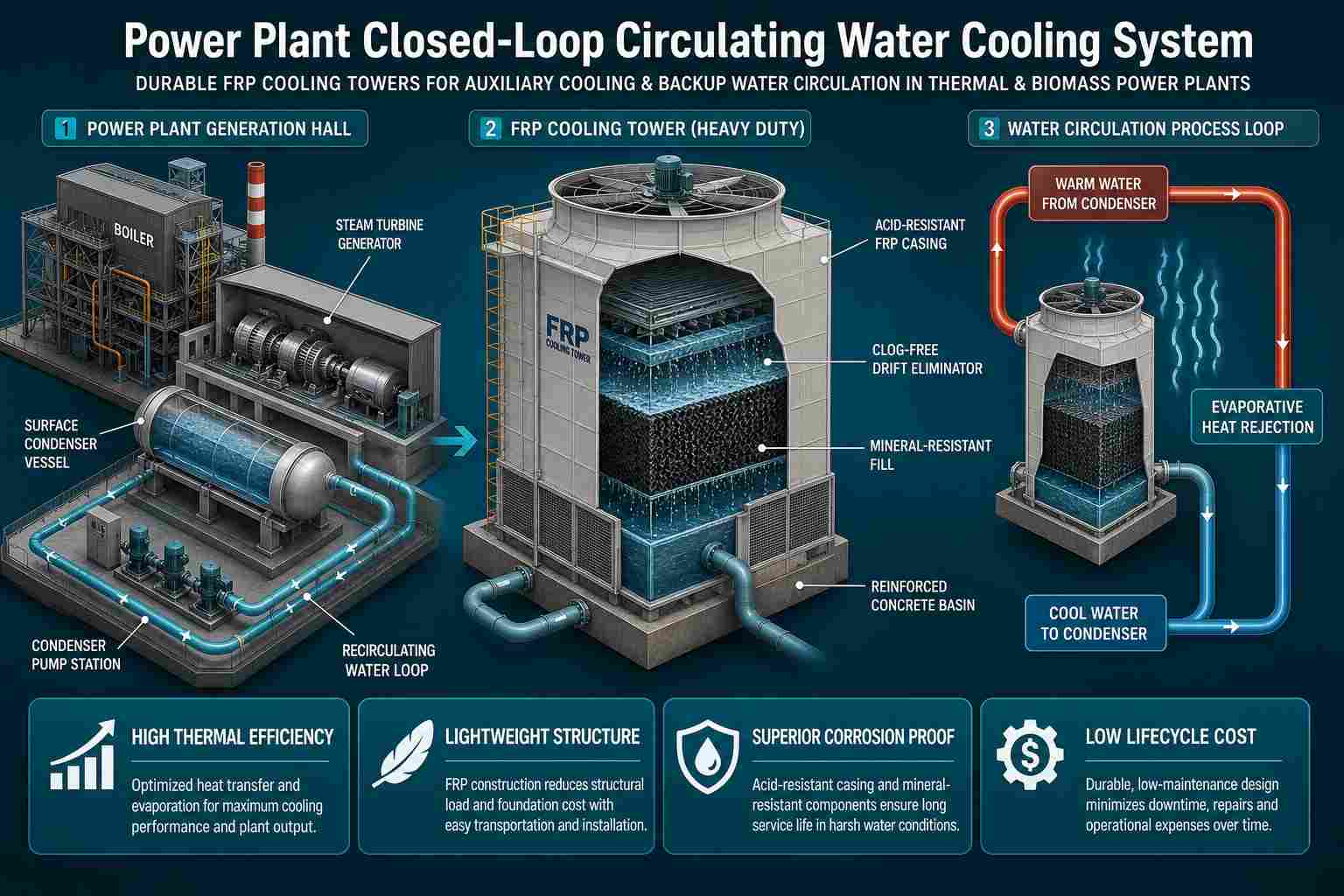
In power generation facilities, the FRP cooling tower functions by receiving heated condenser cooling water from turbines, pumping it to the top of the tower for distribution over fill media, where partial evaporation and air contact lower the water temperature before it is recirculated back to the condenser in a closed-loop system. The main benefits here are high thermal efficiency, low weight that simplifies structural support and installation, and superior corrosion resistance that withstands constant moisture and chemical treatment agents, thereby ensuring long-term operational reliability, reduced downtime, and lower overall lifecycle costs for power plants.
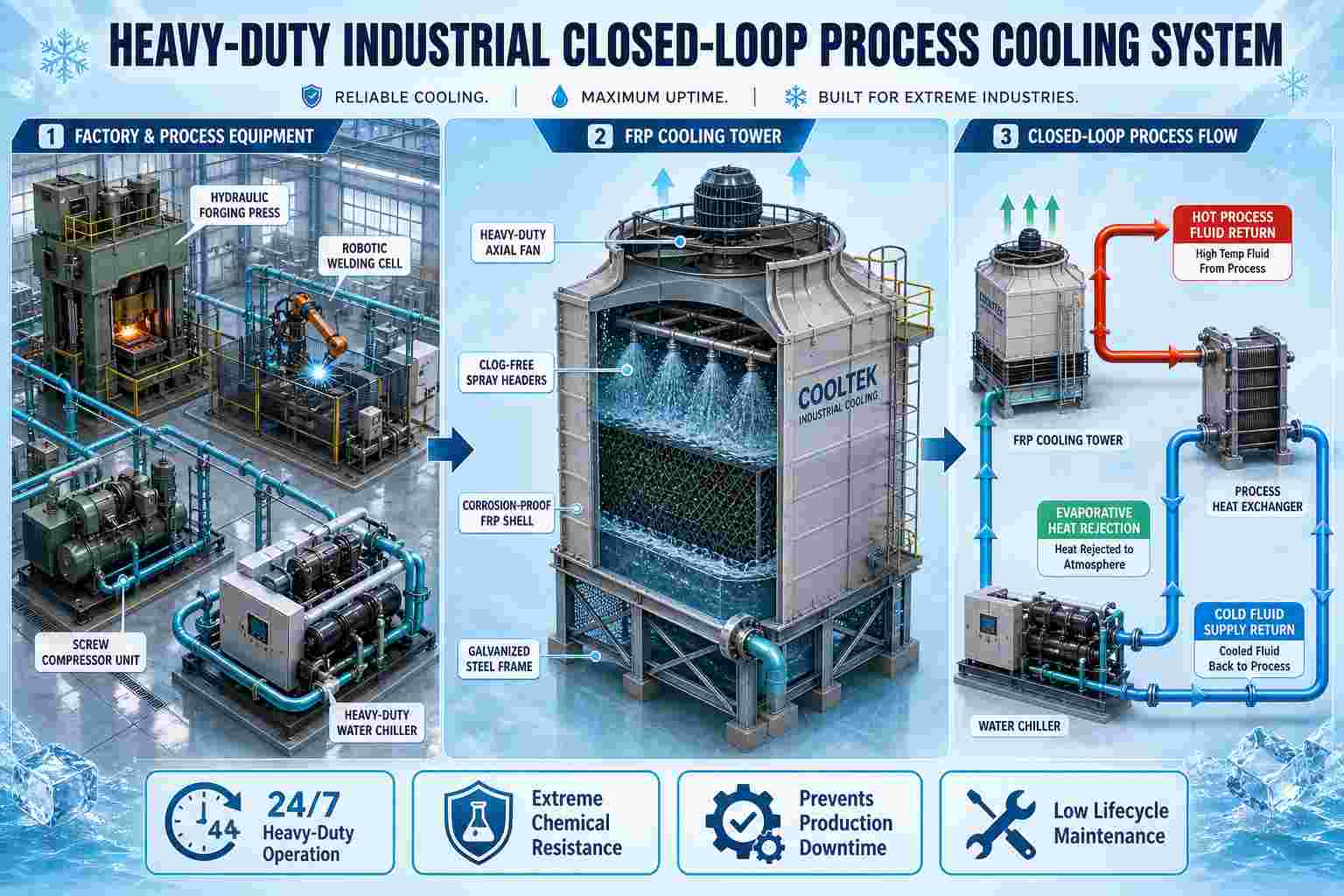
In industrial manufacturing environments, the FRP cooling tower operates by circulating hot cooling water from welding machines, hydraulic systems, compressors, and injection molding equipment through the tower, where it is distributed over FRP fill media and cooled via evaporative heat transfer as air is drawn through by fans, after which the cooled water is collected in the basin and returned to the equipment cooling loop. The key advantages in this setting include strong resistance to corrosion from industrial contaminants, oils, and chemical residues in the cooling water, a lightweight yet rugged FRP structure that withstands demanding round-the-clock operations, and reliable, continuous cooling that prevents equipment overheating and production downtime while reducing maintenance costs and extending service life in harsh factory conditions.
Parameter Specifications
|
Product |
FRP Integrated Cooling Tower |
|||||||||
|
|
||||||||||
|
Model |
τ=27℃ |
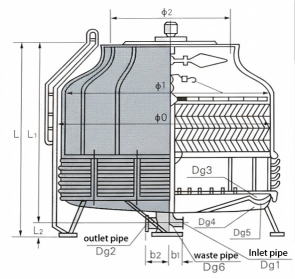
Main Dimensions (mm) |
Air Volume m³/h |
Fan Diameter (mm) |
Motor Power (kw) |
weight (kg) |
inlet pressure 10⁴Pa |
noise at 10m dB (A) |
||
|
Total Height |
Maximum Diameter |
self-weight |
operating weight |
|||||||
|
DBNL3J-12 |
15 |
2333 |
1210 |
7200 |
700 |
0.6 |
217 |
775 |
1.96 |
40.3 |
|
DBNL3J-20 |
24 |
2423 |
1460 |
12400 |
800 |
0.8 |
244 |
958 |
2 |
41.1 |
|
DBNL3J-30 |
35 |
2642 |
1912 |
18000 |
1200 |
0.8 |
424 |
1734 |
2.21 |
43.5 |
|
DBNL3J-40 |
46 |
3142 |
1912 |
21500 |
1200 |
1.1 |
496 |
1896 |
2.6 |
43.5 |
|
DBNL3J-50 |
57 |
3130 |
2215 |
28000 |
1400 |
1.5 |
617 |
2505 |
2.65 |
44.7 |
|
DBNL3J-60 |
68 |
3430 |
2215 |
32300 |
1400 |
1.5 |
667 |
2829 |
2.78 |
45.7 |
|
DBNL3J-70 |
79 |
3444 |
2629 |
39200 |
1600 |
2.2 |
824 |
3816 |
3.03 |
47 |
|
DBNL3J-80 |
92 |
3744 |
2629 |
43400 |
1600 |
2.2 |
909 |
4240 |
2.86 |
47.5 |
|
DBNL3J-100 |
114 |
3694 |
3134 |
56000 |
1800 |
3 |
1014 |
5932 |
3.15 |
50 |
|
DBNL3J-125 |
142 |
3944 |
3134 |
67200 |
1800 |
4 |
1104 |
6158 |
3.15 |
50.7 |
|
DBNL3J-150 |
171 |
3953 |
3732 |
84000 |
2400 |
4 |
1744 |
8246 |
2.9 |
52 |
|
DBNL3J-175 |
200 |
4203 |
3732 |
94300 |
2400 |
5.5 |
1884 |
8582 |
3.15 |
53 |
|
DBNL3J-200 |
231 |
4235 |
4342 |
112000 |
2800 |
5.5 |
2208 |
11210 |
3.01 |
54.6 |
|
DBNL3J-250 |
283 |
4485 |
4342 |
134300 |
2800 |
7.5 |
2420 |
11983 |
3.26 |
55.6 |
|
DBNL3J-300 |
334 |
4623 |
5134 |
168000 |
3400 |
11 |
3648 |
17173 |
3.5 |
56.8 |
|
DBNL3J-350 |
395 |
4873 |
5134 |
187400 |
3800 |
11 |
3950 |
17850 |
3.75 |
57.3 |
|
DBNL3J-400 |
455 |
5018 |
6044 |
224000 |
3800 |
11 |
4406 |
23132 |
3.6 |
58.8 |
|
DBNL3J-450 |
514 |
5268 |
6044 |
242000 |
3800 |
11 |
4752 |
24510 |
3.85 |
58.8 |
|
DBNL3J-500 |
576 |
5619 |
6746 |
280000 |
4200 |
15 |
5887 |
30062 |
3.7 |
60 |
|
DBNL3J-600 |
680 |
6119 |
6746 |
302200 |
4200 |
18.5 |
6689 |
32164 |
4.2 |
61 |
|
Features |
The FRP cooling tower serves not only as a temperature regulator but also delivers an efficient, durable, and maintenance-free solution with optimized lifecycle costs. By harnessing the unique properties of FRP materials, it fundamentally addresses the critical challenges of corrosion and lifespan limitations in harsh operating environments, making it the go-to choice for cooling systems in modern industrial and commercial facilities. |
|||||||||
|
Application
|
Central air conditioning system: refrigeration station for commercial buildings, hotels and hospitals. |
|||||||||
|
Industrial refrigeration: process cooling for food processing, chemical, pharmaceutical and plastic industries. |
||||||||||
|
Power industry: auxiliary cooling system for thermal power plant and nuclear power plant. |
||||||||||
|
Manufacturing industry: circulating water cooling for metallurgical and mechanical processing plants. |
||||||||||
|
Data center: Provides cooling water for server rooms. |
||||||||||
|
Payment |
T/T, Western Union. |
|||||||||
|
Service |
Customize and design the size and style according to requirements |
|||||||||
Related Products

Square Cross Flow HBLG-500 FRP Cooling Tower | Data Center & Industrial | Factory Export
Direct factory exporter of HBLG-500 square cross flow towers. UV-stabilized FRP body for data centers & chemical plants. Low pumping head, ISO export packing.

Stainless Steel Cooling Tower for HVAC & Industrial Process | Factory-Direct Export
Direct from our ISO-certified factory: SUS304/316L stainless steel cooling towers engineered for corrosive environments & HVAC plants. Request export quote & specs.

Square Cross Flow FRP Cooling Tower for Industrial HVAC | China Supplier
Square cross flow FRP cooling tower built for industrial HVAC and light manufacturing. Low water quality tolerance, easy basin access, factory-direct pricing from China. Get specs.

FRP Integrated Cooling Tower for Chemical & HVAC | Factory Direct CE certificate
Source directly from a China-based FRP cooling tower manufacturer. Corrosion-resistant integrated units engineered for chemical processing, data centers & HVAC. Request a factory quote.
Contact us immediately to discuss your product project requirements
Navigation
Navigation
Contact Us
Tel.: +86 189 3266 2725
E-mail: sale@hbfortis.com
Add.: No.8-1, Zhenxing Street, Matun Town, Zaoqiang County, Hengshui City, Hebei Province
Get in Touch
Get in Touch