As a direct manufacturer of FRP cable trunking, we focus on solving the cable management challenges in highly aggressive environments where galvanized steel fails rapidly. Our fiberglass reinforced plastic trunking is pultruded with UV inhibitors and anti-static agents, specifically formulated for chemical processing plants and coastal marine installations. Unlike trading companies, we control the entire production cycle—from resin formulation and continuous pultrusion to precision machining and final assembly—allowing us to offer customized wall thicknesses, non-standard fitting dimensions and project-specific colors without middleman markups. Every batch is tested for flexural strength, impact resistance and surface resistivity before shipment, and we supply documented material test reports, third-party inspection support and load-span calculation data for international project tenders. For wastewater treatment retrofits, offshore platforms and tunnel cable routing, our engineering team reviews your cable schedule and delivers a complete trunking layout—including straight sections, T-elbows, reducers and mounting brackets—within 7 working days. We also handle export packing, fumigation-free crating and container loading plans, so distributors and EPC contractors receive a factory-direct solution that is ready for site installation, not just a box of profiles.

Hebei Fortis Technology Co., Ltd Product Brochure
Product Advantages
FRP cable trunking is engineered to resist attack from acids, alkalis, salts and oxidizing agents that rapidly degrade galvanized steel and even stainless steel in aggressive settings. The thermoset resin matrix does not rust, pit or galvanically corrode, which means no protective coating to chip, reapply or inspect over the service life. In chemical plants, wastewater treatment facilities and coastal marine installations, this translates into a cable management system that maintains structural integrity for decades rather than requiring replacement every few years.
Pultruded fiberglass reinforced plastic delivers tensile and flexural strength comparable to steel at roughly one-quarter of the weight. A standard 3-meter trunking section can typically be handled by one or two workers without lifting equipment, reducing installation labor and crane costs on site. The lighter weight also lowers structural load on supporting brackets and overhead cable racks, which is particularly advantageous in retrofit projects where existing steelwork cannot be reinforced.
Unlike metallic trunking, FRP does not conduct electricity, eliminating the risk of short circuits caused by accidental contact between cables and the enclosure. This inherent dielectric property makes it suitable for power distribution routes in substations, battery rooms and industrial control cabinets where safety isolation is critical. No separate insulating liner or grounding bond is required, simplifying both design and inspection.
Application Scenarios
In chemical plants, cable routes often pass through areas where acid vapors, caustic spills and solvent exposure are routine. FRP cable trunking is deployed along pipe racks, through pump rooms and between reactor columns, carrying power and instrumentation cables above or beside corrosive process lines. The pultruded composite resists attack from hydrochloric acid, sulfuric acid, sodium hydroxide and organic solvents that would strip the zinc coating from galvanized steel within months and cause pitting in stainless steel under chloride-rich conditions. The trunking eliminates the recurring cost of recoating, replacing corroded sections and inspecting coating integrity during plant turnarounds. For plant operators, this means cable routes remain intact through multi-year operating campaigns, reducing unplanned downtime linked to cable damage and lowering maintenance labor in areas requiring permit-controlled access.

Wastewater treatment plants expose cable management systems to hydrogen sulfide, chlorine, high humidity and alternating wet-dry cycles. FRP trunking is installed in aeration basins, sludge handling buildings, chemical dosing rooms and membrane filtration halls, routing cables for pumps, blowers, sensors and SCADA systems. The composite does not corrode under continuous moisture exposure and resists the sulfuric acid that forms when hydrogen sulfide condenses on surfaces. Where galvanized steel trunking fails at joints and support brackets within a few years, FRP maintains structural continuity without cathodic protection or protective wraps. The practical value is a cable route that survives the design life of the treatment facility, avoiding the difficult and costly task of replacing trunking above operating basins and inside confined chemical rooms.

On docksides, offshore platforms, FPSO vessels and port cargo handling areas, salt-laden air and wave spray create a severe galvanic corrosion environment. FRP cable trunking is deployed on open decks, in pump rooms, along jetty pipe racks and inside ballast water treatment spaces, carrying power, control and communication cables. The non-metallic composite eliminates galvanic corrosion entirely and does not require the sacrificial anodes or specialized coatings needed to protect steel trunking in marine atmospheres. It also avoids the spark risk associated with metallic enclosures in areas where flammable vapors may be present. For offshore operators and port authorities, this delivers a cable management system that requires no coating maintenance between dry-docking intervals and reduces weight on deck structures compared with steel alternatives.

Road tunnels, rail tunnels and underground utility galleries require cable routes that resist humidity, seepage water and vehicle exhaust residues while remaining accessible for inspection. FRP trunking is mounted along tunnel walls and in dedicated service ducts, carrying lighting circuits, ventilation control cables, fire alarm wiring and communication lines. The composite resists moisture ingress and does not rust at cut edges or fixing points, which are common failure locations in galvanized trunking installed in damp tunnels. Its electrical insulating property adds a safety margin where cables run close to traction power systems, and the lightweight sections allow installation in confined spaces without heavy lifting equipment. The value for tunnel operators is a cable route with predictable service life and reduced maintenance access requirements in high-traffic tunnels where lane closures are expensive.

Parameter Specifications
|
Product |
FRP Cable Trunking |
|||
|
|
||||
|
Model |
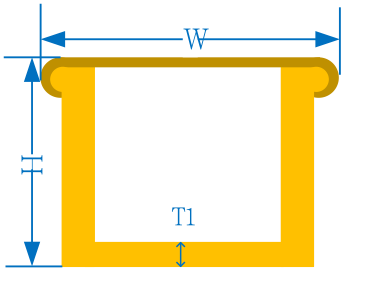
Height×Width(mm) |
Thickness(mm) |
L(mm) |
Weight(kg) |
|
FT-CT1-2 |
100×200 |
3 |
2000 3000 4000 |
5.2 |
|
FT-CT1-3 |
100×300 |
3 |
6.0 |
|
|
FT-CT1-4 |
100×400 |
2.5 |
6.8 |
|
|
FT-CT1-5 |
100×500 |
2.5 |
7.5 |
|
|
FT-CT1-6 |
100×600 |
2.5 |
9.0 |
|
|
FT-CT1-8 |
100×800 |
2.5 |
11.2 |
|
|
FT-CT15-2 |
150×200 |
3 |
2000 3000 4000 |
6.8 |
|
FT-CT15-3 |
150×300 |
3 |
7.5 |
|
|
FT-CT15-4 |
150×400 |
2.5 |
8.2 |
|
|
FT-CT15-5 |
150×500 |
2.5 |
9.0 |
|
|
FT-CT15-6 |
150×600 |
2.5 |
10.6 |
|
|
FT-CT15-8 |
150×800 |
2.5 |
13.1 |
|
|
FT-CT2-2 |
200×200 |
4 |
2000 3000 4000 |
9.0 |
|
FT-CT2-3 |
200×300 |
3.5 |
9.8 |
|
|
FT-CT2-4 |
200×400 |
3 |
10.6 |
|
|
FT-CT2-5 |
200×500 |
3 |
11.4 |
|
|
FT-CT2-6 |
200×600 |
3 |
12.6 |
|
|
FT-CT2-8 |
200×800 |
3 |
14.8 |
|
|
FT-CTn-n |
Customized |
Customized |
Customized |
|
|
Cable trunking accessories |
The cable trunking elbows, three-direct-links, Bends, Risers, T Junctions, Crosses Reducers |
|||
|
|
||||
Related Products

FRP Cable Trunking Exporter for Data Centers | China Factory Direct
Buy FRP cable trunking straight from a China factory exporter. Non-conductive, moisture-proof, ideal for metro, data center & food plant cable routing. Request pricing today.

FRP Cable Tray Manufacturer & Exporter for Chemical Plants | Direct Factory Supply
Source FRP cable trays direct from a China-based manufacturer & exporter. Corrosion-resistant, lightweight, ideal for chemical, offshore & wastewater projects. Get a fast quote.

Fiberglass GFRP FRP cable conduit for cross-river bridge Coastal chemical factory FT-CC1
FRP Cable Conduit is a premier cable management solution engineered for corrosive and demanding environments.

Fiberglass GFRP FRP Cable Tray for Coastal Cable Laying Wiring FT-CLD45a
This FRP Cable Tray is a premier cable management solution engineered for corrosive and demanding environments.
Contact us immediately to discuss your product project requirements
Navigation
Navigation
Contact Us
Tel.: +86 189 3266 2725
E-mail: sale@hbfortis.com
Add.: No.8-1, Zhenxing Street, Matun Town, Zaoqiang County, Hengshui City, Hebei Province
Get in Touch
Get in Touch